Tooth Replacement Options
When a tooth is missing or failing, the right replacement depends less on the tooth than on what surrounds it: the teeth on either side, the bone underneath, and how many teeth are involved.
Single implant with crown: $7,000
$84/month 144 payments at 9.99% APR, on approved credit.
Your consultation, including a 3D X-ray (CT scan), is free.
Send photos if you have them. Either way, we reply with a cost. No obligation.
Ask about replacing a tooth
Reviewed by our treatment coordination team. Call or text (310) 770-3335 if you would rather speak now.
Request received
A treatment coordinator will call you within two hours during office hours (Monday to Friday, 9 to 4).
To talk now, call (310) 770-3335.
- A call within two hours during office hours.
- A written cost from us, before you commit to anything.
- No obligation. Many patients take weeks to decide. That is normal.
- Free consultation and 3D X-ray (CT scan)
- Private practice since 2012
- IV sedation in our own office
- In-house dental laboratory
Before, and after.
Every smile on this site was made here: our patients, our laboratory, our work.
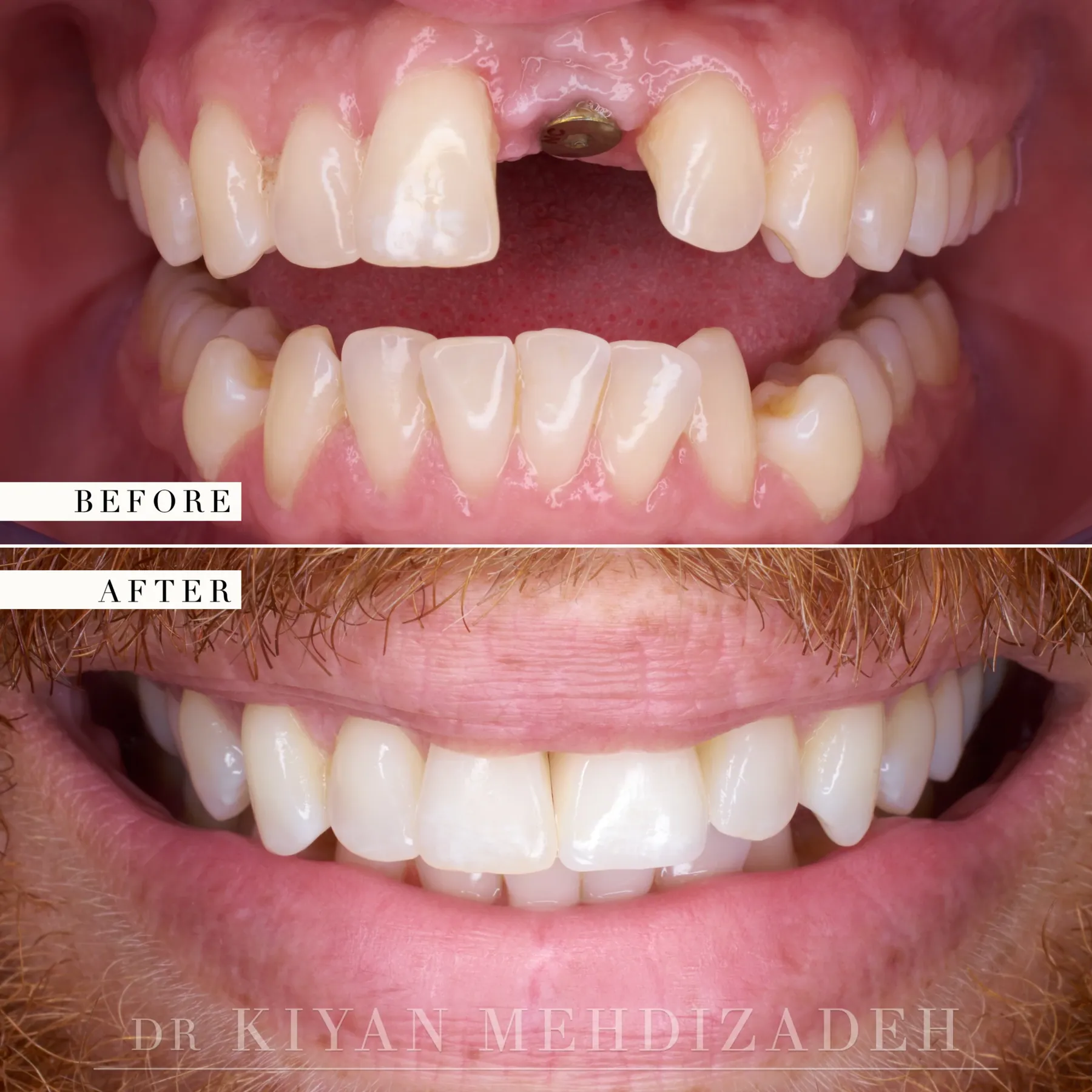 A missing front tooth, replaced with an implant crown matched to the teeth beside it.See the case →
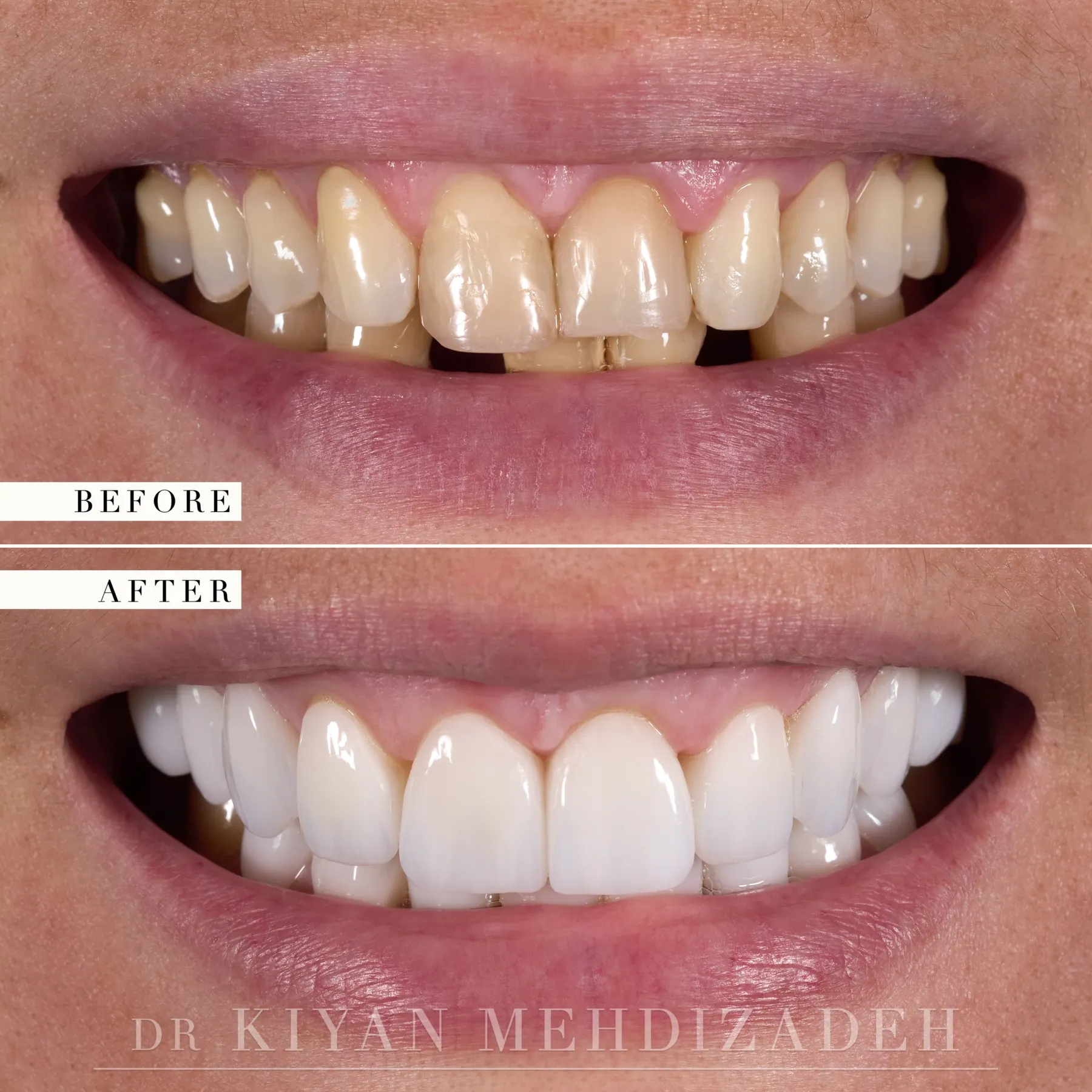
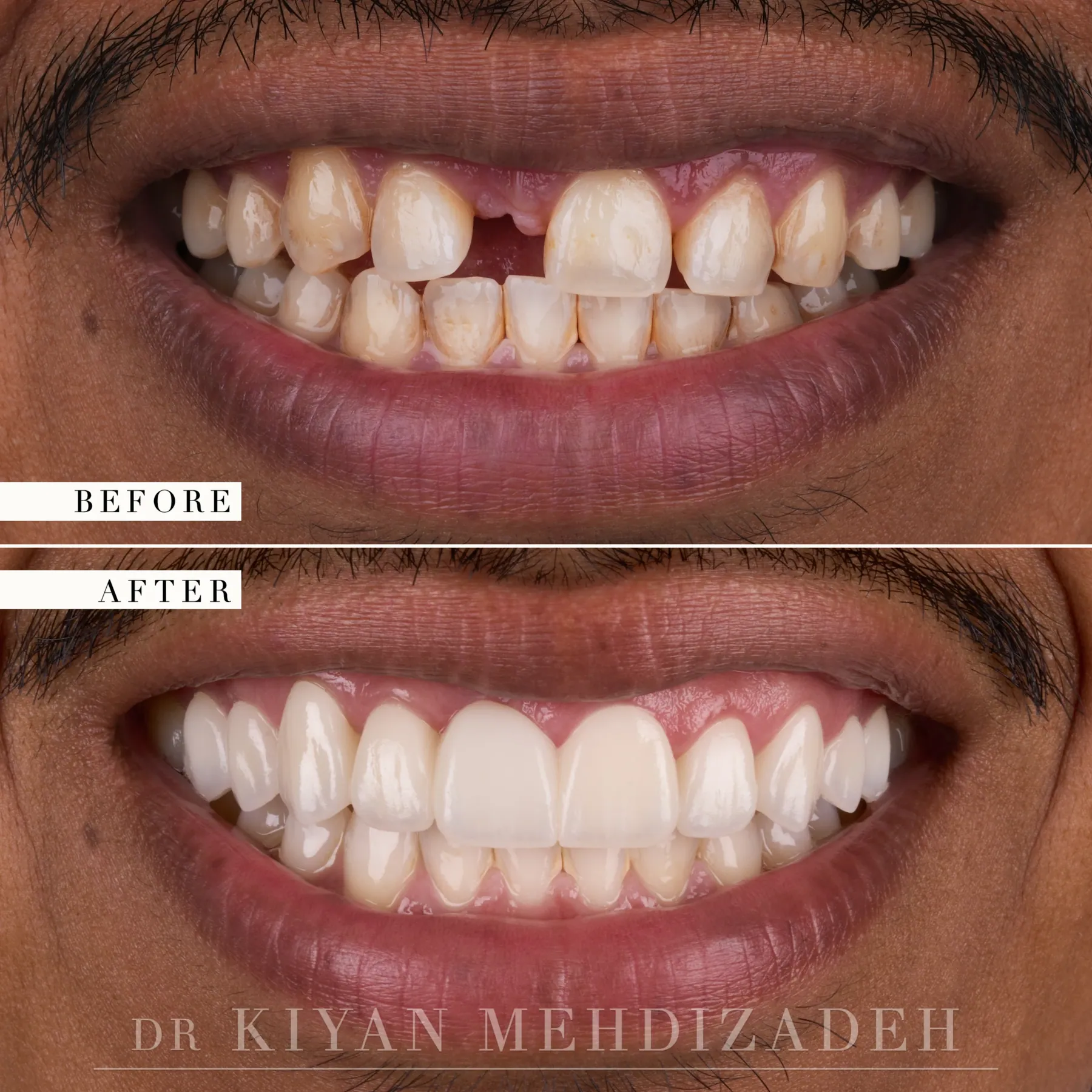 A missing front tooth replaced with a bridge and veneers.See the case →
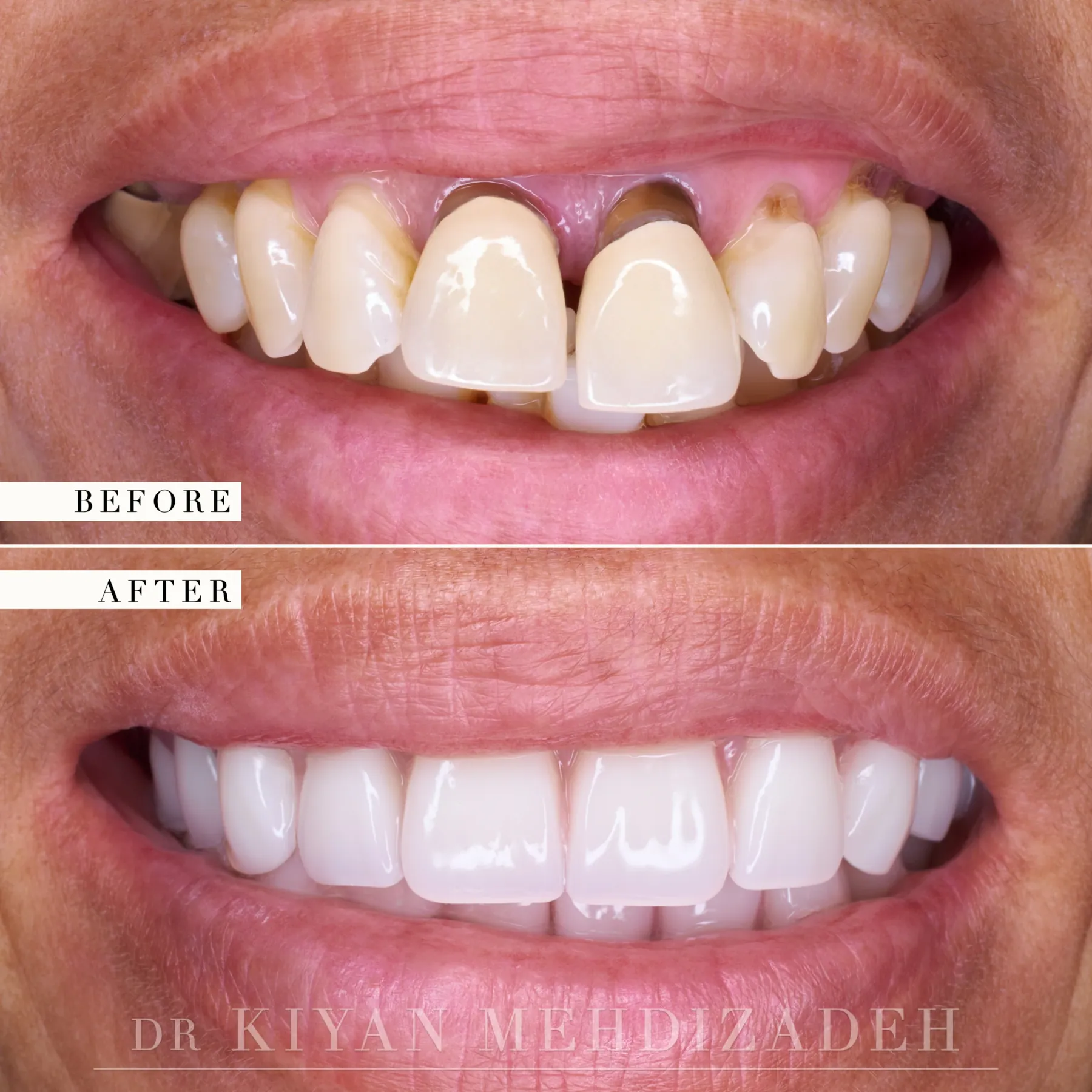
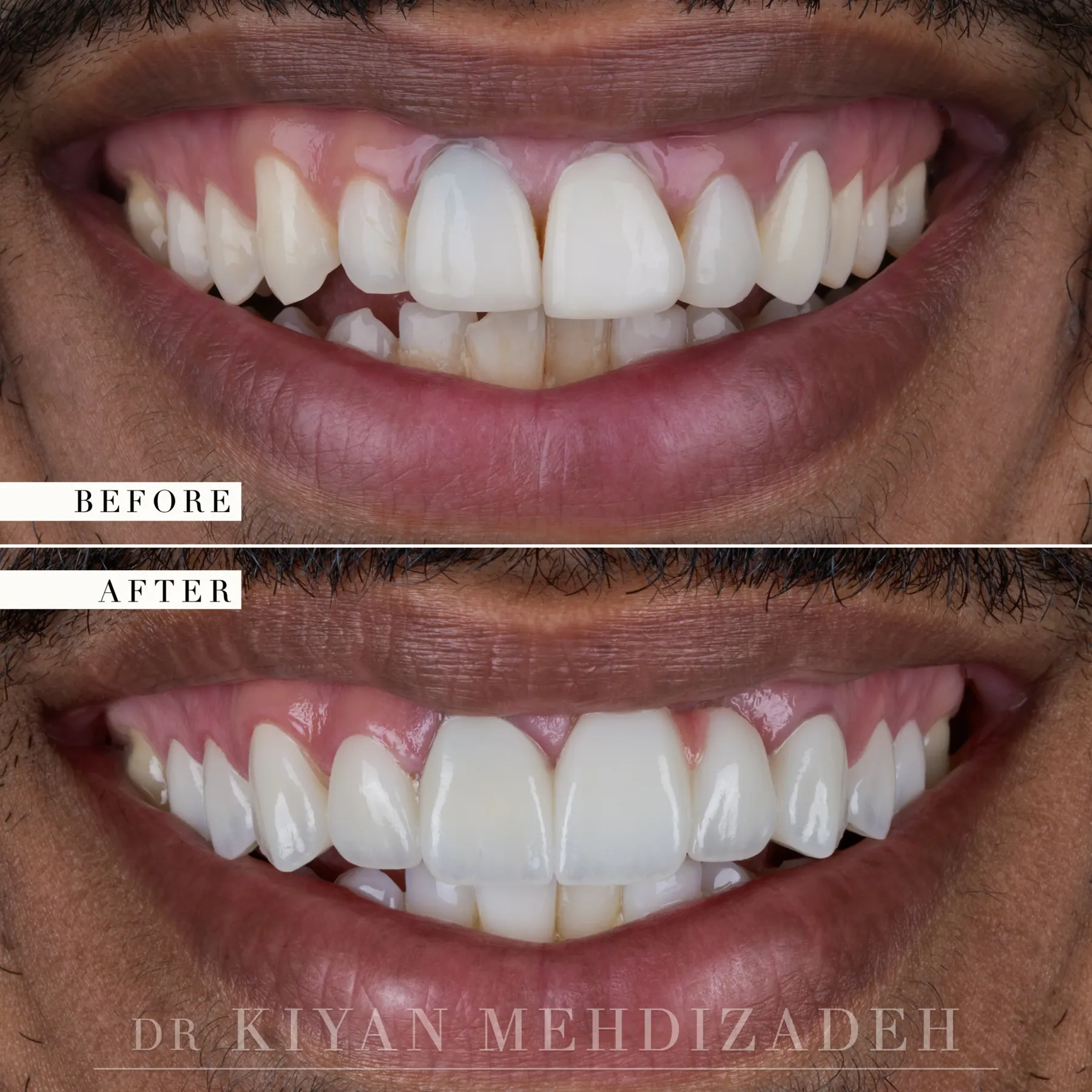 A pink-porcelain bridge after a failed root canal and abscess.See the case →
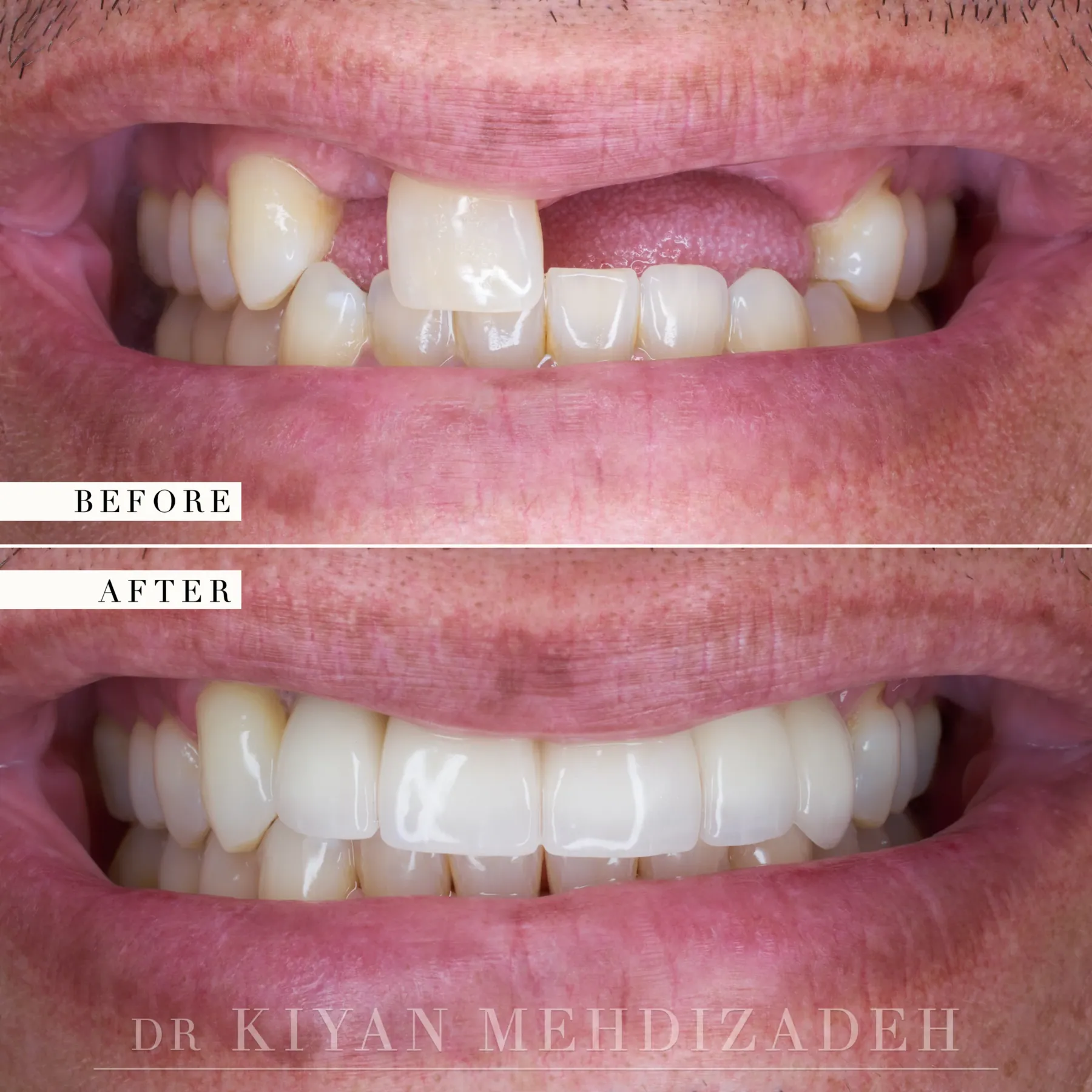 Four missing front teeth rebuilt with bone grafting, three implants and a bridge.See the case →
 Two missing lower teeth on implants, and no more partial denture.See the case →
 Both arches in PMMA on titanium, after years of patching teeth.See the case →
Keeping the natural tooth.
This page sets out each option: how it works, what it asks of the neighboring teeth and the bone, how it is cleaned and how it feels, how long it can last, and what it costs where we publish a price.
A tooth with a sound root and enough structure above the gum to hold a crown is usually worth saving, and saving it comes before any replacement. A root canal removes the infected or inflamed pulp from inside the tooth and seals the canals; a crown then covers what remains, because a tooth treated this way becomes more brittle. The neighboring teeth are not involved, the root keeps the bone around it in use, and the tooth feels and cleans as it did before. A tooth saved this way can last many years.
Some teeth cannot be saved. In this case, a fracture ran beyond what any restoration could hold. In another, two failed root canals on the upper front teeth had led to an abscess, and the teeth were no longer restorable. Dr. Mehdizadeh makes that call at the examination. A root canal and crown is quoted at the consultation.
An implant, for one tooth or several.
An implant replaces a tooth from the root up: a post in the jaw where the root used to be, which the bone grows against over the following months, with a crown on top. It stands on its own, so the neighboring teeth stay untouched, and because it carries chewing force into the bone it keeps that bone in use. Where the bone has shrunk, grafting comes first. It is fixed, and it is brushed and flossed like a natural tooth. Long-term studies report implant survival above ninety percent at ten years; the crown on top is a wearing part, and in time it may need repair or replacement.
In this case, an implant replaced one upper central incisor and left the eight natural teeth around it untouched. For several missing teeth, implants can carry a bridge. In another, four upper front teeth had been missing long enough for the ridge to resorb; Dr. Mehdizadeh rebuilt the bone, then placed three implants for the four teeth, and the flipper is gone. In a third, two lower implants replaced a removable partial denture.
A single implant with a custom shade-matched crown is $7,000; the crown's shade is matched to the teeth beside it. $84/month: 144 payments at 9.99% APR, on approved credit. An implant bridge for several missing teeth is $15,000. $180/month: 144 payments at 9.99% APR, on approved credit.
See also: Single tooth implants; Implants for several missing teeth.
A conventional bridge.
A bridge places crowns on the two teeth beside the gap and suspends a replacement tooth, the pontic, between them, all made as one piece. It asks the most of the neighboring teeth, since both are shaped down to take crowns, so it makes most sense where those teeth already need crowns or where an implant site would need extensive grafting. The bone under the pontic carries no load and continues to shrink slowly. It is fixed, and a floss threader or water flosser cleans under the pontic. Bridges typically last around ten to fifteen years, and often longer, depending on the health of the supporting teeth and gums. A conventional bridge is quoted at the consultation.
In this case, an upper front tooth had been missing since childhood, and the site would have needed significant grafting, with a less predictable gum line, to take an implant. A three-unit bridge was the more dependable route.
In this case, the infection had taken bone and gum with the two front teeth, so the gum line over the gap sat higher than over the teeth beside it. Rebuilding only the teeth onto a receded gum line leaves them too long. Our laboratory added pink porcelain to the bridge: a gum-colored ceramic, matched to natural gum in color, translucency and texture, that replaces the lost gum and bone height so the teeth are the right length and the gum line reads as continuous. It is the choice when that tissue cannot be predictably rebuilt; the alternative is grafting to regrow the bone and gum, which this site could not reliably support.
A full denture.
A full denture replaces every tooth in an arch and rests on the gum. The upper one holds by suction across the palate; the lower one sits on a narrower ridge and is usually less stable. Bone that no longer carries a tooth slowly shrinks, which is why a denture that rests on the gum loosens over time. It comes out every night to be cleaned, and it needs relining as the ridge changes. A full denture is $4,000 per arch. $48/month per arch: 144 payments at 9.99% APR, on approved credit.
An implant-retained denture.
An implant-retained denture clips onto implants. It still comes out for cleaning, but the implants hold it steady while eating and speaking, and they keep the bone in use where they sit. The clips are wearing parts and need replacing from time to time. It is $14,000 per arch. $168/month per arch: 144 payments at 9.99% APR, on approved credit.
See also: Implant dentures.
A full-arch fixed bridge.
Four implants can carry a whole arch of fixed teeth, screwed to the implants and not removed by the patient. In this case, periodontal disease was failing every tooth; Dr. Mehdizadeh removed twenty-five failing teeth and placed four implants in each arch to carry fixed bridges in PMMA on milled titanium bars. A water flosser and interdental brushes clean it at home, with professional recall. The implants keep the bone in use; the teeth on top are a wearing part, and PMMA can need refurbishment at some point.
Full-arch options start at $19,000 per arch, in PMMA on a milled titanium bar, including the surgery, IV sedation, extractions, temporary teeth and the follow-up visits until the final teeth are delivered. $227/month per arch: 144 payments at 9.99% APR, on approved credit.
See also: All-on-4 full-arch implants.
Leaving the gap.
Leaving a space costs nothing today, and for some back teeth, where the bite is stable, it can be a reasonable choice. Over time, though, the neighboring teeth drift into the space and the bone that held the tooth resorbs. That narrows the options later: a gap left for years can need grafting before an implant, as in this case.
The options side by side.
| Option | Neighboring teeth | Bone beneath | Fixed? |
|---|---|---|---|
| Single implant | untouched | kept in use | fixed |
| Implant bridge | untouched | kept at implants | fixed |
| Conventional bridge | crowned | not loaded | fixed |
| Full denture | none remain | keeps shrinking | removable |
| Implant-retained denture | none remain | kept at implants | removable |
| Full-arch fixed bridge | none remain | kept at implants | fixed |
| Leaving the gap | drift into space | keeps shrinking | — |
How the choice is made.
Healthy neighboring teeth point toward an implant, which leaves them alone; teeth that already need crowns make a bridge more reasonable. The bone, measured on a 3D X-ray (CT scan), decides whether an implant can go in directly or after grafting, and general health shapes the plan as well.
See also: Am I a candidate for implants?.

One doctor, from consultation to final teeth.
Dr. Mehdizadeh examines you, gives the IV sedation, places the implants and designs the teeth, and our laboratory, in the same building, makes them.
Find out what your new smile would cost.
Tell us what is going on. Add photos if you have them; if not, we will call and talk it through.
Or call (310) 770-3335.
Ask about replacing a tooth
Reviewed by our treatment coordination team. Call or text (310) 770-3335 if you would rather speak now.
Request received
A treatment coordinator will call you within two hours during office hours (Monday to Friday, 9 to 4).
To talk now, call (310) 770-3335.
Frequently Asked Questions
Is an implant always better than a bridge?
No. An implant leaves the neighboring teeth untouched, which suits a gap between healthy teeth, as in one of the cases on this page. A bridge can be the more dependable choice where the bone would need extensive grafting, as in one of the cases on this page, or where the neighboring teeth already need crowns.
Should I save my tooth or replace it with an implant?
Save it if it can be saved. A tooth with a sound root and enough structure above the gum to hold a crown is usually kept with a root canal and a crown.
What is pink porcelain?
A gum-colored ceramic added to a bridge to replace gum and bone height lost to infection or tooth loss. Without it, teeth rebuilt onto a receded gum line look too long. It is the choice when the lost tissue cannot be predictably regrown; the alternative is grafting to rebuild the bone and gum.
How long does each option last?
Long-term studies report implant survival above ninety percent at ten years, and the teeth on top are wearing parts. Bridges typically last around ten to fifteen years, and often longer. Dentures need relining as the ridge changes.
What do the options cost?
A single implant with a custom shade-matched crown is $7,000. $84/month: 144 payments at 9.99% APR, on approved credit. An implant bridge is $15,000. $180/month: 144 payments at 9.99% APR, on approved credit. Full-arch options start at $19,000 per arch. $227/month per arch: 144 payments at 9.99% APR, on approved credit. An implant-retained denture is $14,000 per arch ($168/month per arch) and a full denture $4,000 per arch ($48/month per arch). A root canal and crown, and a conventional bridge, are quoted at the consultation. Most PPO plans contribute toward the cost of treatment. Financing is available.
Last Updated: October 2026