Single Tooth Implants in Beverly HillsOne implant, and a shade-matched crown.
We replace one missing tooth, or one tooth that cannot be saved, with one implant and one crown, and leave the teeth on either side as they are.
Single implant with crown: $7,000
$84/month 144 payments at 9.99% APR, on approved credit.
Your consultation, including a 3D X-ray (CT scan), is free.
Send photos if you have them. Either way, we reply with a cost. No obligation.
Ask about a single implant
Reviewed by our treatment coordination team. Call or text (310) 770-3335 if you would rather speak now.
Request received
A treatment coordinator will call you within two hours during office hours (Monday to Friday, 9 to 4).
To talk now, call (310) 770-3335.
- A call within two hours during office hours.
- A written cost from us, before you commit to anything.
- No obligation. Many patients take weeks to decide. That is normal.
- Free consultation and 3D X-ray (CT scan)
- Private practice since 2012
- IV sedation in our own office
- In-house dental laboratory
Before, and after.
Every smile on this site was made here: our patients, our laboratory, our work.
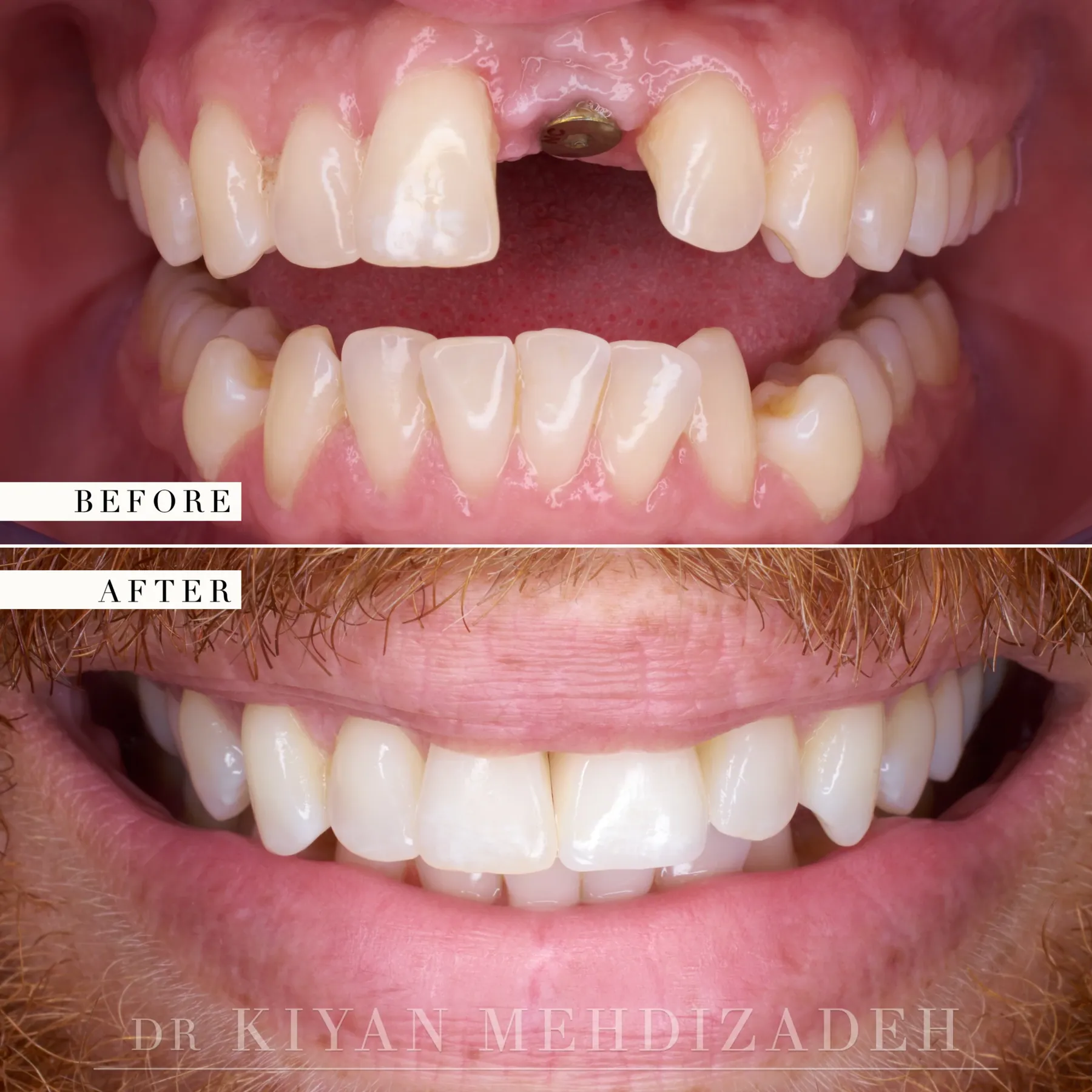 A broken front tooth replaced with one implant crown, matched to the tooth beside it.See the case →
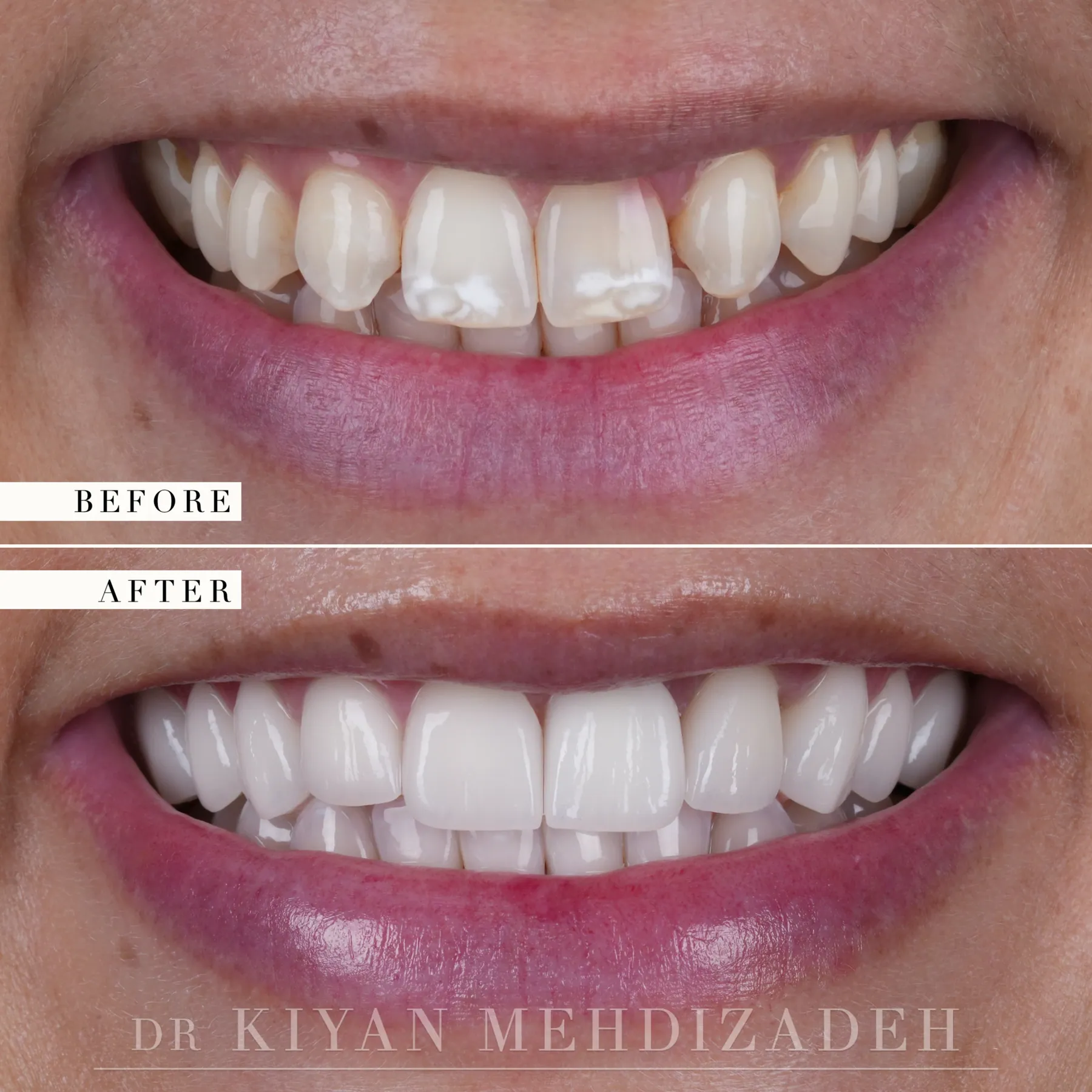 A front tooth replaced without losing the gum line, with veneers beside it.See the case →
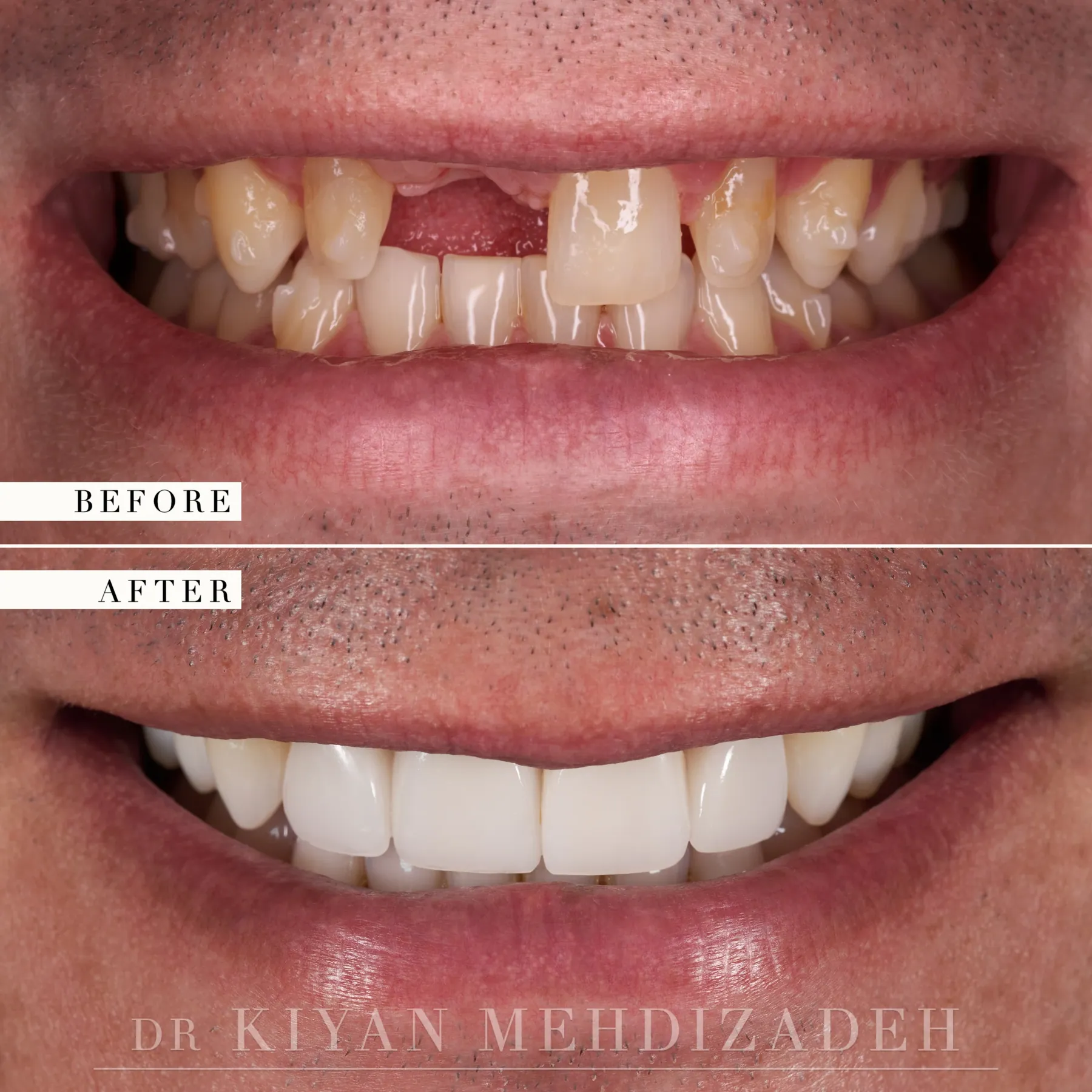 A missing front tooth on an implant, and three veneers to close the gaps braces left.See the case →
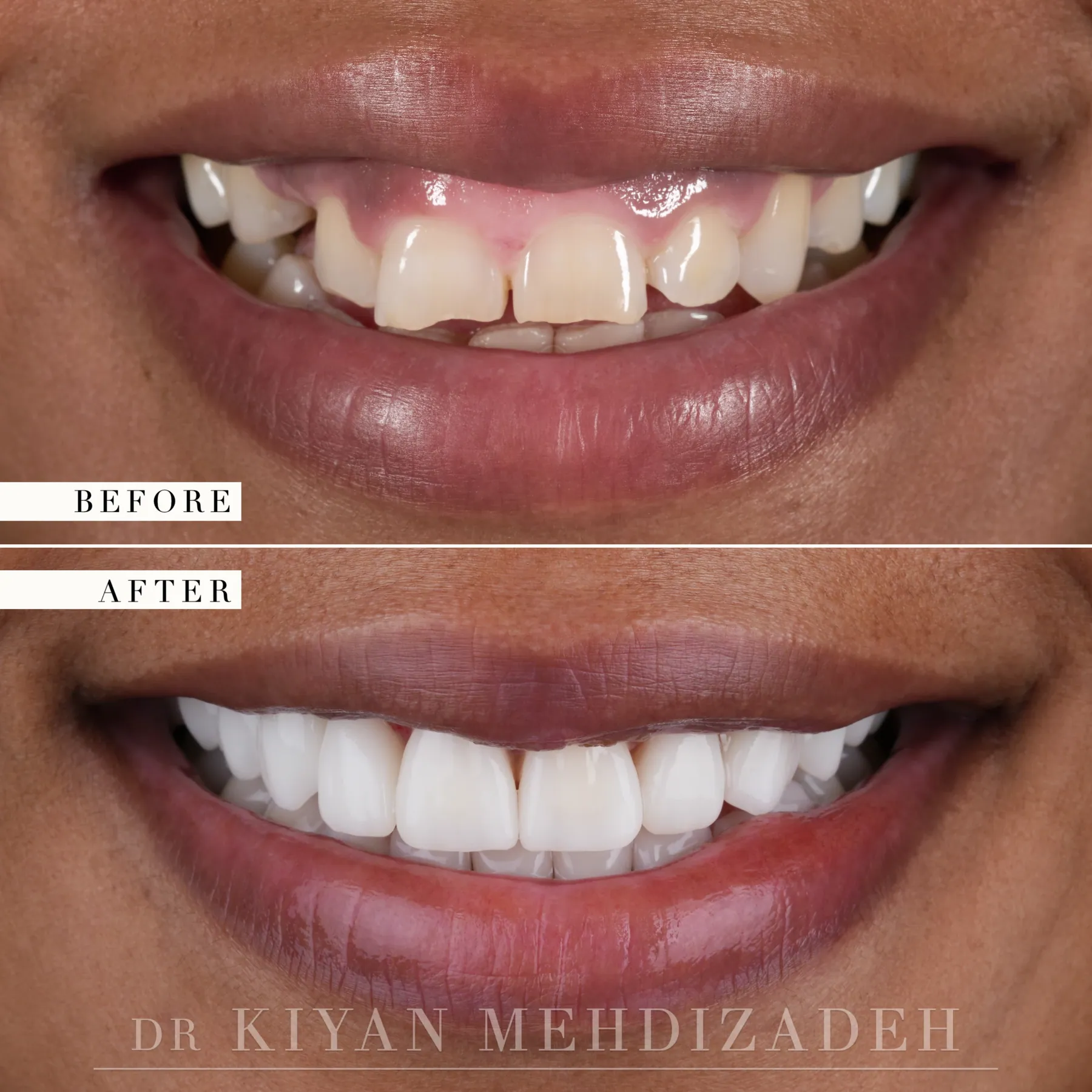 A canine that never came in, replaced with an implant, with a gum lift and veneers.See the case →
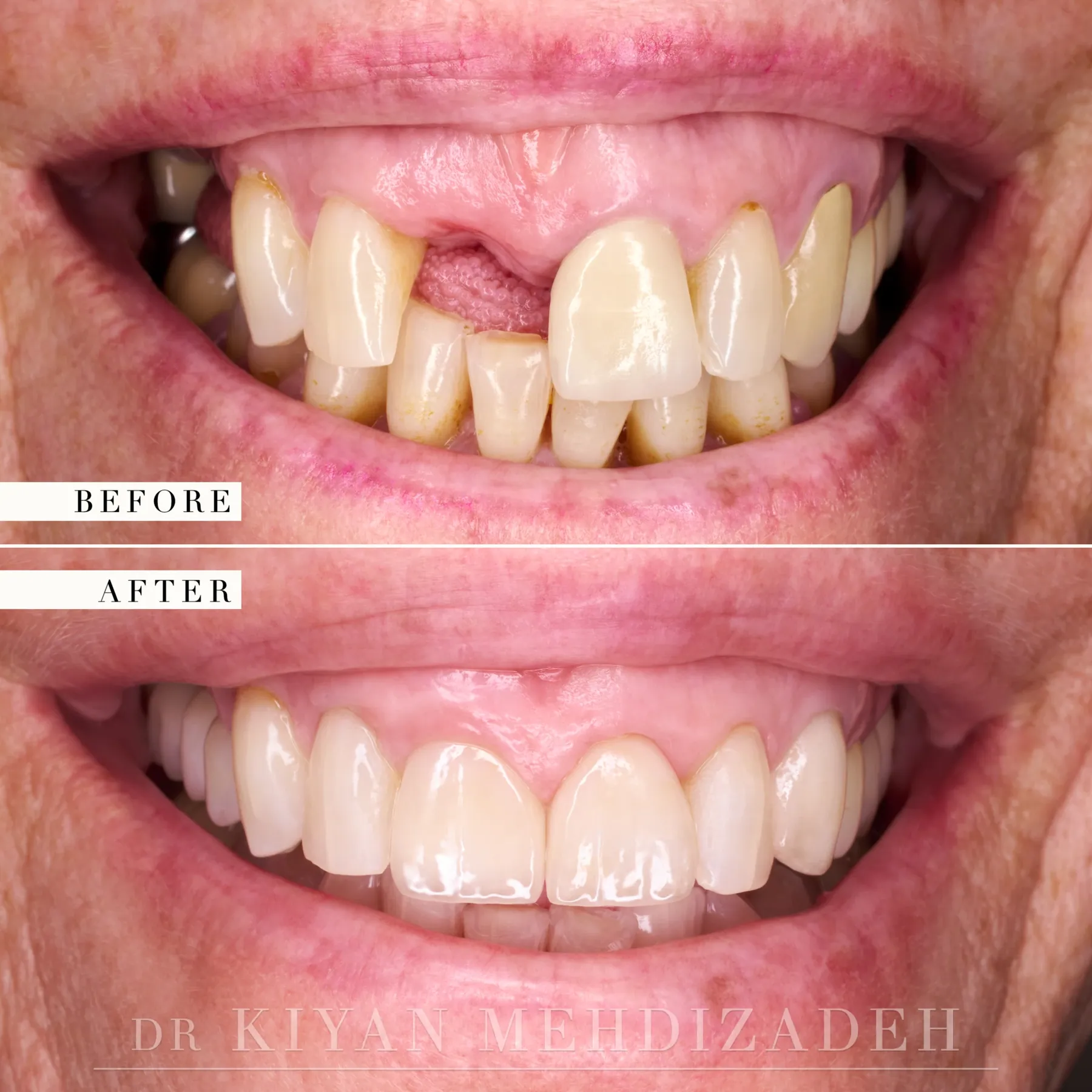 Three missing teeth, each on its own implant, matched to the natural teeth.See the case →
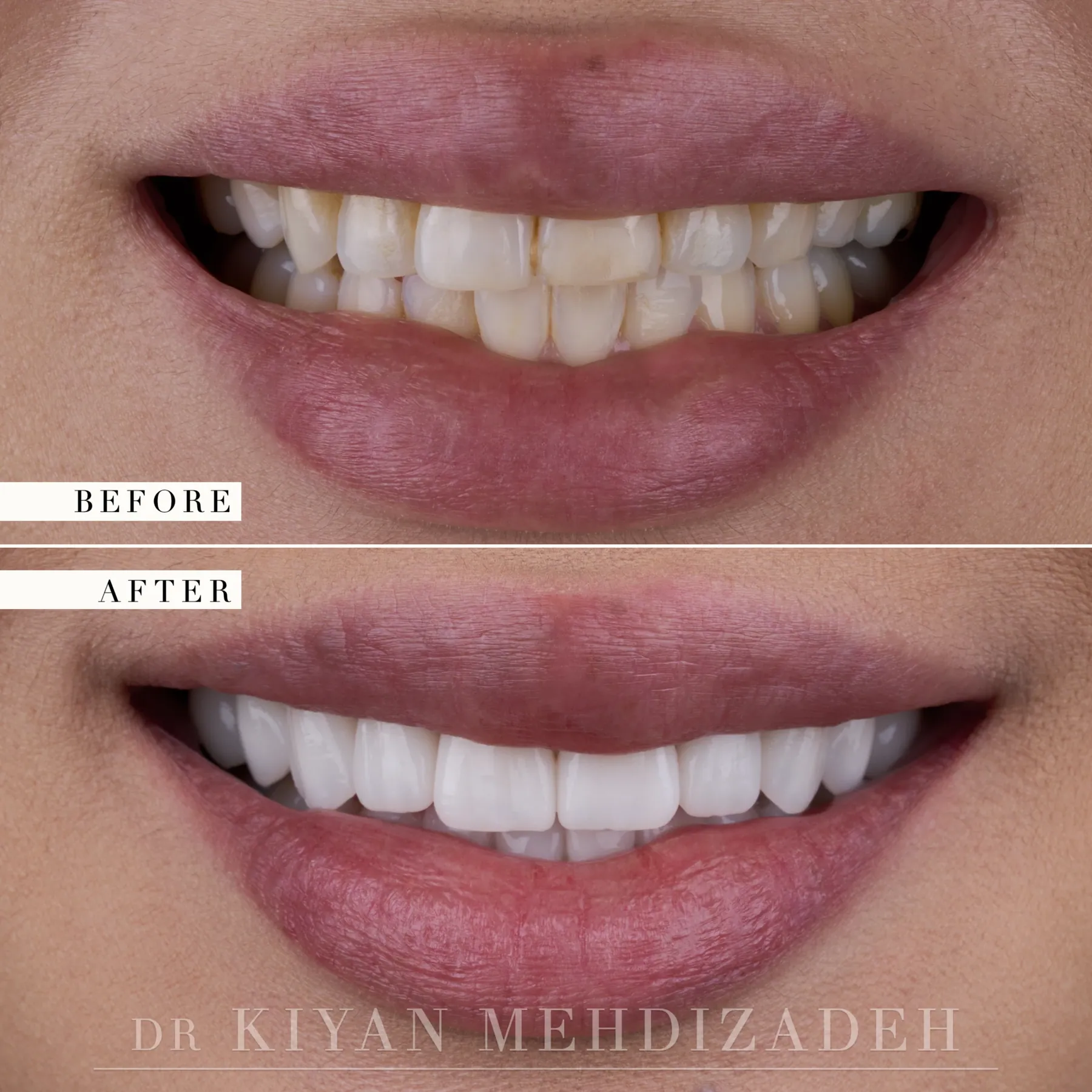 A tooth that could not be saved, replaced with an implant inside a new smile.See the case →
One price, front tooth or back.
The $7,000 includes the extraction, any socket graft and the temporary tooth.
Single implant with a custom shade-matched crown
$84/month
$7,000
144 payments at 9.99% APR, on approved credit.
The crown's shade is custom matched to your own teeth rather than chosen from a shade guide, and that is what the price reflects.
IV sedation, if you choose it, is a flat fee of $1,500 - $1,800, added to the procedure. The consultation, including a 3D X-ray (CT scan), is complimentary. Most PPO plans contribute toward the cost of treatment. Financing is available.
A crown matched to the tooth beside it.
A natural tooth is not one color. It is more saturated near the gum and lighter toward the edge, it turns translucent where the enamel thins, and its surface texture scatters light. A shade tab records only the base color. The ceramist in our laboratory builds the porcelain by hand in layers, matched to the tooth beside it, and we try the crown in before we fix it in place.
Porcelain does not respond to whitening. If you want your teeth lighter, we whiten them first, let the color settle, and record the shade against the finished teeth.
Where the implant sits among veneers, we design its crown with them as one set: with twenty veneers in this case, and in this one with three veneers that also closed the spaces braces had left. In another, Dr. Mehdizadeh placed the implant where the smile design called for, so its crown matched the veneers around it.
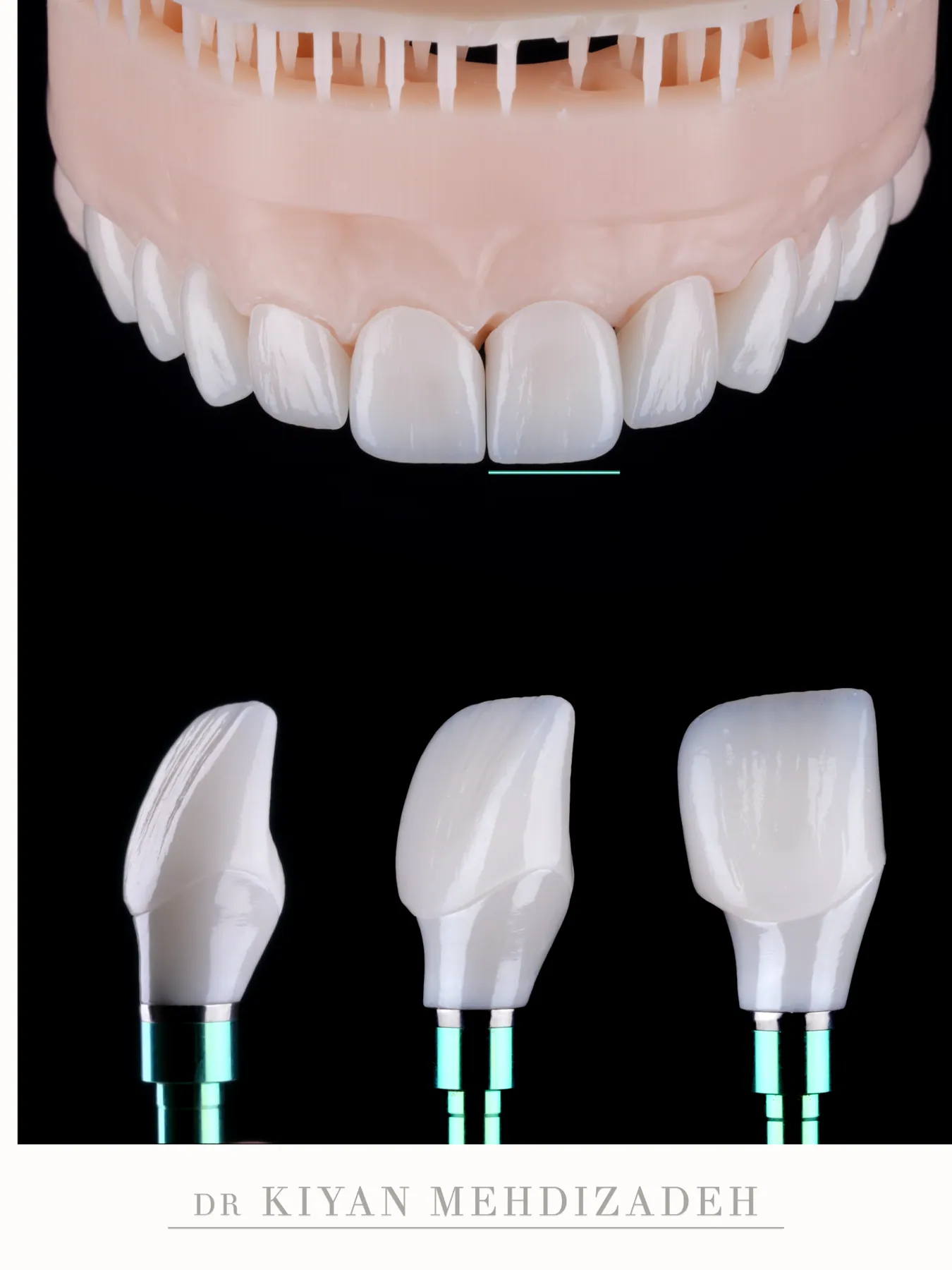
Why a front tooth is harder to replace.
A front tooth implant has to blend with the natural teeth beside it, in the part of the smile people look at first. Five things decide whether it does.
The gum line. Natural gum arches over each tooth and rises to a point between neighboring teeth; that small triangle of gum is the papilla. An implant is round, and the gum heals around it in a flat collar unless the temporary tooth on it shapes the tissue into an arch. Where a papilla is missing, the space between the teeth shows as a dark triangle.
The bone. On the lip side of an upper front tooth, the bone over the root is often thinner than one millimeter, and it takes its blood supply from the ligament around the root. When the whole tooth comes out, that thin bone shrinks over the following months and the gum follows it. The new tooth then looks longer than its neighbor, with a gray shadow at the gum line.
The shade. The two upper central incisors sit side by side at the center of the smile, and the eye compares them more closely than any other pair of teeth.
The implant itself. Most implants are titanium, the material with the longest record in dentistry. Titanium is gray, and a gray tint can show through thin gum. Zirconia, a ceramic, is the metal-free alternative, and it is white. Dr. Mehdizadeh places both.
The position. Dr. Mehdizadeh plans the implant on the CT scan where the finished crown needs it, rather than where the socket happens to lead, so the crown rises out of the gum at the same height and angle as its neighbor.
An implant on the day the tooth comes out.
When a tooth has to be removed, the implant can sometimes go into the socket at the same appointment. This is immediate placement, and Dr. Mehdizadeh does it here when the case allows. It saves a second surgery. In this case he removed a fractured upper front tooth, kept the thin bone at the front of the socket and placed the implant at the same appointment; the crown went on three months later.
It needs bone that holds the implant firmly on the day, a site free of infection and an intact bone wall on the lip side. Where those are missing, Dr. Mehdizadeh grafts the socket at the extraction and places the implant once the bone has healed.
At an upper front tooth, partial extraction therapy can keep the gum line where it is. In the socket shield technique, Dr. Mehdizadeh removes the crown of the tooth and the back part of the root, and leaves a thin section of root on the lip side against the bone. That section keeps its ligament, so the bone it supports keeps its blood supply and has no reason to shrink. The implant goes in behind it during the same procedure. Hurzeler and co-workers first described the technique in 2010, and Dr. Mehdizadeh trained in periodontal microsurgery with Hurzeler and Zuhr in Munich.
In this case he used it at one of the upper central incisors, and the gum line at the implant now sits level with the teeth beside it. It suits selected sites: the retained root must be free of infection and the published evidence is still limited, so extraction with grafting remains the right route in many cases.
Where the implant is firm enough on the day, a temporary crown can go on it before you leave, shaped to support the gum and kept clear of the bite. Dr. Mehdizadeh decides this at surgery, so we do not promise it in advance. Otherwise a temporary tooth fills the gap while the implant heals.
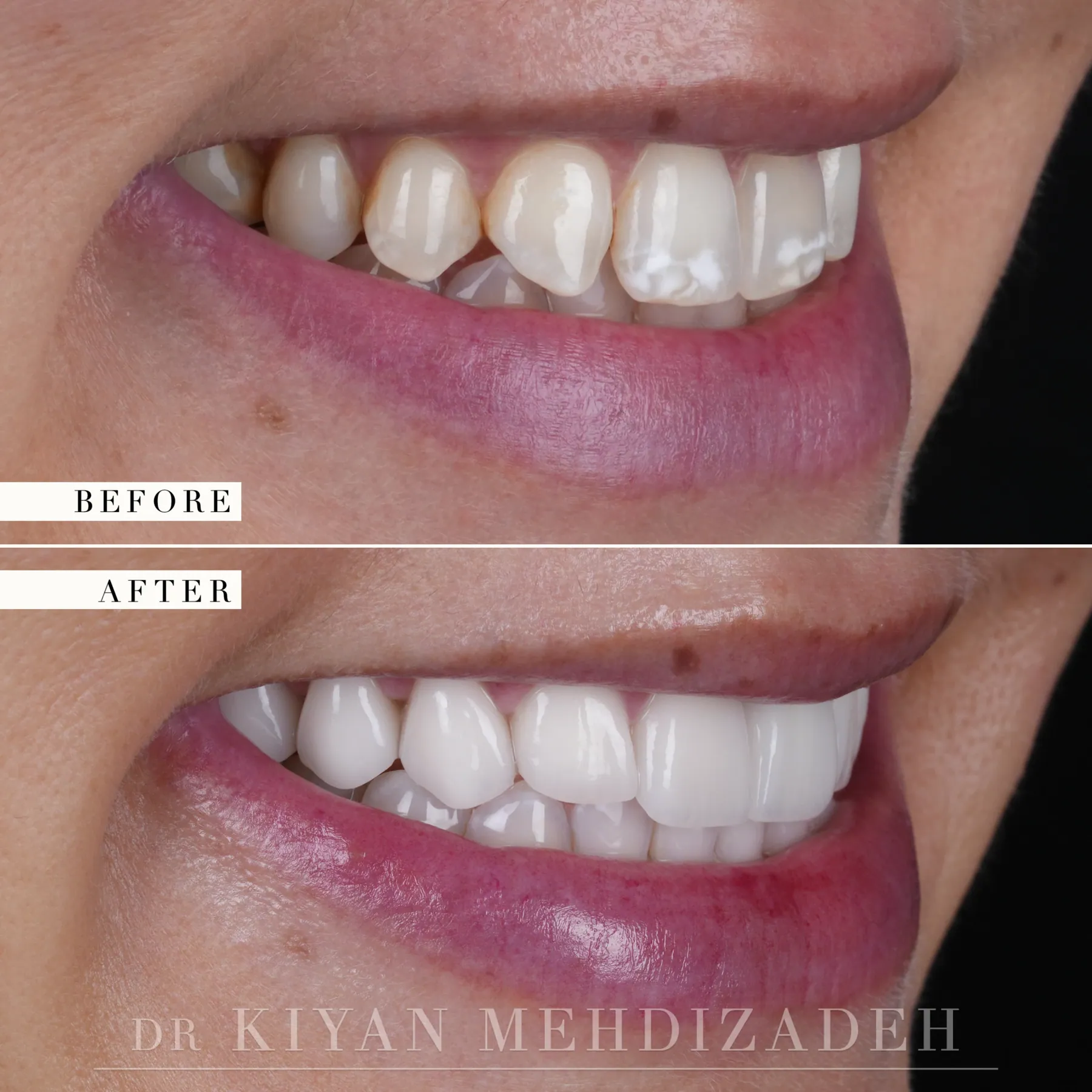
From the scan to the crown.
One front-tooth case took three months from extraction to crown. A graft placed before the implant adds months, because the bone has to heal first.
Consultation and CT scan
A written plan with every visit and the total cost.
Extraction
If the tooth is still there, with the implant at the same appointment where the socket allows it.
Grafting
If the bone needs it; a small graft often goes in with the implant.
Implant placement
Under local anesthesia or IV sedation given in this office by Dr. Mehdizadeh.
Integration
The bone grows against the implant over the following months, two months in this case and this one. Dr. Mehdizadeh assesses the implant before our laboratory starts the crown.
The crown, try-in and delivery
Made by our laboratory and shade-matched to the tooth beside it. We check the color, the shape, the gum line and the bite, then fix the crown in place.
Other ways to replace one tooth.
A conventional bridge fixes a false tooth to crowns on the teeth either side of the gap, which means cutting both of those teeth down to replace a third. Where the neighbors are healthy, an implant leaves them untouched.
Left open, a gap lets the neighboring teeth tip into the space and the opposing tooth grow toward it, and the bone beneath it shrinks.

One doctor, from the implant to the crown.
Dr. Mehdizadeh places the implant, performs any grafting it needs and designs the crown. Our laboratory, in the same building, makes the crown and matches it to your own teeth.
Find out what your implant would cost.
Tell us what is going on. Add photos if you have them; if not, we will call and talk it through.
Or call (310) 770-3335.
Ask about a single implant
Reviewed by our treatment coordination team. Call or text (310) 770-3335 if you would rather speak now.
Request received
A treatment coordinator will call you within two hours during office hours (Monday to Friday, 9 to 4).
To talk now, call (310) 770-3335.
Frequently Asked Questions
How much does a single tooth implant cost?
A single implant with a custom shade-matched crown is $7,000. $84/month: 144 payments at 9.99% APR, on approved credit. The consultation, including a 3D X-ray (CT scan), is complimentary.
Why is the crown's shade custom matched?
A natural tooth grades in color from the gum to the edge, turns translucent near the edge and scatters light at its surface. A crown matched only to a shade tab can look artificial beside it, so the ceramist layers the porcelain by hand to match the tooth next to it.
Can the implant go in the same day the tooth is removed?
When the socket allows it, yes. That needs bone that holds the implant firmly, no infection and an intact bone wall on the lip side; otherwise Dr. Mehdizadeh grafts the socket and places the implant once it has healed.
Will I have a gap while the implant heals?
A temporary tooth fills the gap while the implant heals. Where the implant is firm enough on the day, the temporary can be a crown on the implant itself, fitted at the same appointment.
What is a socket shield?
A form of partial extraction therapy for an upper front tooth. Dr. Mehdizadeh leaves a thin section of root on the lip side against the bone and places the implant behind it, to keep the bone and the gum line in front from shrinking.
Does getting an implant hurt?
The surgery is done under local anesthesia or IV sedation in this office, and most sedated patients remember very little of it. Afterwards, swelling builds for about two days and settles over the following week; most people manage on ordinary pain relief.
How long does a single implant take?
The implant goes in at one appointment, and the bone then needs a few months to integrate with it before the crown goes on. The front-tooth case on this page took three months from extraction to crown; a graft placed first adds months.
Last Updated: October 2026