Last Updated: October 2026
What this case cost
$132/month
144 payments at 9.99% APR, on approved credit.
Total: $11,000 for the extraction, the implant, whitening of the natural teeth and the custom shade-matched crown.
Have you lost or broken a front tooth?
Replacing one front tooth beside healthy neighbors is a different problem from a full smile makeover, and it is solved in a different order. Send us a photo of your smile and we will tell you what the tooth would take to replace, whether the neighboring teeth need anything, and what that would cost.
- A call within two hours during office hours.
- A written cost from us, before you commit to anything.
- No obligation. Many patients take weeks to decide. That is normal.
Ask about your case
Reviewed by our treatment coordination team. Call or text (310) 770-3335 if you would rather speak now.
Request received
A treatment coordinator will call you within two hours during office hours (Monday to Friday, 9 to 4).
To talk now, call (310) 770-3335.
Treatment Plan by Dr. Mehdizadeh
- Assessment of the fractured tooth, the surrounding bone and the shade of the adjacent teeth.
- Extraction of the upper left central incisor, preserving the bone at the front of the socket.
- Implant placement at tooth number nine, positioned for the crown rather than the socket.
- Whitening of the natural teeth during the healing period, with time allowed for the shade to settle.
- Eight weeks of integration before restorative work.
- One custom shade-matched implant crown in porcelain-layered zirconia.
The Patient's Journey
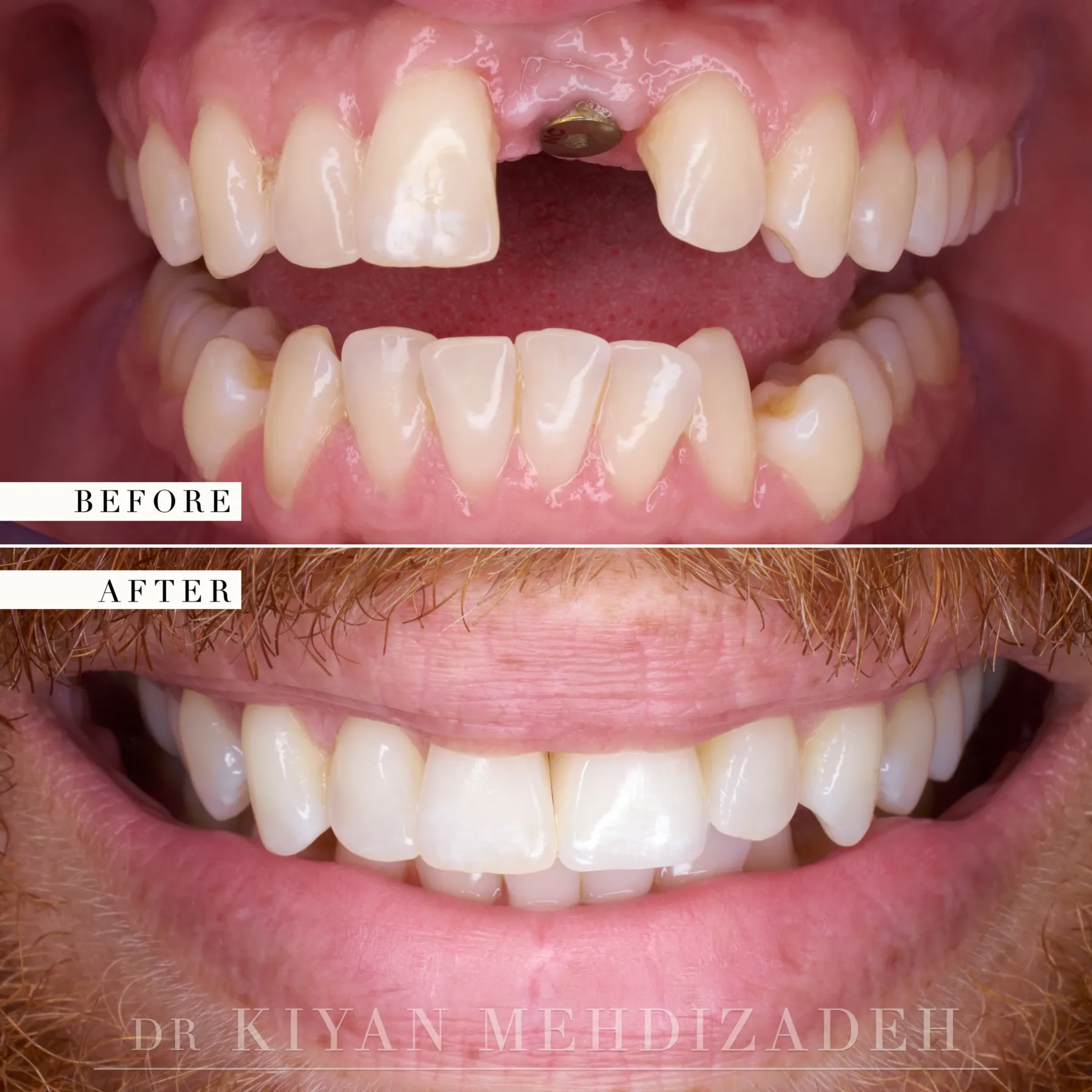
This patient fractured an upper front tooth beyond what any restoration could hold. The tooth was number nine, the maxillary left central incisor, which sits immediately beside the midline and is visible in every photograph. What he wanted was to replace it without wearing a flipper, the removable plate that usually fills the gap while an implant heals. The remainder of his dentition was healthy and required no treatment at all.
A single failing tooth among healthy neighbors changes what the case demands. Most anterior work arrives with several teeth needing attention, and the restorations can then be designed together, fabricated together and matched to one another. Here there was one new restoration, and it had to match eight untouched natural teeth. The maxillary right central incisor sat directly beside it, and the eye compares those two teeth more closely than any other pair in the mouth.
Understanding the Challenge
Natural enamel is not a single color. Three properties act together, and a shade tab records only the first. Saturation runs as a gradient from the gingival margin down to the incisal edge. Translucency appears as a band across the incisal third, where the enamel thins. Surface texture, the perikymata and developmental grooves, scatters light instead of reflecting it evenly. A crown matched to a shade tab under clinic lighting can reproduce the base saturation faithfully and still read as artificial in daylight.
Porcelain also does not respond to peroxide. Once a crown has been fabricated its color is fixed for the life of the restoration, while the natural dentition around it continues to change. That single fact determined the sequence of the entire case. Whitening had to be completed, and the rebound period allowed to pass, before the shade for the crown was recorded. A crown matched to teeth that are about to be lightened is wrong within two weeks, and the only remedy is to remake it.
Extract without losing the buccal plate that supports the gingival margin. Place the implant prosthetically, in the position the crown requires. Whiten the natural dentition first and allow the shade to stabilize. Match one crown to the untouched incisor beside it. Complete treatment within three months.
How We Approached Treatment
The fractured tooth was extracted and an implant placed at the same site. Extraction of a maxillary incisor is the moment at which gingival architecture is most easily lost. The buccal plate is the thin shell of bone covering the outer surface of the socket, frequently under a millimeter thick, and it resorbs rapidly once the tooth that maintained it is gone. The gingival margin follows that bone downward. Preserving the plate during extraction is what permits the finished crown to emerge from the tissue at the height of its neighbor.
Implant position was determined prosthetically, by where the crown had to sit, rather than by the path of least resistance through the socket. An implant placed for surgical convenience can osseointegrate perfectly and remain unrestorable in aesthetic terms, because the crown is then forced to emerge at an angle no amount of laboratory work will disguise. Eight weeks were allowed for osseointegration before restorative treatment began.
Whitening was carried out during that healing interval, which is the one window in this case where it costs no additional time. The natural teeth were lightened and then left to stabilize, since shade rebounds for a period after any peroxide course. Only afterwards was the crown shade recorded, and it was recorded against the finished color of the adjacent central incisor rather than against a target chosen in advance.
The crown was fabricated in porcelain-layered zirconia. A zirconia framework carries the occlusal load. Feldspathic porcelain is then built over that framework in successive layers by hand, reproducing the saturation gradient, the incisal translucency and the surface characterization that a monolithic material renders only approximately. On a solitary anterior unit adjacent to untouched natural teeth, that hand layering is what allows the restoration to reproduce the optical properties of enamel rather than only its base shade.
The Result After Three Months
Treatment ran three months from extraction to the seated crown. The finished restoration replaces a tooth lost entirely, in the most conspicuous position in the dentition, alongside teeth that were never prepared.
The gingival margin around the implant sits level with the natural incisor beside it. That was the objective of the surgical sequence rather than a fortunate by-product of it. The crown carries the saturation gradient and incisal translucency of the adjacent central incisor, recorded from that tooth after whitening rather than from a shade guide.
Nothing else in the mouth was treated. The eight teeth surrounding the restoration remain the patient's own and remain unprepared. Preparing them for veneers would have made the match substantially easier, because restorations matched to each other are a far simpler problem than a restoration matched to enamel. It would also have cost him healthy tooth structure he had no reason to lose.
Frequently Asked Questions About Single Front Tooth Implants
Why was the tooth extracted instead of repaired?
The fracture extended beyond what a restoration could retain. A tooth remains restorable while sufficient sound structure survives above the gingival margin for a restoration to grip, and once a fracture passes that point any repair is a postponement rather than a treatment.
Why an implant rather than a bridge?
A conventional bridge replacing one incisor requires the adjacent teeth on either side to be prepared for crowns. Both neighboring teeth were healthy and untouched. An implant replaces the missing tooth independently and leaves those teeth intact, which is why it was the appropriate choice in this case.
Why is one front tooth harder to match than several?
When several anterior teeth are restored together, the restorations are designed and fabricated as a set and need only match one another. A solitary unit must match natural enamel that cannot be altered, in the position where the eye compares two teeth most directly.
Why was whitening done before the crown was made?
Porcelain does not respond to peroxide. A crown fabricated before whitening would have been matched to a color the natural teeth were about to leave behind, and would have appeared dark within weeks. Completing the whitening, then allowing the shade to stabilize, establishes the target the restoration is matched to.
How long does an implant need before the crown can be fitted?
Eight weeks were allowed here for osseointegration, the process by which bone grows into direct contact with the implant surface. The interval depends on bone quality and on the stability achieved at placement, and it is assessed rather than assumed.
What is porcelain-layered zirconia?
A zirconia framework carries the occlusal load and dental porcelain is built over it in layers by hand. The layering reproduces the saturation gradient from gingival margin to incisal edge, the translucency of the incisal third and the surface characterization of enamel, none of which a monolithic material reproduces convincingly on an anterior tooth.
Can an implant crown be matched exactly to a natural tooth?
Matching depends on reproducing saturation, translucency and surface texture together rather than saturation alone, and on recording the shade from the adjacent tooth itself. Where the neighboring teeth are healthy and the shade is recorded after whitening has stabilized, a solitary anterior crown can be made to sit unremarked beside them.
What keeps the gum around a front implant looking natural?
The bone beneath it. The buccal plate at the front of an anterior socket is frequently under a millimeter thick, and it resorbs quickly once the tooth is removed, carrying the gingival margin with it. Preserving that plate during extraction, and placing the implant in the position the restoration requires, are what hold the tissue where it started.
How long does an implant crown last?
The implant itself is intended to remain in service indefinitely once osseointegrated. The crown above it is a wearing component and should be expected to need replacement eventually, as any restoration does, with the interval determined by the occlusion and by maintenance.
How much does a single front tooth implant and crown cost?
This case was $11,000, covering the extraction, the implant, whitening of the natural teeth and the custom shade-matched crown. $132/month: 144 payments at 9.99% APR, on approved credit.
What decides whether a case like this takes three months?
The healing interval accounts for most of it. Extraction and implant placement occupy a single appointment, osseointegration then runs for a period that cannot be compressed, and the restoration is fabricated afterwards. Cases requiring bone grafting before an implant can be placed run considerably longer.
Last Updated: October 2026