Clear Alignersin Beverly Hills
Clear aligners straighten teeth with a series of thin, clear plastic trays, each one moving the teeth a short distance toward a planned position. We offer both Invisalign and ClearCorrect, and we plan where the teeth finish for the smile you want, not just for alignment.
Clear aligners: $6,800
$82/month 144 payments at 9.99% APR, on approved credit.
Your consultation, including a 3D X-ray (CT scan), is free.
Send photos if you have them. Either way, we reply with a cost. No obligation.
Ask about clear aligners
Reviewed by our treatment coordination team. Call or text (310) 770-3335 if you would rather speak now.
Request received
A treatment coordinator will call you within two hours during office hours (Monday to Friday, 9 to 4).
To talk now, call (310) 770-3335.
- A call within two hours during office hours.
- A written cost from us, before you commit to anything.
- No obligation. Many patients take weeks to decide. That is normal.
- Free consultation and 3D X-ray (CT scan)
- Private practice since 2012
- IV sedation in our own office
- In-house dental laboratory
Aligners as part of smile design.
Straight teeth are often one part of what a patient wants rather than the whole of it. Aligners change where teeth sit. A tooth's shape, color and size, the level of the gum line and a missing tooth are the work of veneers, gum surgery and implants. Many of the patients who come to us after orthodontics want those things too, and the order of treatment decides how well each step works.
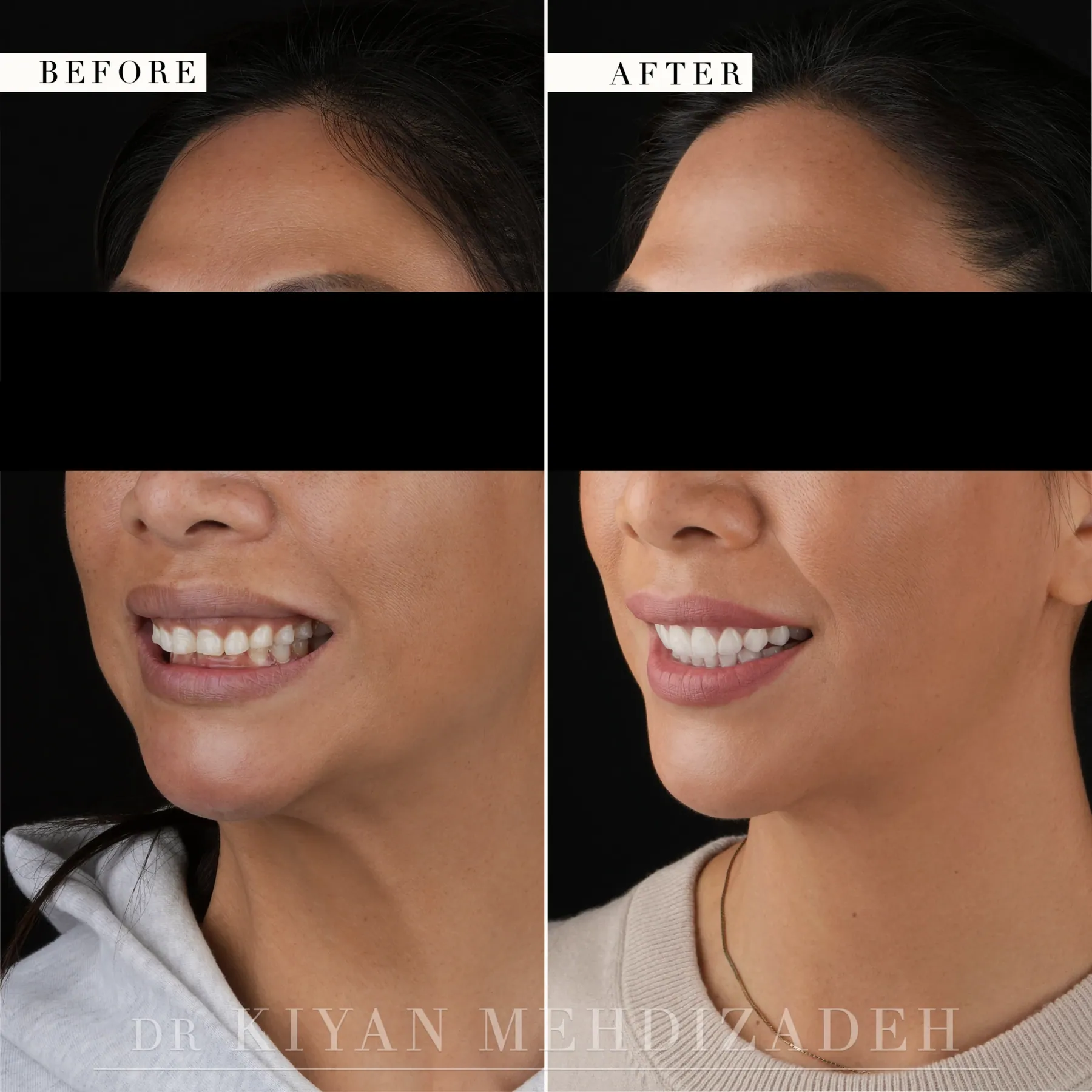
Aligners first, veneers after. When teeth are crowded, spaced or out of line, straightening them first gives a better foundation for veneers, and it often means less tooth reduction, because teeth already in position need less enamel removed to bring their surfaces into line. The patient in this case had already completed Invisalign before she came to us. Her teeth were straight, but excess gum covered them, grinding had worn them down, and one upper tooth was missing. Dr. Mehdizadeh performed crown lengthening to set the gum line, placed an implant, and the case finished with porcelain veneers. The patient in another case came to us after braces. Her teeth were straight, but the gum line was uneven and two lower first molars were missing; the plan combined a gum lift, two implants and twenty veneers, with the implant crowns made alongside the veneers and matched in shade.
Veneers where aligners cannot close the space. In this case, the patient had been told Invisalign could not close the gap between his front teeth. His teeth were reasonably positioned; they were too narrow for the space in his jaw, and moving them together would only have opened new gaps beside them. Ten upper veneers spread the extra width across the smile so no single tooth looks oversized.
Sometimes veneers alone are enough: where the teeth are relatively straight, they may not need to move first. Which order suits a patient is a design decision, and Dr. Mehdizadeh makes it at the consultation with the whole smile in view. Porcelain veneers have their own page.
What decides how an aligner case finishes.
Three things decide how an aligner case finishes. The first is case selection: aligners are well suited to moving teeth within the jaw, and choosing them for the problems they handle well is the start of a good result. The second is wear. Teeth follow the plan most closely when the trays are worn as directed; when they are not, the teeth fall behind, and the case takes longer and needs more refinements.
The third is planning, and it is where aligners meet the rest of the smile. The digital plan decides where every tooth ends up. If that end position is designed only for straightness, the teeth can finish straight but wrong for the gum line, the lip or the veneers that may follow. We plan the end position for the smile the patient wants, not just for alignment.
We offer both Invisalign and ClearCorrect. They work on the same principle, and we go through the choice between them when a case is planned.
Who aligners suit.
Aligners move teeth, so they suit problems of tooth position. The common ones are crowding, where the teeth overlap or turn because the arch is short of room; spacing, including a gap between the front teeth; and mild bite problems, such as a deep bite, a mild crossbite, or front teeth that do not meet. Teeth that have drifted back toward their old positions years after braces are a frequent reason adults start aligner treatment.
A bite problem that comes from the size or position of the jaws, rather than the teeth, is a different question, and the examination shows which one a patient has. The gums and the bone around the teeth need to be healthy before any teeth move, because aligners move teeth through bone, so we treat active gum disease first.
From the first scan to the retainer.
Records
Treatment begins with records: photographs, X-rays and a scan or impressions of the teeth.
The digital plan
From those, a digital plan stages the movement from where the teeth are to where they need to be, and each tray in the series carries one stage.
Wearing the trays
Each tray is worn for a set interval, then the next. The trays only work while they are in: as general guidance, about 22 hours a day, out only to eat, to drink anything but water, and to brush.
Attachments
Small, tooth-colored shapes of composite bonded to some of the teeth give the trays something to grip, so they can turn a tooth or move it up or down. Where the teeth are crowded, a little enamel is sometimes smoothed from between them to make room.
Refinement
Teeth do not always follow the plan exactly. When some lag behind, a refinement, a further set of trays made from a new scan, finishes the movement.
The retainer
We polish the attachments off at the end. Teeth tend to move back toward where they started, and the retainer is what holds the result: usually clear trays worn at night, sometimes with a thin wire bonded behind the front teeth. Wearing it is part of the treatment.
What aligners cost.
Clear aligners
$82/month
$6,800
144 payments at 9.99% APR, on approved credit.
Invisalign or ClearCorrect, chosen when your case is planned.
Where aligners are one stage of a larger plan, we quote the plan as a whole. The consultation, including a 3D X-ray (CT scan), is complimentary. Most PPO plans contribute toward the cost of treatment. Financing is available.

One doctor plans the movement and the smile.
Dr. Mehdizadeh plans and supervises every aligner case himself. Where veneers, a gum lift or implants follow the aligners, they are planned in the same design, and our laboratory, in the same building, makes the porcelain.
Tell us what you would like to change.
Tell us what is going on. Add photos if you have them; if not, we will call and talk it through.
Or call (310) 770-3335.
Ask about clear aligners
Reviewed by our treatment coordination team. Call or text (310) 770-3335 if you would rather speak now.
Request received
A treatment coordinator will call you within two hours during office hours (Monday to Friday, 9 to 4).
To talk now, call (310) 770-3335.
Frequently Asked Questions
Do you offer Invisalign or ClearCorrect?
Both. Each is a system of clear trays made from a digital plan, and we go through the choice between them when your case is planned.
How many hours a day do I wear aligners?
About 22 hours a day, as general guidance. They come out to eat, to drink anything but water, and to brush. Teeth move only while the trays are in.
What are attachments?
Small, tooth-colored shapes of composite bonded to some teeth so the trays can grip them and turn or move them. We polish them off when treatment ends.
What is a refinement?
A further set of trays made from a new scan, used when some teeth have not fully followed the plan. It finishes the movement the first series started.
Do I need a retainer afterwards?
Yes. Teeth tend to move back toward where they started, and the retainer is what holds the result. Retainers are usually clear trays worn at night.
Can aligners close the gap between my front teeth?
Often, when the teeth are the right width for the space. When they are too narrow, moving them together opens new gaps beside them, and veneers that spread the width across the smile close the space instead, as in one of the cases on this page.
Should I straighten my teeth before veneers?
Not always. If the teeth are relatively straight, veneers alone may be enough. With significant crowding, spacing or bite problems, straightening first gives a better foundation and often means less tooth reduction for the veneers.
I had braces years ago and my teeth have moved. Can aligners help?
Often, yes. Teeth that have drifted after braces are a common reason adults start aligner treatment, and a retainer afterwards holds the corrected position.
How much do clear aligners cost?
Clear aligners are $6,800. $82/month: 144 payments at 9.99% APR, on approved credit. Most PPO plans contribute toward the cost of treatment. Financing is available.
Last Updated: October 2026