Diastema Closure with Porcelain Veneers: When Invisalign Can’t Close the Gap
10 upper veneers designed for natural, masculine proportions
By Dr. Kiyan Mehdizadeh, DMD · 9460 Wilshire Blvd, Suite 850, Beverly Hills, CA 90212 · (310) 770-3335
Last Updated: August 2026
Have a gap you want closed?
Closing a diastema well is a proportion problem, not a filling problem. Widen the wrong teeth and the result looks like dentistry. Send us a photo and we will tell you how it would need to be designed, and what it would cost.
- A response within one business day. Usually much sooner.
- A real cost estimate, not a range designed to get you in the door.
- No obligation. Many patients take months to decide. That is normal.
Ask about your case
Reviewed by our treatment coordination team. Call or text (310) 770-3335 if you would rather speak now.
Request received
Our treatment coordination team will review what you sent and call you
within one business day.
If you would like to hold a consultation time now, you can do that below.
Treatment Plan by Dr. Kiyan Mehdizadeh
- Comprehensive smile analysis with digital photography and diagnostic wax-up
- 10 upper porcelain veneers with proportioned width distribution across the smile zone
- Strategic diastema closure without disproportionately widening central incisors
- Color, texture, and shape matched for a masculine, natural appearance
- Minimal enamel preparation (0.3–0.5mm) to preserve natural tooth structure
Diastema Treatment: Why Invisalign Couldn’t Close This Gap
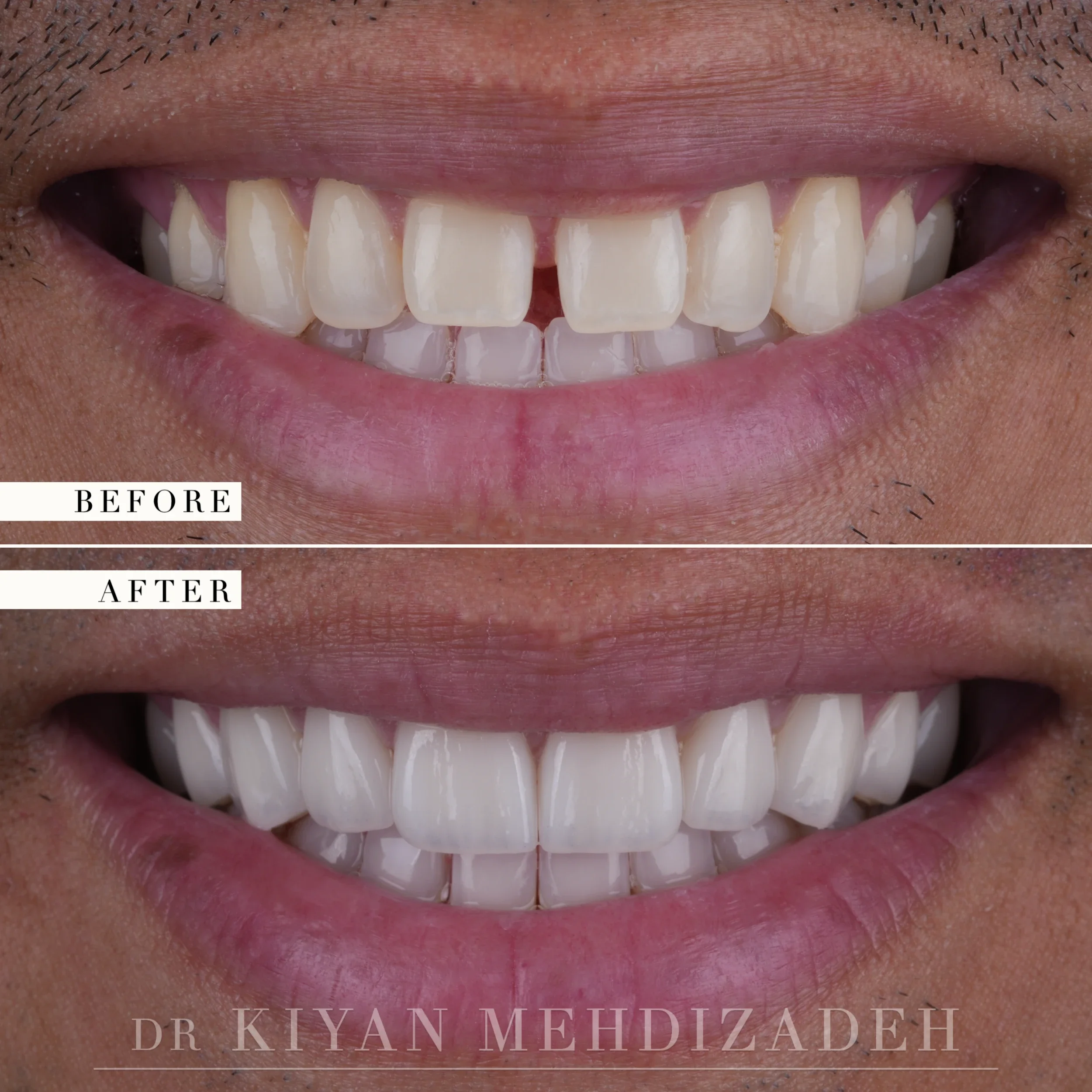
This young man presented with a common frustration: he had been told Invisalign could not close his diastema, the gap between his front teeth. The problem was not alignment. His teeth were reasonably positioned in the arch. The issue was anatomy. His teeth were simply too narrow to fill the available space in his jaw, and no amount of orthodontic movement would change that fundamental reality. Moving narrow teeth together would close the midline gap but open new spaces between the lateral incisors and canines.
Diastema closures present a unique challenge in cosmetic dentistry. The obvious solution of making the two front teeth wider often creates an unnatural appearance. Disproportionately wide central incisors look immediately artificial and are the hallmark of poorly planned veneer work. The skill lies in distributing additional width across multiple teeth so no single tooth appears oversized.
“A smile that’s fresh, bright, and youthful—but unmistakably masculine.”
How Natural Tooth Proportions Work
Natural teeth follow specific mathematical relationships that the eye recognizes subconsciously. The central incisors are the widest teeth in the smile, typically measuring 8.5–9.5mm. The lateral incisors are approximately 75–80% of the central width. The canines are approximately 75–80% of the laterals. This cascading ratio, sometimes called the “golden proportion” or “recurring esthetic dental ratio,” is what makes a smile look natural rather than manufactured. When closing a diastema, adding all the necessary width to the central incisors alone breaks this cascade and produces an immediately detectable artificial result.
The Diastema Challenge
Close a visible midline diastema without creating the telltale sign of amateur cosmetic work: oversized, disproportionate front teeth that announce themselves as veneers. This requires distributing width across the entire smile zone while maintaining natural tooth-to-tooth ratios.
How the Veneers Were Designed
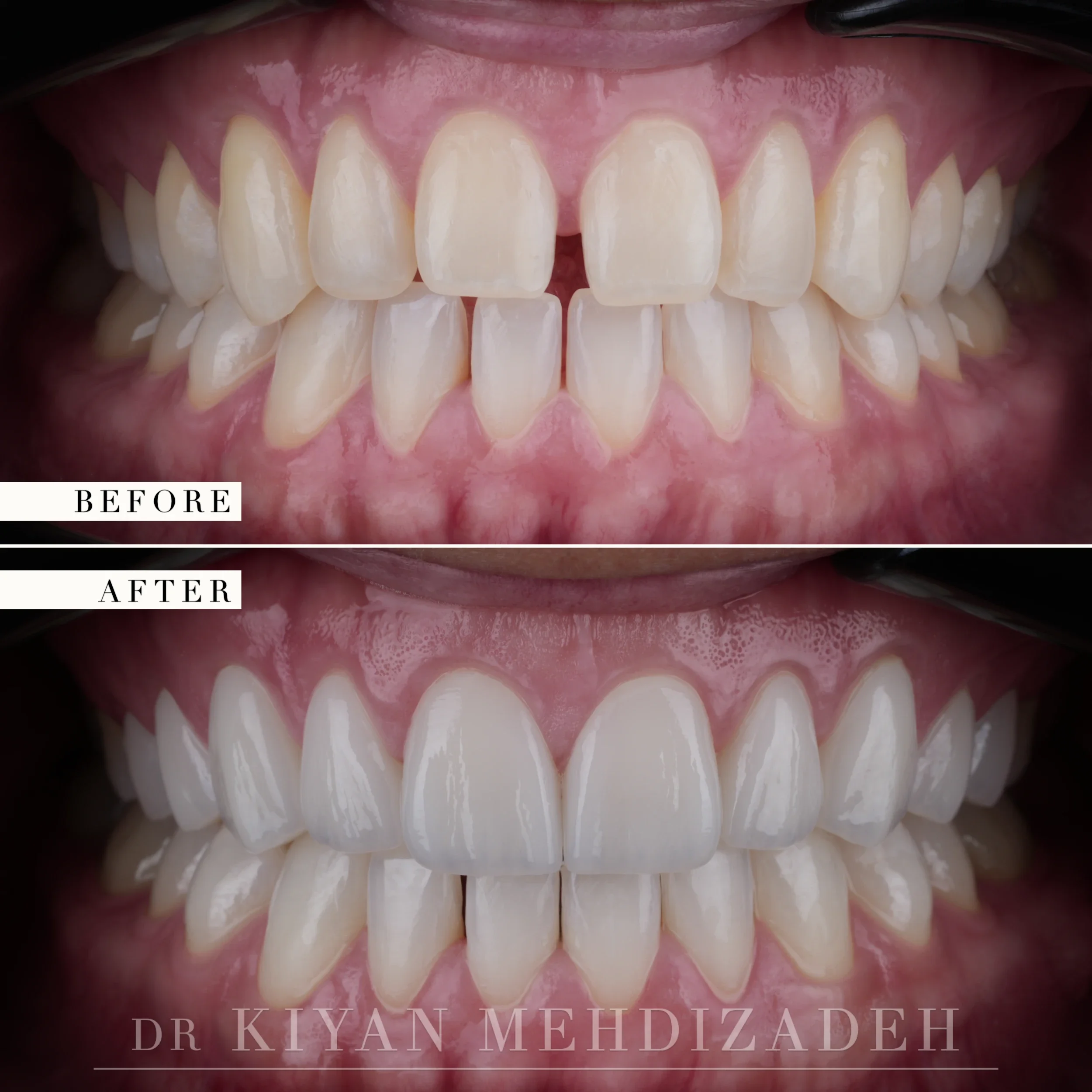
Ten upper porcelain veneers were designed to close the diastema while maintaining natural proportions throughout the smile. The treatment was planned using digital photography and a diagnostic wax-up to visualize the final result before any tooth preparation began. The width was distributed strategically across the smile zone:
- Slight increase to central incisors, enough to contribute to gap closure, not enough to look oversized
- Proportional additions to lateral incisors and canines maintaining the 80% ratio cascade
- Extended coverage to first premolars to widen the visible smile corridor
- Each tooth sized in proper ratio to its neighbors for seamless natural appearance
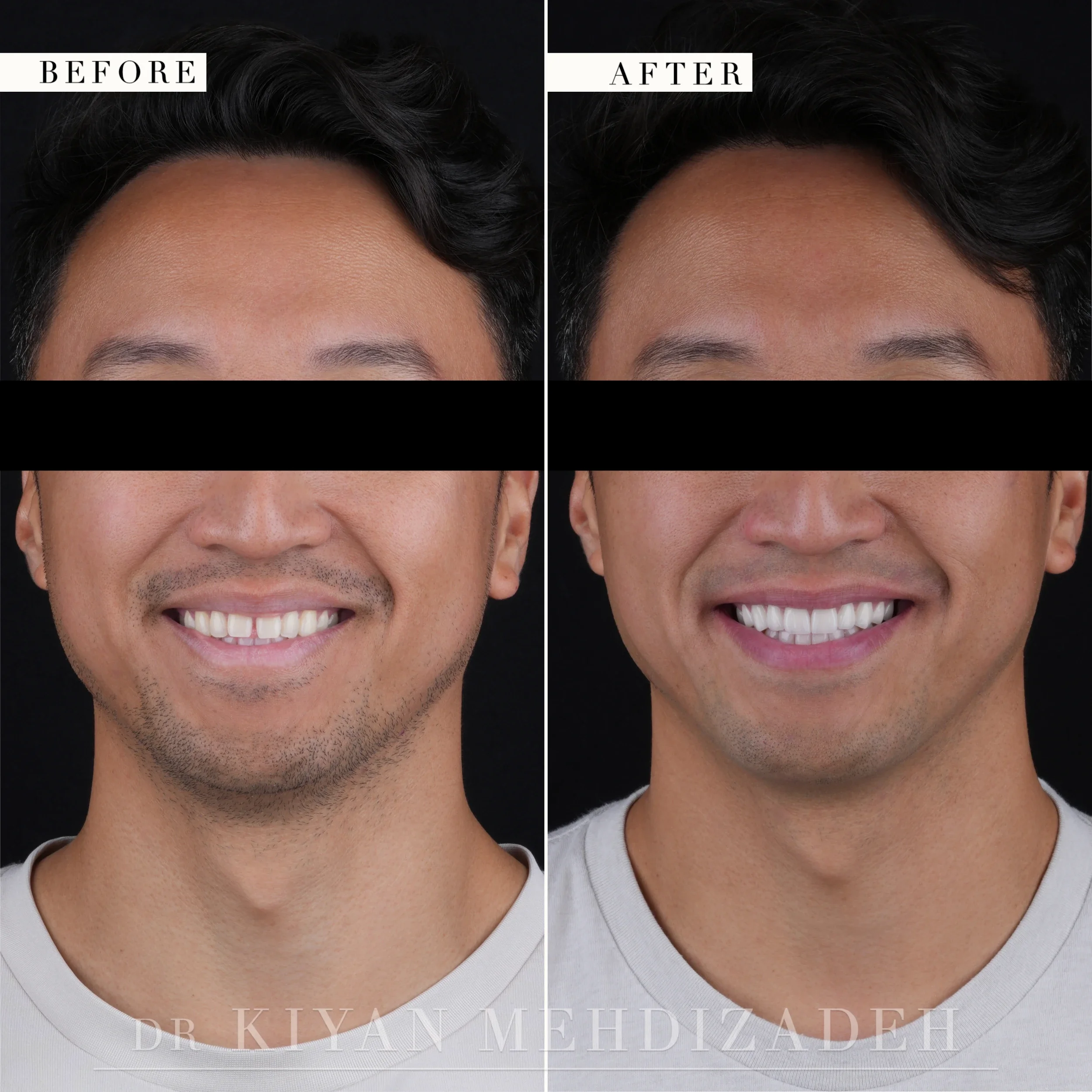
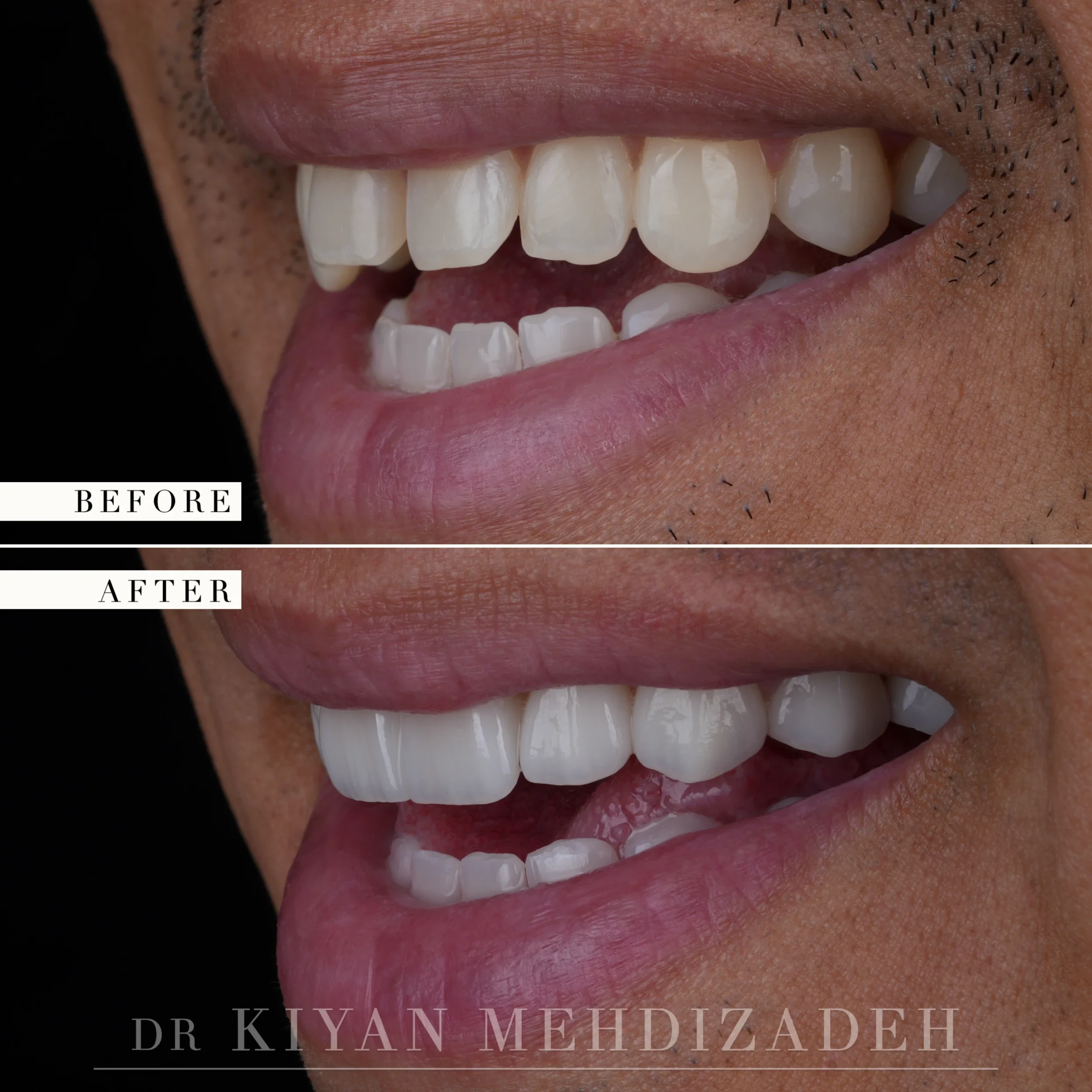
The result is a diastema that is completely closed with teeth that look naturally sized. No single tooth appears too wide because the additional width is distributed across all 10 teeth in the smile zone.
Designing a Masculine Smile with Porcelain Veneers
Male smile design differs meaningfully from female smile design. Men’s teeth typically feature more angular incisal edges with less rounding, slightly less translucency at the edges, more pronounced surface texture, and a flatter smile arc. The color should read as naturally bright and clean, not artificially white. These are subtle distinctions, but they determine whether veneers look like natural teeth or like dental work.
The shade selected was fresh and youthful without crossing into the artificial territory that announces cosmetic work. The porcelain was layered by the laboratory ceramist to replicate natural enamel texture, and the shape maintains the angular characteristics appropriate for a masculine smile.
The Result After 6 Weeks of Treatment
Six weeks from start to finish. His diastema is gone, and his smile looks seamlessly natural: no gap, no oversized teeth, no visible indication of dental work. The porcelain veneers do not announce themselves. They simply look like he was born with beautiful, well-proportioned teeth. The treatment required just three appointments: preparation, try-in, and final bonding.
This case demonstrates that orthodontics is not always the answer for a diastema. When the underlying tooth anatomy is the limiting factor—specifically when teeth are too narrow for the available arch space—porcelain veneers offer a solution that alignment alone cannot achieve. The key is designing restorations that respect natural proportions while solving the actual problem.
“The best cosmetic work is the work nobody notices.”
Frequently Asked Questions About Diastema Closure with Veneers
Why couldn’t Invisalign close this diastema?
Invisalign moves teeth into new positions, but it does not change their physical size. When teeth are too narrow for the available space in the jaw, orthodontic movement alone cannot eliminate the gap. Moving the teeth together would close the midline diastema but create new gaps between the lateral incisors and canines. The teeth need to be made physically wider with restorative work like porcelain veneers.
Why were 10 veneers needed instead of just two front teeth?
Closing a diastema with only two veneers on the central incisors would create disproportionately wide front teeth that look obviously artificial. By treating 10 teeth across the upper smile zone, the additional width was distributed across the entire visible smile, maintaining natural proportions where no single tooth appears oversized. Each tooth was sized in proper ratio to its neighbors using established dental proportion guidelines.
What makes a masculine smile design different from a feminine one?
Masculine smiles typically feature more angular incisal edges with less rounding, slightly less translucency at the tooth edges, more pronounced surface texture, a flatter smile arc, and less gingival display. These subtle characteristics are factored into the design phase to create results that look natural for each patient’s facial features and gender presentation.
How long does diastema closure with veneers take?
This case was completed in approximately 6 weeks from initial consultation to final bonding. The process required three appointments: preparation and impressions, a try-in appointment to verify fit and aesthetics, and final bonding. Most of the elapsed time is spent in the dental laboratory where the ceramist hand-layers the custom porcelain restorations.
Will porcelain veneers look obviously fake?
When properly designed and executed, porcelain veneers should be indistinguishable from natural teeth. The telltale signs of poor veneer work—including unnatural opaque color, excessive uniformity, and wrong proportions—are the result of inadequate planning and execution, not inherent limitations of porcelain. The ceramist hand-layers each veneer to replicate natural enamel texture, translucency gradients, and surface characteristics.
How much does diastema closure with porcelain veneers cost?
Porcelain veneers for diastema closure typically range from $1,800 to $3,500 per tooth. A treatment plan with 10 veneers falls between $18,000 and $35,000 depending on complexity, materials selected, and individual case requirements. The investment includes all preparation appointments, temporary veneers, laboratory fabrication, and final bonding. A consultation provides a personalized treatment plan and accurate quote.
Can dental bonding close a diastema instead of porcelain veneers?
Composite bonding can close small gaps at lower upfront cost, but the material stains over time, chips more easily, and typically needs replacement every 3–7 years. Porcelain veneers are more durable, stain-resistant, and maintain their appearance for 15–20 years or longer with proper care. For significant diastemas requiring multiple teeth to be treated simultaneously, porcelain veneers deliver a more predictable, longer-lasting, and aesthetically superior result.
Do porcelain veneers for diastema closure require shaving down teeth?
Minimal preparation is required. Typically 0.3 to 0.5mm of enamel is removed from the front surface of each tooth, which is far less invasive than dental crowns and preserves the vast majority of natural tooth structure. In diastema cases, even less removal may be needed on the sides of the teeth where the gap exists, since the veneer is filling space that is already open rather than overlaying existing tooth surface.
How long do porcelain veneers last after diastema closure?
Porcelain veneers are a permanent commitment in the sense that enamel is modified during preparation and the teeth will always need veneers going forward. The restorations themselves last 15–20 years or more with proper care, including regular brushing, flossing, and professional cleanings every 6 months. The diastema will never return: once corrected with veneers, the new proportions are maintained through future veneer replacements.
Can a diastema come back after porcelain veneers?
No. Unlike orthodontic treatment where teeth can relapse toward their original positions without retainers, porcelain veneers physically fill the space and maintain the corrected proportions long term. The veneers are bonded directly to the tooth structure and cannot shift. When the veneers eventually need replacement after 15–20 years, the new set is fabricated to the same dimensions, maintaining the closed diastema indefinitely.
Last Updated: August 2026

Dr. Kiyan Mehdizadeh, DMD
Doctor of Dental Medicine
Most cosmetic dentists refer out for surgery. Most surgeons don't do cosmetic work. Dr. Mehdizadeh trained in both — implantology and bone grafting at Loma Linda and UCLA, fixed prosthodontics under Mauro Fradeani in Italy, periodontal microsurgery with Hürzeler and Zuhr in Munich, and IV sedation at the University of Alabama. That combination means complex cases involving surgery, grafting, implants, and restorative work are planned and executed by a single provider with full command of every phase.
Technical skill produces function. Taste is what produces beauty. The difference between dental work that looks like dental work and a result that looks entirely natural comes down to aesthetic judgment — proportion, texture, translucency, how light moves across a surface. That sensibility runs through everything here, from the way cases are designed to the office itself.
An in-house master ceramist and on-site laboratory allow restorations to be designed, fabricated, and refined with direct collaboration between doctor and technician — no outsourced lab work, no guesswork, no compromise on the final product. Dr. Mehdizadeh is one of few dentists with the refined ability to provide care across multiple specialties, resulting in cohesive and holistic outcomes.
Education & Credentials
- Doctor of Dental Medicine (DMD), cum laude — Boston University
- Bachelor of Science in Biology — Emory University
- Mastership in Implant Dentistry & Grafting — Loma Linda University / gIDE Institute
- Advanced Implant Therapy & Grafting — UCLA / gIDE Institute
- Implant Placement & Restoration — UCLA / Nobel Biocare
- Guided Bone Regeneration & Ridge Augmentation — gIDE Institute
- Sinus Elevation & Augmentation — gIDE Institute
- Soft Tissue Management & Grafting — gIDE Institute
- Minimally Invasive Augmentation & Autogenous Bone Management — IDEA, San Francisco
- Master Program in Fixed Prosthodontics — Fradeani Education, Italy
- Aesthetic Dentistry — UCLA School of Dentistry
- Advanced Occlusion & Bite Design — UCLA
- Periodontal Micro-Surgery — Hürzeler/Zuhr, Munich
- Micro-Endodontic Training — University of Pennsylvania
- IV Sedation — University of Alabama at Birmingham
- Injectable Therapy for TMJ & Facial Pain — American Academy of Facial Esthetics
Considering similar treatment?
Send Dr. Mehdizadeh a photo and ask what’s possible for your case.
Other cases like this one
Closing the Gaps Braces Could Not
Did braces leave you with gaps that never closed?
View case →Replacing a Missing Front Tooth With a Bridge and Veneers
Missing a front tooth for years?
View case →Porcelain Veneers for Small Lateral Incisors: When Shape Matters More Than Position
Do you have peg laterals?
View case →