A Permanent Answer to Four Missing Front Teeth
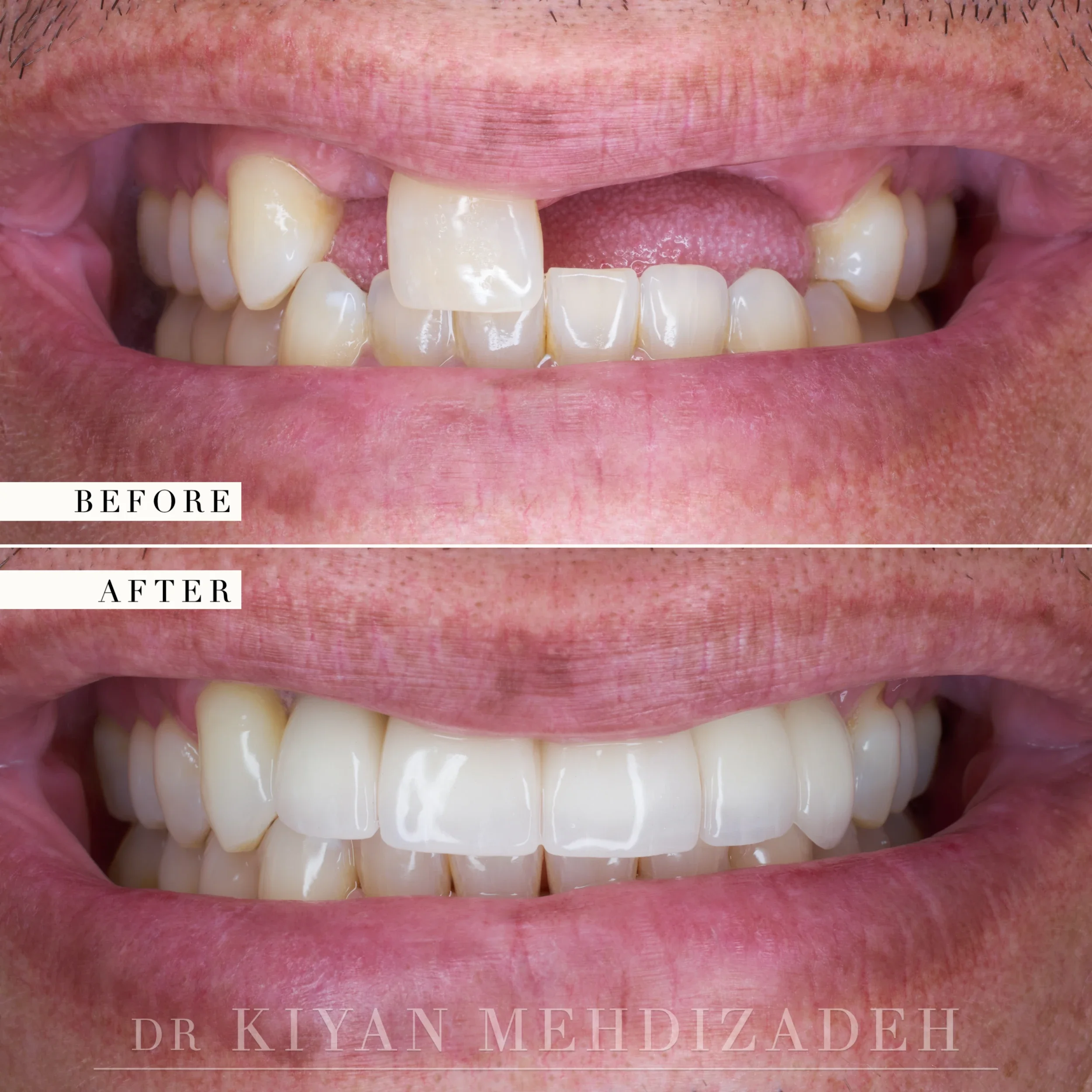
Four upper front teeth had been missing long enough for the ridge beneath them to resorb. The bone had to be rebuilt before anything could be placed in it.
By Dr. Kiyan Mehdizadeh, DMD · 9460 Wilshire Blvd, Suite 850, Beverly Hills, CA 90212 · (310) 770-3335
Last Updated: September 2026
Have you been wearing a flipper for years?
A removable partial rests on the tissue rather than loading the bone, so the ridge underneath it keeps resorbing and the appliance keeps needing adjustment. How much bone is left decides whether implants can go in directly or whether the ridge has to be rebuilt first. Send us a photo of your smile and we will tell you which situation you are in and what it would cost.
- A response within one business day. Usually much sooner.
- A real cost estimate, not a range designed to get you in the door.
- No obligation. Many patients take months to decide. That is normal.
Ask about your case
Reviewed by our treatment coordination team. Call or text (310) 770-3335 if you would rather speak now.
Request received
Our treatment coordination team will review what you sent and call you
within one business day.
If you would like to hold a consultation time now, you can do that below.
Treatment Plan by Dr. Kiyan Mehdizadeh
- Whitening of the natural dentition, completed before any restorative shade was recorded.
- Bone grafting to rebuild the resorbed anterior ridge.
- Three implants placed, at teeth seven, nine and eleven.
- Healing and osseointegration.
- One implant crown on the implant at tooth seven, and one porcelain veneer on the natural tooth at eight.
- A three-unit implant bridge spanning teeth nine to eleven, carrying tooth ten as a pontic.
The Patient's Journey
This patient was missing four upper front teeth: the lateral incisor, central incisor, lateral incisor and canine on one side of the midline, numbers seven, nine, ten and eleven. He had been managing with a removable partial denture, a flipper, and had tolerated the arrangement long enough to be thoroughly tired of it. What he asked for was something permanent.
He also presented with severe bone loss across the edentulous span, and that finding, rather than the absent teeth themselves, determined how long this reconstruction would take.
Alveolar bone exists to support teeth, and it is maintained by the occlusal load they transmit into it. Extract the tooth and the stimulus disappears with it, so the ridge resorbs. Resorption is most rapid during the first year following an extraction and continues at a diminishing rate indefinitely afterwards, which means an edentulous anterior ridge that has carried no teeth for years is both narrower and lower than it was, sometimes markedly so.
A removable partial denture does not prevent this. The appliance rests on the mucosa and transfers its load to the soft tissue rather than into the underlying bone, so resorption continues beneath it undisturbed. The prosthesis is subsequently relined to the new contour, which is the reason a flipper that fitted accurately at delivery becomes loose within a year or two.
Implants cannot be placed into bone that is not there. Where the ridge has resorbed below the volume an implant requires for primary stability, the bone is reconstructed first and allowed to consolidate before any implant is placed, and that sequence is the reason this case ran seven months rather than three.
Implants cannot be placed into bone that is not there. Where the ridge has resorbed below the volume an implant requires, the bone is rebuilt first and allowed to consolidate, and only then is the implant placed. That sequence is the reason this case ran seven months rather than three.
Rebuild the resorbed anterior ridge before placing anything in it. Replace four missing teeth with three implants. Bring the one natural tooth in the span into the new work. Whiten before any shade is recorded. Nothing removable at the end of it.
Whitening came first, for the same reason it comes first in every case carrying restorations at the front of the mouth. Ceramic does not respond to peroxide, so a shade recorded before the natural dentition has been lightened produces restorations that are wrong the moment the whitening is finished, and the only available remedy is to remake them.
The ridge was grafted and left to consolidate. Three implants were subsequently placed into the reconstructed bone, at teeth seven, nine and eleven. Four teeth were missing and three implants replaced them, because tooth ten is carried as a pontic on a bridge spanning nine to eleven. A pontic is a replacement tooth suspended between two supporting units rather than standing on an implant of its own.
That distribution is deliberate rather than economical. Adjacent implants in the anterior maxilla compete for the limited interproximal bone between them, and the interdental papilla, the triangle of gingival tissue occupying the space between two teeth, is notoriously difficult to maintain between two implants placed side by side. Spanning the space with a pontic gives the soft tissue a considerably better chance of reading as gum between teeth rather than as a flat shelf beneath them.
That distribution is deliberate rather than economical. Adjacent implants in the anterior maxilla compete for the same limited bone between them, and the papilla, the small triangle of gum that fills the space between two teeth, is difficult to maintain between two implants placed side by side. Spanning the gap with a pontic gives the soft tissue a better chance of looking like gum between teeth rather than a flat shelf.
Five units now span teeth seven to eleven: an implant crown, a porcelain veneer, and a three-unit bridge. The flipper is gone, and he occludes on restorations anchored in bone rather than on an appliance resting against his palate.
The grafted bone now carries occlusal load again, which is what preserves it. Bone loaded through an osseointegrated implant is maintained in a way that bone beneath a removable prosthesis is not, so the ridge reconstructed for this restoration is also being maintained by it.
Five units span teeth seven to eleven: an implant crown, a veneer, and a three-unit bridge. The flipper is gone. He bites on teeth that are attached to his jaw rather than resting on his palate.
The grafted bone now carries load again, which is what keeps it. Bone that is loaded through an implant is maintained in a way that bone under a denture is not, so the ridge that was rebuilt for this reconstruction is also being preserved by it.
Frequently Asked Questions About Bone Grafting and Front Tooth Implants
Why did the bone need grafting before implants?
Alveolar bone is maintained by the load teeth transmit into it. Once teeth are lost the ridge resorbs, quickest in the first year and slowly thereafter. Where it has resorbed below the volume an implant requires, the bone is rebuilt and allowed to consolidate before anything is placed in it.
Does a partial denture prevent bone loss?
No. A removable partial rests on the soft tissue and transfers its load to the tissue rather than into the bone, so the ridge continues to resorb underneath it. That is why a flipper that fitted well at the start needs relining as time passes.
Why three implants for four missing teeth?
Tooth ten is carried as a pontic, a replacement tooth suspended between two supports rather than standing on its own implant. Adjacent implants in the anterior maxilla compete for the limited bone between them, and the gum papilla is difficult to maintain between two implants side by side. Spanning the gap gives the soft tissue a better result.
What is a pontic?
A replacement tooth in a bridge that has no implant or root of its own. It is supported by the units on either side of it and shaped to emerge from the gum as a natural tooth would.
Why was the healthy natural tooth given a veneer?
Tooth eight needed no treatment for its own sake. It sits at the midline with new restorations on either side, and leaving it untouched would have required everything around it to match one natural tooth exactly. Restoring it brings it into the same design.
Why was whitening done first?
Ceramic does not lighten. A shade recorded before the natural teeth are whitened produces restorations that are wrong as soon as the whitening is finished, and the only remedy is to remake them.
How long does bone grafting add to treatment?
The graft has to consolidate before an implant can be placed into it, and that interval is what took this case to seven months rather than three or four. It cannot be compressed, and attempting to place an implant into a graft that has not consolidated risks losing both.
Will the grafted bone hold up over time?
Bone loaded through an implant is maintained in a way that bone beneath a denture is not. The reconstruction that the graft made possible is also what preserves it, provided the implants are maintained and the tissue around them stays healthy.
Is an implant bridge cleaned differently from natural teeth?
Yes. Conventional floss will not pass under a pontic, so cleaning runs through interdental brushes and a water flosser, together with professional recall using instruments intended for implant surfaces.
How much does bone grafting with anterior implants cost?
This case was $28,000, covering whitening, bone grafting, three implants, an implant crown, a veneer and a three-unit implant bridge. Implants with their crowns range from $4,000 to $6,000 per site and porcelain veneers from $2,000 to $4,000 per tooth, with grafting quoted according to the volume required. Financing options are available and a detailed breakdown is provided at the consultation.
Last Updated: September 2026

Dr. Kiyan Mehdizadeh, DMD
Doctor of Dental Medicine
Most cosmetic dentists refer out for surgery. Most surgeons don't do cosmetic work. Dr. Mehdizadeh trained in both — implantology and bone grafting at Loma Linda and UCLA, fixed prosthodontics under Mauro Fradeani in Italy, periodontal microsurgery with Hürzeler and Zuhr in Munich, and IV sedation at the University of Alabama. That combination means complex cases involving surgery, grafting, implants, and restorative work are planned and executed by a single provider with full command of every phase.
Technical skill produces function. Taste is what produces beauty. The difference between dental work that looks like dental work and a result that looks entirely natural comes down to aesthetic judgment — proportion, texture, translucency, how light moves across a surface. That sensibility runs through everything here, from the way cases are designed to the office itself.
An in-house master ceramist and on-site laboratory allow restorations to be designed, fabricated, and refined with direct collaboration between doctor and technician — no outsourced lab work, no guesswork, no compromise on the final product. Dr. Mehdizadeh is one of few dentists with the refined ability to provide care across multiple specialties, resulting in cohesive and holistic outcomes.
Education & Credentials
- Doctor of Dental Medicine (DMD), cum laude — Boston University
- Bachelor of Science in Biology — Emory University
- Mastership in Implant Dentistry & Grafting — Loma Linda University / gIDE Institute
- Advanced Implant Therapy & Grafting — UCLA / gIDE Institute
- Implant Placement & Restoration — UCLA / Nobel Biocare
- Guided Bone Regeneration & Ridge Augmentation — gIDE Institute
- Sinus Elevation & Augmentation — gIDE Institute
- Soft Tissue Management & Grafting — gIDE Institute
- Minimally Invasive Augmentation & Autogenous Bone Management — IDEA, San Francisco
- Master Program in Fixed Prosthodontics — Fradeani Education, Italy
- Aesthetic Dentistry — UCLA School of Dentistry
- Advanced Occlusion & Bite Design — UCLA
- Periodontal Micro-Surgery — Hürzeler/Zuhr, Munich
- Micro-Endodontic Training — University of Pennsylvania
- IV Sedation — University of Alabama at Birmingham
- Injectable Therapy for TMJ & Facial Pain — American Academy of Facial Esthetics
Considering similar treatment?
Send Dr. Mehdizadeh a photo and ask what’s possible for your case.
Other cases like this one
Rebuilding a Front Tooth Without Losing the Gum Line
Protecting the gum line during extraction so an implant could sit where a natural tooth had been
View case →Orthodontics, a Bridge & Veneers for a Missing Front Tooth
Reopening a long-standing gap, then replacing an upper front tooth with a three-unit bridge
View case →Congenitally Missing Canines: Harmonizing Existing Implants
Working with imperfect implant positions to create a harmonious smile
View case →