Very White Teeth That Still Look Like Teeth
She asked for a significantly brighter smile. A bright shade is what makes restorations look artificial when the shape underneath it is wrong, so the shape was settled before the color was discussed.
By Dr. Kiyan Mehdizadeh, DMD · 9460 Wilshire Blvd, Suite 850, Beverly Hills, CA 90212 · (310) 770-3335
Last Updated: September 2026
Do you want very white teeth that still look like teeth?
A bright shade is not what makes restorations look artificial. Shape is. The same shade on a correctly proportioned tooth with natural surface texture looks like a healthy tooth. On a flat, uniform one it looks like dentistry. Send us a photo of your smile and we will tell you what is achievable and what it would cost.
- A response within one business day. Usually much sooner.
- A real cost estimate, not a range designed to get you in the door.
- No obligation. Many patients take months to decide. That is normal.
Ask about your case
Reviewed by our treatment coordination team. Call or text (310) 770-3335 if you would rather speak now.
Request received
Our treatment coordination team will review what you sent and call you
within one business day.
If you would like to hold a consultation time now, you can do that below.
Treatment Plan by Dr. Kiyan Mehdizadeh
- Examination of both arches, which identified one unrestorable tooth she had not come in about.
- Extraction of the decayed tooth and placement of an implant in the upper right posterior region.
- Smile design establishing the proportions, surface texture and light behavior of every restoration.
- Provisional restorations, revised in the mouth to her own specification.
- Shade selected after the shape was approved.
- Twenty porcelain veneers and one implant crown in e.max, ten upper and ten lower.
The Patient's Journey
This patient came in wanting a significantly brighter smile. That was the whole of her stated complaint. The examination added something she had not come in about: one upper tooth toward the back had decayed beyond the point where a restoration would retain anything, and it required extraction.
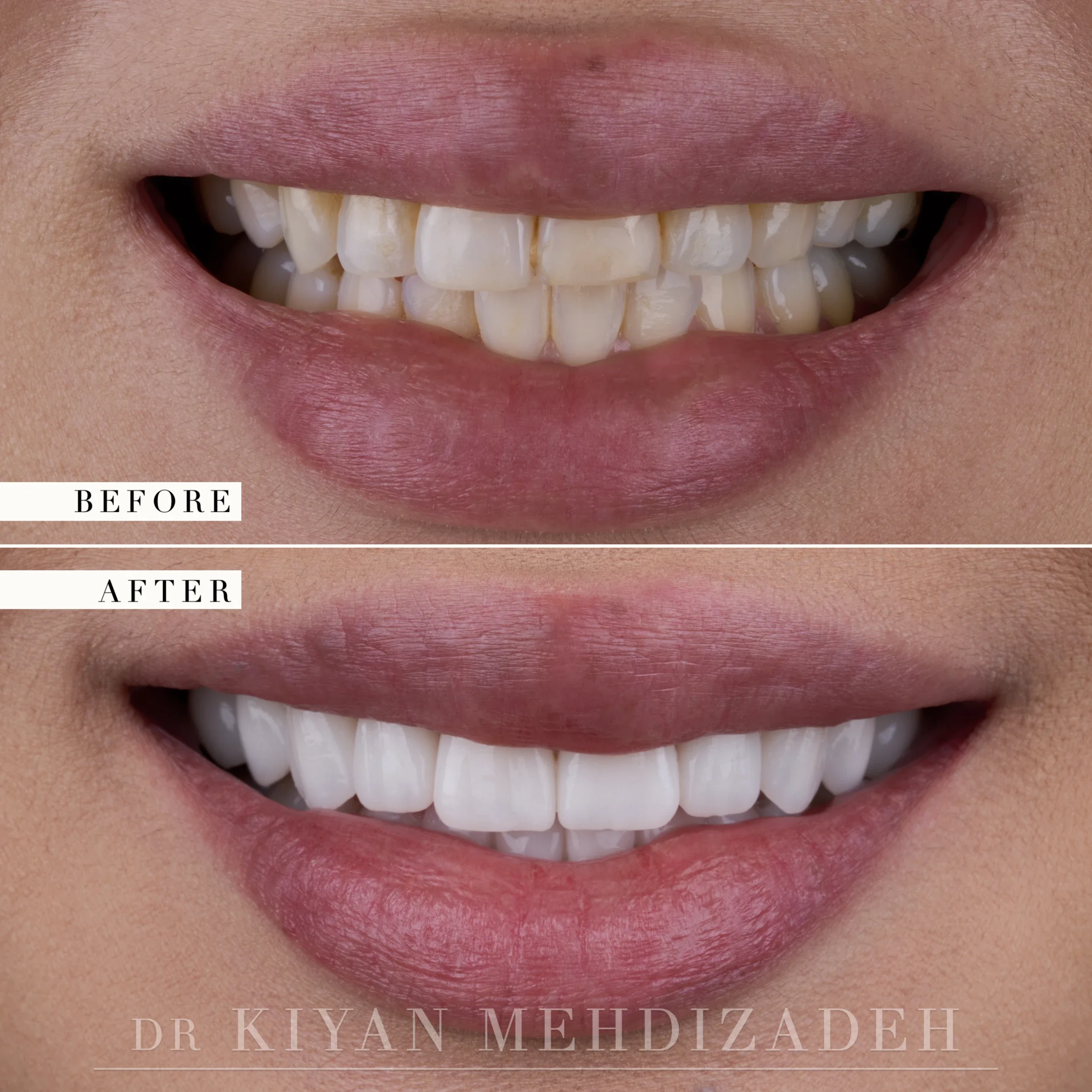
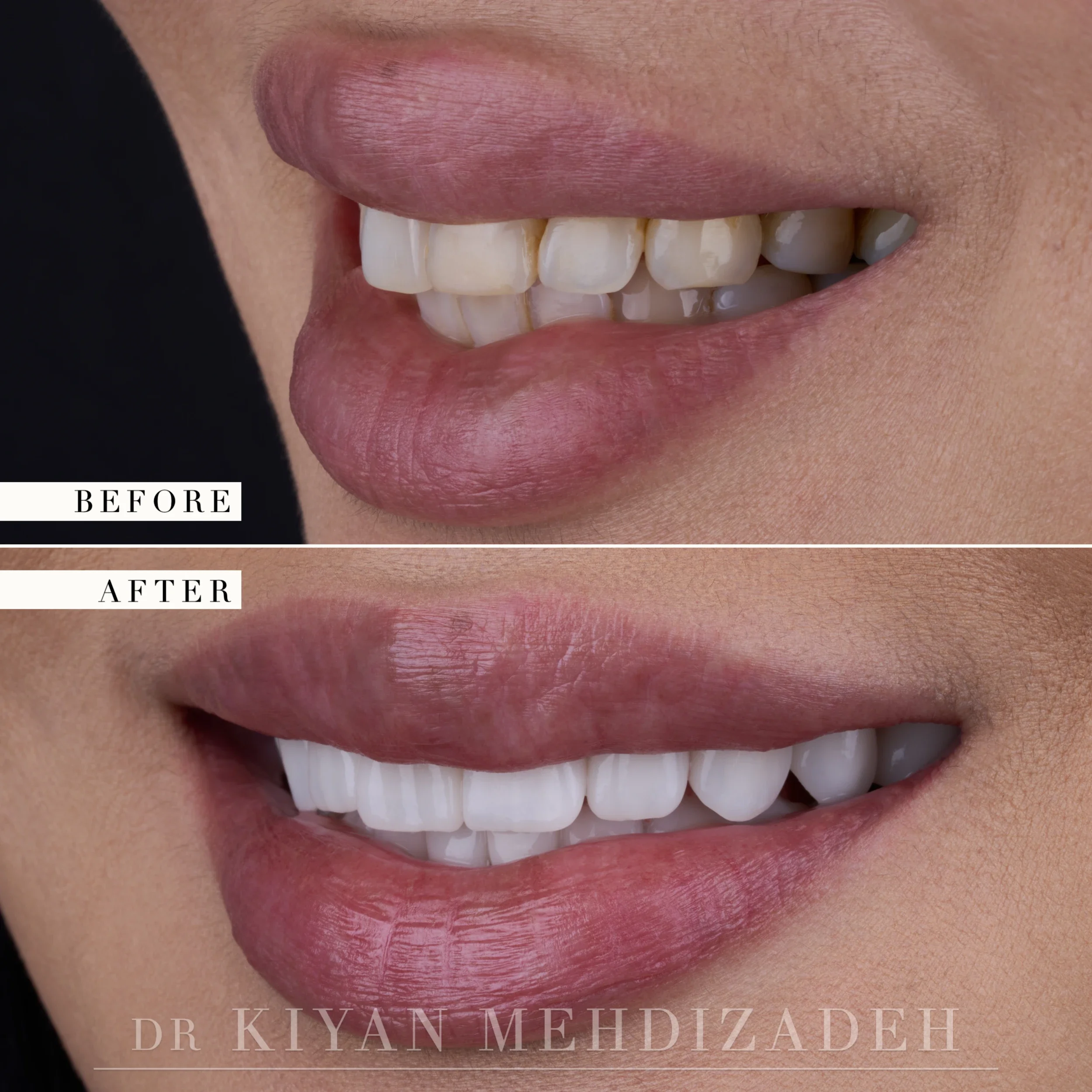
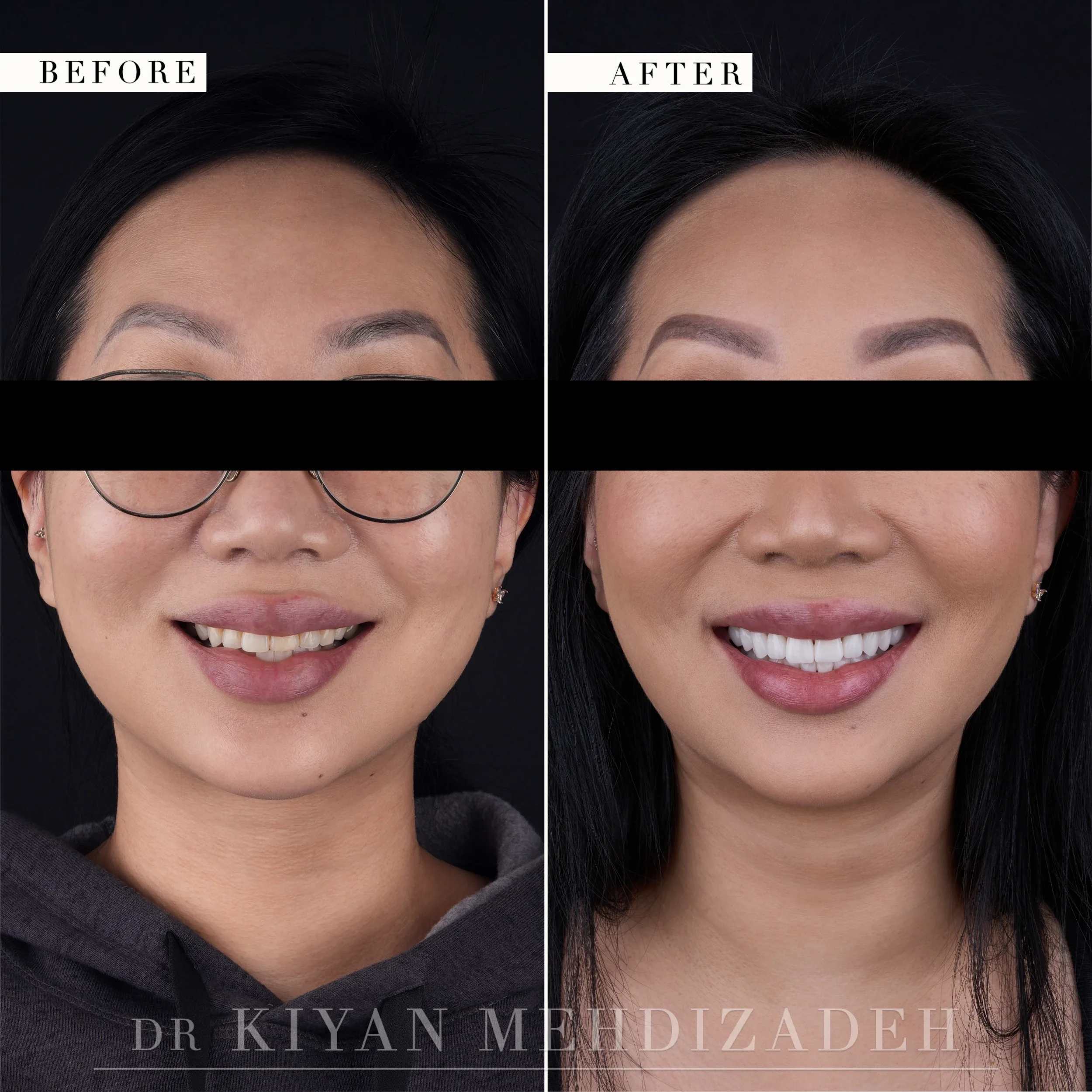
The photographs show the appearance problem. The upper teeth were crowded, darkened and rotated, and the smile was narrow in relation to her face. A brighter shade on its own would not have corrected any of that.
Understanding the Challenge
Very white restorations have a reputation for looking artificial, and the reputation is deserved in the cases that earn it. The reason is rarely the shade itself. A tooth looks natural because of its proportions, its surface texture and the way light enters it and scatters before leaving. A tooth that is flat, uniform and mechanically even will look manufactured at any shade whatsoever.
That is why the brightness she asked for was never the difficult part of this case. The difficult part was designing twenty-one restorations that retained enough individual variation to remain convincing while carrying a shade considerably lighter than the teeth she arrived with.
The extraction introduced a second consideration. An implant crown and a veneer are made differently and supported differently. Where both appear in the same arch, the crown has to belong to the same set rather than resemble it approximately.
Remove the unrestorable tooth and replace it with an implant. Establish proportions and surface texture before discussing shade. Design all twenty-one restorations as one set. Deliver the brightness she asked for without the uniformity that makes brightness look artificial. Keep the smile in proportion to her face.
How Dr. Mehdizadeh Approached Treatment
The decayed tooth was extracted and an implant was placed in the upper right posterior region. The restorative design proceeded while that site healed, because the proportions of the anterior restorations could be established from the records independently of the implant's readiness, so none of the design work had to wait on the bone.
The design specified shape before anything else. Proportions, the contours of each surface, the texture across the facial aspect and the way each unit was intended to handle light were all determined before any conversation about shade took place. Shade was selected afterwards, against approved shapes, which is the reverse of the order most patients expect.
She wore provisional restorations and had them revised in the mouth to her own specification. Provisionals are where a patient's preferences are expressed against something they can see and feel, rather than described in advance to a laboratory that has never met them.
The approved provisionals were reproduced as twenty porcelain veneers and one implant crown in e.max, ten veneers in the upper arch and ten in the lower. Every unit was designed and fabricated in the practice's own laboratory by its master ceramist, which is how twenty-one restorations carrying deliberate individual variation stay recognizably one set.
The Result After Ten Weeks
The shade is substantially lighter than the teeth she arrived with. The proportions are even, the smile fills the width of her face, and the individual variation in shape and surface texture is what keeps a shade this bright looking like enamel rather than ceramic. Seven appointments across ten weeks covered the extraction, the implant, the design, the provisional phase and the final cementation.
There is no outstanding treatment. The implant does not decay, but the tissue surrounding it requires the same attention as the tissue around a natural tooth, which is what the routine examinations and cleanings provide.
Frequently Asked Questions About Very White Veneers, Shade and Tooth Shape
Do very white veneers always look fake?
No, and the shade is rarely the reason when they do. A tooth looks natural because of its proportions, its surface texture and the way light enters and scatters inside it. A flat, mechanically uniform tooth looks manufactured at any shade.
Why was the shape decided before the shade?
Because shape is what makes a restoration convincing and shade is what makes it bright. Selecting a shade first and fitting shapes to it means the brightness is doing work the shape should be doing. Here the proportions and texture were approved before shade was discussed.
What is surface texture and why does it matter?
The fine detail across the front of a tooth, which breaks light up instead of reflecting it evenly. Natural teeth are not smooth. Reproducing that detail is a large part of why a bright restoration still looks like enamel.
How white is too white?
It depends on the shape carrying the shade, which is why the question cannot be answered from a shade guide alone. A bright shade on well-proportioned, textured teeth remains convincing. The same shade on flat, uniform ones does not.
Why was one tooth extracted?
It had decayed beyond the point where a restoration retains anything. She had not come in about it, and it was identified at the examination of both arches rather than found later.
Why an implant rather than a bridge for the extracted tooth?
An implant replaces the tooth without involving the teeth on either side of the space. A bridge requires both of them to be prepared for crowns, which means treating two sound teeth in order to replace a third.
Does an implant crown look different from a veneer?
It is made and supported differently, so it has to be designed into the same set rather than matched to it afterwards. Here the crown and the twenty veneers were specified against one plan, which is what keeps them consistent.
What happens during the provisional stage?
Provisional restorations are worn and revised in the mouth until the patient is satisfied with them. It is where preferences are expressed against something visible rather than described in advance, and the approved result is what the ceramic reproduces.
Is there anything left to do after treatment?
No further treatment. The implant does not decay, but the tissue around it needs the same attention as tissue around a natural tooth, and that is what the routine examinations and cleanings are for.
How much does a case like this cost?
This case was $50,000, covering one extraction, one implant, one implant crown and twenty porcelain veneers across both arches. Implants with crowns range from $4,000 to $6,000 per site and porcelain veneers from $1,800 to $3,500 per tooth. Financing options are available and a detailed breakdown is provided at the consultation.
Last Updated: September 2026

Dr. Kiyan Mehdizadeh, DMD
Doctor of Dental Medicine
Most cosmetic dentists refer out for surgery. Most surgeons don't do cosmetic work. Dr. Mehdizadeh trained in both — implantology and bone grafting at Loma Linda and UCLA, fixed prosthodontics under Mauro Fradeani in Italy, periodontal microsurgery with Hürzeler and Zuhr in Munich, and IV sedation at the University of Alabama. That combination means complex cases involving surgery, grafting, implants, and restorative work are planned and executed by a single provider with full command of every phase.
Technical skill produces function. Taste is what produces beauty. The difference between dental work that looks like dental work and a result that looks entirely natural comes down to aesthetic judgment — proportion, texture, translucency, how light moves across a surface. That sensibility runs through everything here, from the way cases are designed to the office itself.
An in-house master ceramist and on-site laboratory allow restorations to be designed, fabricated, and refined with direct collaboration between doctor and technician — no outsourced lab work, no guesswork, no compromise on the final product. Dr. Mehdizadeh is one of few dentists with the refined ability to provide care across multiple specialties, resulting in cohesive and holistic outcomes.
Education & Credentials
- Doctor of Dental Medicine (DMD), cum laude — Boston University
- Bachelor of Science in Biology — Emory University
- Mastership in Implant Dentistry & Grafting — Loma Linda University / gIDE Institute
- Advanced Implant Therapy & Grafting — UCLA / gIDE Institute
- Implant Placement & Restoration — UCLA / Nobel Biocare
- Guided Bone Regeneration & Ridge Augmentation — gIDE Institute
- Sinus Elevation & Augmentation — gIDE Institute
- Soft Tissue Management & Grafting — gIDE Institute
- Minimally Invasive Augmentation & Autogenous Bone Management — IDEA, San Francisco
- Master Program in Fixed Prosthodontics — Fradeani Education, Italy
- Aesthetic Dentistry — UCLA School of Dentistry
- Advanced Occlusion & Bite Design — UCLA
- Periodontal Micro-Surgery — Hürzeler/Zuhr, Munich
- Micro-Endodontic Training — University of Pennsylvania
- IV Sedation — University of Alabama at Birmingham
- Injectable Therapy for TMJ & Facial Pain — American Academy of Facial Esthetics
Considering similar treatment?
Send Dr. Mehdizadeh a photo and ask what’s possible for your case.