Last Updated: October 2026
Is there a mark on your teeth that whitening will not shift?
Discoloration that formed with the tooth does not bleach out, and whitening has a ceiling that sits short of what most patients picture. Porcelain covers the first problem and ignores the second, because the ceramist chooses the shade. Send us a photograph of your smile and we will tell you what is involved.
- A call within two hours during office hours.
- A written cost from us, before you commit to anything.
- No obligation. Many patients take weeks to decide. That is normal.
Ask about your case
Reviewed by our treatment coordination team. Call or text (310) 770-3335 if you would rather speak now.
Request received
A treatment coordinator will call you within two hours during office hours (Monday to Friday, 9 to 4).
To talk now, call (310) 770-3335.
Treatment Plan by Dr. Mehdizadeh
- Assessment and smile design, fixing shade, shape and proportion before any preparation.
- Gum lift across the upper ten teeth, repositioning the gum line the design was built to.
- Ten upper e.max veneers, second premolar to second premolar.
- Eight lower e.max veneers, first premolar to first premolar.
- Try-in of the completed design, revised in the mouth before cementation.
- Bite checked and adjusted once all eighteen units were seated.
The Patient's Journey
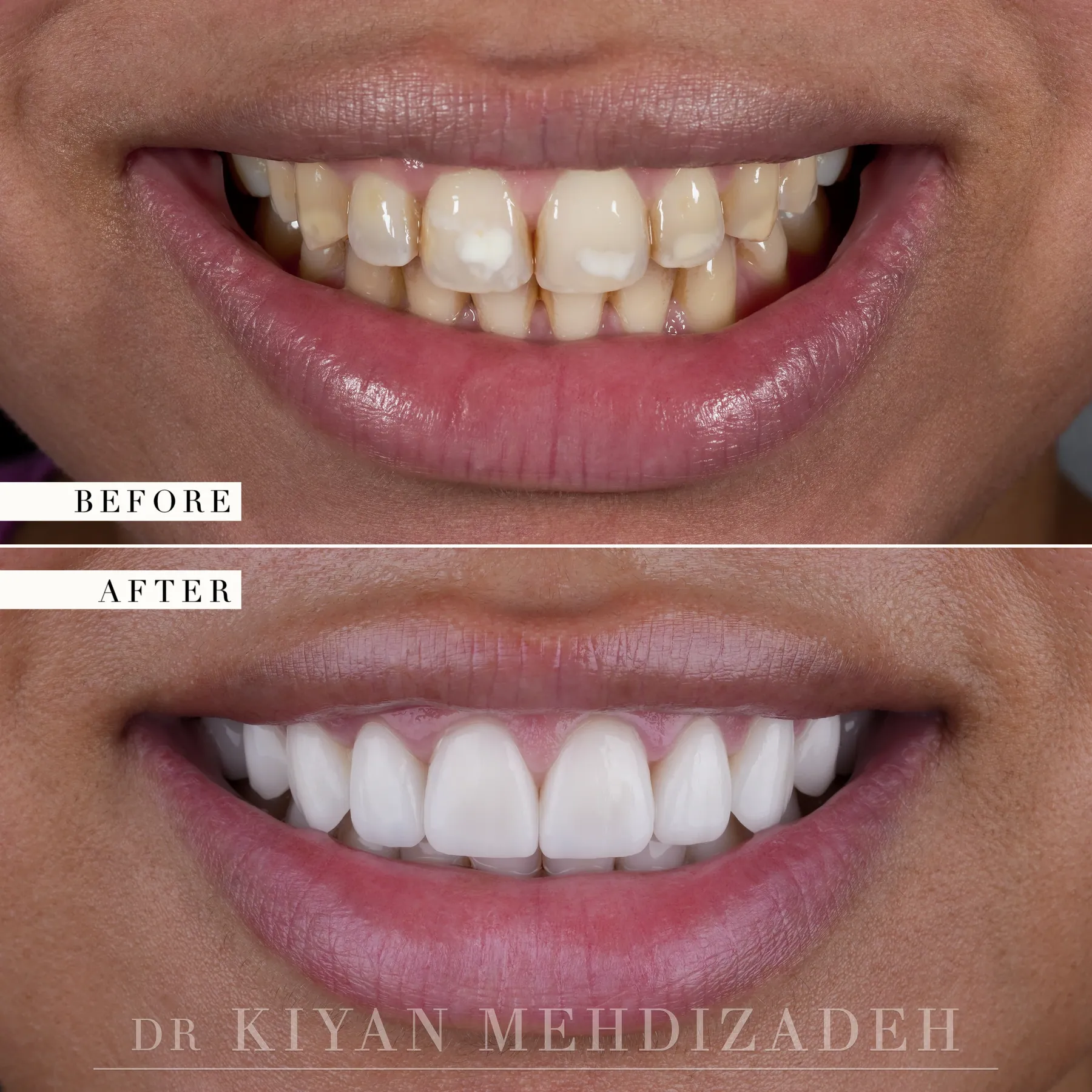
This patient arrived with two spots of discoloration in her teeth that no amount of bleaching would lift. They were congenital: they formed with the teeth rather than landing on them later. Her teeth were also yellow, and the brightness she wanted sat beyond what whitening can reach.
She asked for three things. She wanted the discoloration gone, the whole smile brighter than whitening could make it, and a shape closer to the one she had in mind. Dr. Mehdizadeh folded all three into one plan rather than treating them in sequence, because one material answers all three.
Why Whitening Could Not Reach It
A congenital spot is not a stain. Stain sits on the tooth or in the outer enamel, and bleaching breaks it down. A congenital spot formed as the tooth formed, because that patch of enamel carries less mineral than the enamel beside it. Hypomineralized enamel, in the clinical term, holds light differently from the enamel around it, and it goes on doing so for as long as the tooth is there. Bleaching acts on the patch and on the tooth around it unevenly, which is why whitening a tooth with a congenital patch in it often leaves the patch just as visible.
Whitening also has a ceiling. The peroxide in it breaks down the pigment inside the tooth, and once it has broken down all the pigment it can reach, the shade stops where the dentin under the enamel puts it. That ceiling sits well short of the brightness many patients have in mind, and further whitening does not move it. Porcelain has no ceiling, because the ceramist chooses the shade and then builds the tooth to it.
One Plan Instead of Three
Treating the three problems separately would have meant whitening first, then judging what the spots looked like against a brighter background, then taking on shape with whatever the first two stages had produced. Each stage would have constrained the next, and the spots would have outlasted all of them. Veneers settle color, discoloration and shape in one decision, which is why we wrote one plan.
That plan covers ten upper teeth and eight lower teeth. Veneering the upper teeth alone would have brightened them past the lower teeth and left a two-tone smile that shows whenever she speaks. Reaching back to the second premolars above and the first premolars below holds the shade consistent across everything a wide expression reveals.
Cover the discoloration rather than bleach around it. Take the brightness past the ceiling whitening reaches. Reset the gum line so the teeth can carry youthful proportions. Hold the shade consistent through everything a wide smile shows.
How We Approached Treatment
Dr. Mehdizadeh lifted the gum across the upper ten teeth before he prepared a single tooth. The gum line fixes how long a tooth looks, and length fixes proportion, so a veneer built to an unchanged gum line can only sit as well as that gum line allows. Moving the tissue first let him design the teeth to the proportions he wanted and then build them, instead of fitting them around the tissue that happened to be there.
We chose e.max for all eighteen units. E.max is a pressed lithium-disilicate ceramic, and this case needed two things from it at once: enough opacity to stop the discoloration showing through, and enough translucency to pass light the way enamel passes it. A veneer that masks a patch without keeping that second property turns the tooth opaque, and an opaque tooth looks like porcelain from across a room.
Shape carried the rest of the brief. Youthful proportion comes from relationships rather than size: the central incisors a little longer than the laterals, canines that still come to a point, and incisal edges that keep small irregularities instead of running flat across the arch. We designed to those relationships before the laboratory pressed anything, and we tried the design in before anyone cemented it.
The Result After Ten Weeks
The discoloration is gone, because the porcelain covers it instead of competing with it. The smile is brighter than whitening could have made it, and it holds that brightness across all eighteen restorations rather than stopping where the veneers stop. The gum line sits where the design needed it, and the incisal edges, the canines and the surface texture keep the variation natural teeth have.
Ten weeks covered the case from the first appointment to the last. The plan dealt with every problem she brought in, the discoloration, the color and the shape, and left nothing for a second round. Porcelain wears, the way everything in a mouth wears, so permanence is the one thing no plan can promise. Within that limit this plan did everything she asked of it.
Frequently Asked Questions About Veneers for Discoloration
Can veneers cover discoloration that whitening cannot remove?
Yes, and that is one of the clearest reasons to choose them. A congenital patch sits inside the enamel, where bleach cannot reach it. A veneer gives the tooth a new surface, and a ceramic with enough opacity stops the patch showing through while still passing light the way enamel does.
Why does whitening not remove a congenital white spot?
Because the spot is part of the tooth rather than something sitting on it. That patch of enamel carries less mineral than the enamel beside it, hypomineralized enamel in the clinical term, and it reflects light differently as a result. Peroxide breaks down pigment; it cannot remineralize enamel that formed that way.
How white can whitening make teeth?
Whitening breaks down the pigment inside the tooth until there is no more pigment to reach, and then it stops. Where it stops depends on the dentin under the enamel, not on how long the patient keeps going. Patients who want brightness past that point need porcelain, because the ceramist sets the shade rather than bleaching toward it.
What is a gum lift, and why do it before veneers?
A gum lift repositions the gum line. The gum line decides how long each tooth looks, and length decides proportion, so moving the tissue first lets the design set the proportions rather than inherit them. Dr. Mehdizadeh lifted the gum across the upper ten teeth here before he prepared any of them.
What is e.max?
A pressed lithium-disilicate ceramic. It comes in a range of opacities, which matters when a veneer has to mask something underneath it, and it transmits light closely enough to enamel that a masked tooth still looks alive rather than flat.
Why eighteen veneers rather than only the front teeth?
Because the back teeth would then stay the color the front teeth used to be. A bright upper smile over untreated lower teeth shows as two tones whenever someone speaks or laughs. Ten above and eight below carries the shade through everything a wide smile reveals.
Do eighteen veneers look fake?
They look fake when every tooth matches every other tooth in length, edge and surface. Natural teeth do not do that. The design here varies the edges, keeps the canines pointed and leaves surface texture in the porcelain, so the eye finds the same irregularity it expects.
How long does a case like this take?
This one took ten weeks from the first appointment to the last. The gum lift needs time to settle before preparation, and the design, the try-in and the laboratory work account for the rest.
What did this case cost?
This case was $38,000, covering eighteen e.max veneers and a gum lift, including the design and try-in stages. $454/month: 144 payments at 9.99% APR, on approved credit.
Does a plan like this leave anything out?
No. The plan addresses every problem the patient arrives with, which is how we write a plan. The one thing dentistry cannot deliver is permanence, because every restoration wears and will one day need renewing. Within that limit the plan does everything.
Last Updated: October 2026