Full Mouth Veneers: Bright, Textured, and Masculine
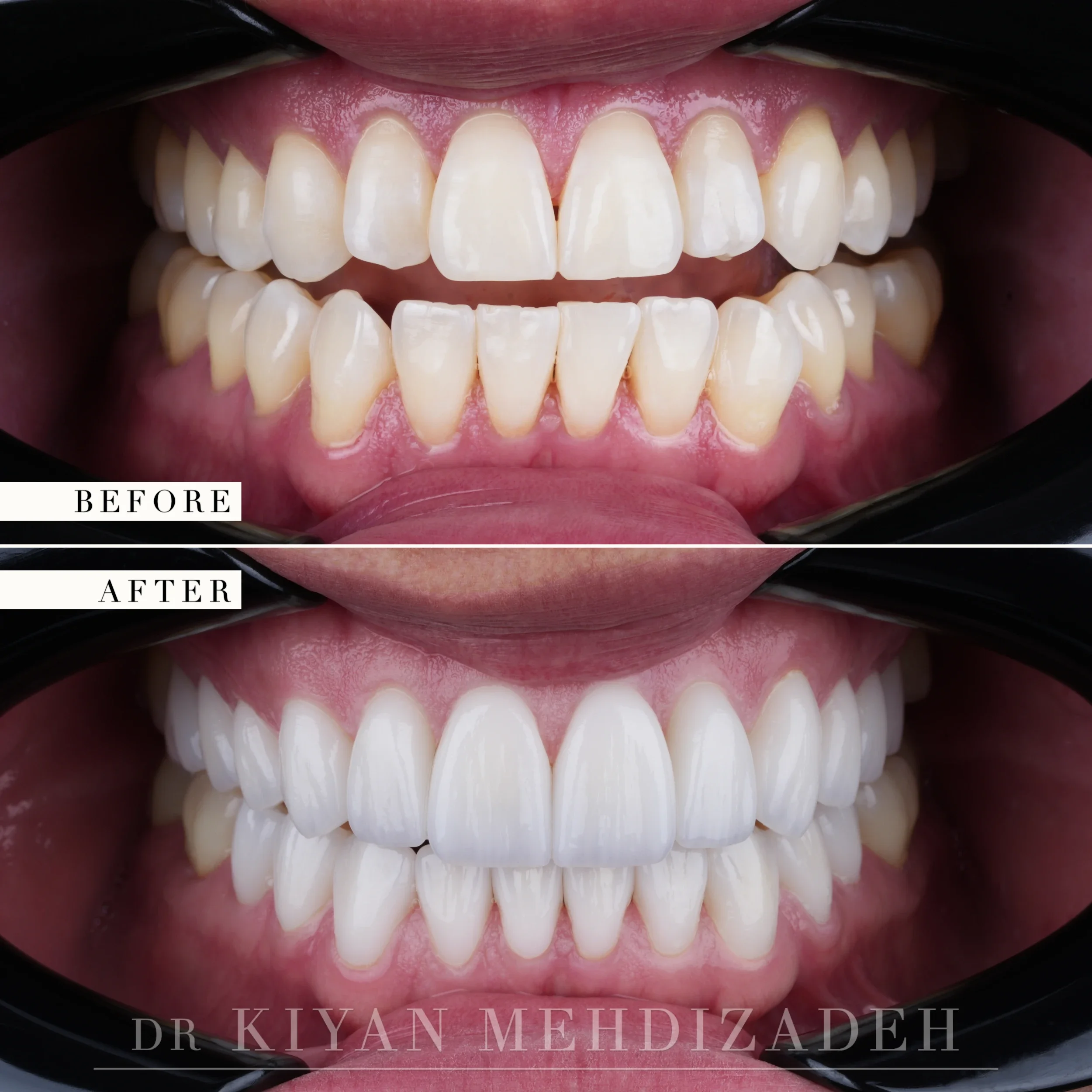
22 porcelain veneers to correct low tooth display, crowding, and wear
By Dr. Kiyan Mehdizadeh, DMD · 9460 Wilshire Blvd, Suite 850, Beverly Hills, CA 90212 · (310) 770-3335
Last Updated: August 2026
Want it bright without looking fake?
A bright smile that still reads as real is a texture and proportion problem, not a shade problem. Go too white and too smooth and it announces itself from across a room. Send us a photo and we will show you where the line is.
- A response within one business day. Usually much sooner.
- A real cost estimate, not a range designed to get you in the door.
- No obligation. Many patients take months to decide. That is normal.
Ask about your case
Reviewed by our treatment coordination team. Call or text (310) 770-3335 if you would rather speak now.
Request received
Our treatment coordination team will review what you sent and call you
within one business day.
If you would like to hold a consultation time now, you can do that below.
Treatment Plan by Dr. Kiyan Mehdizadeh
- Comprehensive bite analysis and occlusal correction
- 12 upper porcelain veneers with lengthened, proportional design
- 10 lower porcelain veneers to complete full mouth rehabilitation
- High-texture surface design to offset bright shade selection
- Masculine, angular tooth forms with controlled width-to-length ratios
Designing a Bright Smile That Still Looks Natural
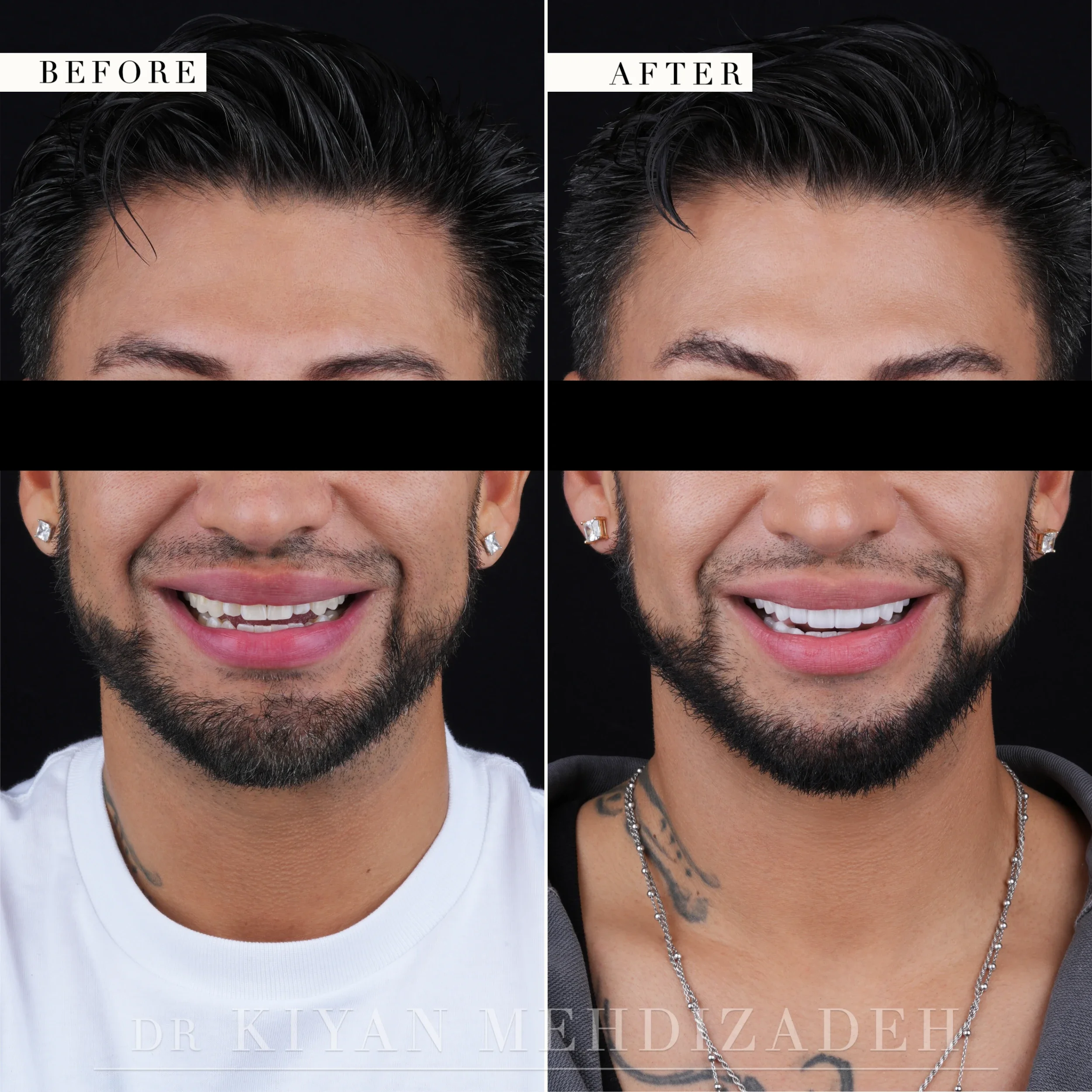
This young man wanted a dramatically brighter smile—something that would stand out without requiring the constant maintenance of whitening treatments. But brightness alone isn’t the goal. An extremely white smile without proper design looks artificial, oversized, and immediately reads as “dental work.” The challenge was achieving the shade he wanted while keeping the overall appearance masculine, proportional, and believable.
His existing teeth presented several compounding issues. Low tooth display meant his smile didn’t reveal enough enamel, making him appear older and less expressive. Crowding had pushed teeth out of alignment, creating irregular contours. Years of wear had shortened the biting edges, further reducing the visibility of his teeth when he smiled. These aren’t cosmetic complaints—they’re functional and structural concerns that affect both aesthetics and long-term dental health.
“Bright doesn’t have to mean obvious. Texture is the difference between a white smile and a white smile that looks real.”
The Texture Strategy
When patients request a very bright shade, the instinct at many practices is to simply fabricate white veneers and bond them. The result is teeth that look like Chiclets—flat, monochromatic, and immediately artificial. The key to making bright shades work is surface texture.
The Design Challenge
Deliver a dramatically bright smile that reads as natural and masculine—not as obviously cosmetic dental work. Correct crowding, wear, and low tooth display simultaneously while establishing a stable bite for long-term durability.
High texture was added to every restoration. Texture creates micro-variations in how light reflects off the tooth surface. Instead of a flat, uniform bounce of light that screams “veneer,” textured porcelain scatters light the way natural enamel does. This produces depth and dimension that makes even a very bright shade appear organic. The texture also makes the teeth appear more slender and less bulky—a critical detail when adding length and reshaping the entire smile.
Correcting Low Tooth Display
Low tooth display is one of the most common concerns men bring to a cosmetic consultation, even if they can’t articulate it by name. They describe it as “my teeth don’t show when I smile” or “I look like I’m hiding my teeth.” The fix involves lengthening the visible portion of the teeth while maintaining proportional width-to-length ratios. If teeth are simply made longer without adjusting width, the result looks narrow and disproportionate. If they are made wider to compensate, they look bulky.
Twelve upper and 10 lower porcelain veneers were designed to address every dimension simultaneously. The teeth were lengthened to improve display, but the width was carefully controlled so each tooth maintained a natural ratio relative to its neighbors. The central incisors set the standard, and the laterals, canines, and premolars follow in a proportional cascade.
Bite Correction for Longevity
Beautiful dental work that doesn’t account for the bite is beautiful dental work that fails. Crowding and wear don’t happen randomly—they’re the result of how teeth contact each other during function. If 22 veneers are placed without correcting the underlying occlusal issues, the result is built on a faulty foundation.
The bite was corrected as part of the veneer design, ensuring that forces are distributed evenly across all teeth during chewing, speaking, and resting. This isn’t just about aesthetics—it’s about making the investment last. Veneers placed into a corrected bite experience far less stress and have significantly longer lifespans than those placed without occlusal consideration.
- Teeth lengthened to increase smile display without appearing disproportionate
- High surface texture added to every restoration for natural light interaction
- Bright shade selected that avoids the flat, artificial look of untextured white porcelain
- Angular, masculine forms designed to complement facial structure
- Bite corrected to protect the restorations long-term
- Upper and lower arches treated together for full-mouth harmony
The Result
Six weeks from consultation to completion. His smile now reveals dramatically brighter, longer teeth with the texture and dimension of natural enamel. The crowding is resolved, the wear is corrected, and the bite is stable. Most importantly, the brightness he wanted doesn’t announce itself as dental work—it simply looks like he has great teeth.
This case demonstrates that achieving a very bright smile isn’t about choosing a white shade and hoping for the best. It requires deliberate design decisions around texture, proportion, and form that work together to keep the result looking natural. When patients say they want “white but natural,” texture is the answer.
“Texture is what separates a bright smile from a fake one.”
Frequently Asked Questions About Full Mouth Veneers
What is low tooth display and how is it fixed?
Low tooth display means the teeth don’t show enough when smiling, often making the smile appear aged or closed off. It’s corrected by lengthening the visible portion of the teeth with porcelain veneers while maintaining proper width-to-length proportions so the result looks natural rather than elongated.
Can veneers be made very bright without looking fake?
Yes, but it requires deliberate design. High surface texture is added to the porcelain to scatter light the way natural enamel does, creating depth and dimension even at very bright shades. Without texture, bright veneers appear flat and monochromatic—the classic “Chiclet” look. Texture is what makes a bright smile look real.
Why were both upper and lower teeth treated?
Treating only the upper arch creates a mismatch in color, size, and shape between upper and lower teeth that becomes immediately noticeable. Full mouth treatment with 22 veneers ensures both arches are harmonized in shade, proportion, and form for a cohesive result.
Why is bite correction included with veneers?
Crowding and wear are caused by how teeth contact each other during function. Placing veneers without correcting the bite means the same forces that caused the original damage will stress the new restorations. Bite correction distributes forces evenly, protecting the veneers and significantly extending their lifespan.
How long does full mouth veneer treatment take?
This case was completed in approximately 6 weeks from initial consultation to final placement. Most of that time is spent in the laboratory fabricating the custom porcelain restorations. Chair time involves several appointments for preparation, try-in, and final bonding.
How much do 22 porcelain veneers cost?
This case was $52,000, covering twenty-two porcelain veneers with bite correction. Porcelain veneers range from $1,800 to $3,500 per tooth depending on complexity. We accept PPO insurance and offer financing through Proceed Finance, PatientFi, Happen Bank, CareCredit, and Cherry.
Will bright veneers require whitening maintenance?
No. Porcelain does not stain or discolor the way natural enamel does. The shade selected at placement does not change for the life of the restorations. This was a primary goal for this patient—a bright smile without the ongoing commitment of whitening treatments.
What makes a veneer design look masculine?
Masculine veneer design features more angular, squared-off tooth forms with less rounded edges, slightly more surface texture, reduced translucency at the biting edges, and broader proportions. These subtle design choices create a smile that reads as strong and natural rather than delicate or cosmetically obvious.
How long do porcelain veneers last?
High-quality porcelain veneers typically last 15–20 years or longer with proper care. Longevity depends on material quality, precision of placement, bite stability, and patient maintenance including regular dental visits and avoiding habits that stress the restorations.
Does correcting crowding with veneers require orthodontics first?
Not always. Mild to moderate crowding can often be corrected with veneers alone by reshaping the tooth surfaces to create the appearance of alignment. Severe crowding may benefit from orthodontic treatment before veneer placement to establish proper tooth positions. The decision depends on the degree of crowding and the patient’s overall treatment goals.
Last Updated: August 2026

Dr. Kiyan Mehdizadeh, DMD
Doctor of Dental Medicine
Most cosmetic dentists refer out for surgery. Most surgeons don't do cosmetic work. Dr. Mehdizadeh trained in both — implantology and bone grafting at Loma Linda and UCLA, fixed prosthodontics under Mauro Fradeani in Italy, periodontal microsurgery with Hürzeler and Zuhr in Munich, and IV sedation at the University of Alabama. That combination means complex cases involving surgery, grafting, implants, and restorative work are planned and executed by a single provider with full command of every phase.
Technical skill produces function. Taste is what produces beauty. The difference between dental work that looks like dental work and a result that looks entirely natural comes down to aesthetic judgment — proportion, texture, translucency, how light moves across a surface. That sensibility runs through everything here, from the way cases are designed to the office itself.
An in-house master ceramist and on-site laboratory allow restorations to be designed, fabricated, and refined with direct collaboration between doctor and technician — no outsourced lab work, no guesswork, no compromise on the final product. Dr. Mehdizadeh is one of few dentists with the refined ability to provide care across multiple specialties, resulting in cohesive and holistic outcomes.
Education & Credentials
- Doctor of Dental Medicine (DMD), cum laude — Boston University
- Bachelor of Science in Biology — Emory University
- Mastership in Implant Dentistry & Grafting — Loma Linda University / gIDE Institute
- Advanced Implant Therapy & Grafting — UCLA / gIDE Institute
- Implant Placement & Restoration — UCLA / Nobel Biocare
- Guided Bone Regeneration & Ridge Augmentation — gIDE Institute
- Sinus Elevation & Augmentation — gIDE Institute
- Soft Tissue Management & Grafting — gIDE Institute
- Minimally Invasive Augmentation & Autogenous Bone Management — IDEA, San Francisco
- Master Program in Fixed Prosthodontics — Fradeani Education, Italy
- Aesthetic Dentistry — UCLA School of Dentistry
- Advanced Occlusion & Bite Design — UCLA
- Periodontal Micro-Surgery — Hürzeler/Zuhr, Munich
- Micro-Endodontic Training — University of Pennsylvania
- IV Sedation — University of Alabama at Birmingham
- Injectable Therapy for TMJ & Facial Pain — American Academy of Facial Esthetics
Considering similar treatment?
Send Dr. Mehdizadeh a photo and ask what’s possible for your case.
Other cases like this one
When One Gum Procedure Is Not Enough
Does your smile show more gum than you would like?
View case →Treating the Teeth Without Fighting the Bite
Is your underbite chipping your front teeth?
View case →Crossbite Correction with Porcelain Veneers and Dental Implants: No Braces Required
Is your bite doing this too?
View case →