Natural, Under the Radar
Age-appropriate veneers that enhance without announcing
By Dr. Kiyan Mehdizadeh, DMD · 9460 Wilshire Blvd, Suite 850, Beverly Hills, CA 90212 · (310) 770-3335
Last Updated: August 2026
Want it to look like nothing was done?
Most veneer work announces itself. If what you want is for people to notice you and not your teeth, that is a harder problem and a different kind of design. Send us a photo and we will tell you what it would take to get there.
- A response within one business day. Usually much sooner.
- A real cost estimate, not a range designed to get you in the door.
- No obligation. Many patients take months to decide. That is normal.
Ask about your case
Reviewed by our treatment coordination team. Call or text (310) 770-3335 if you would rather speak now.
Request received
Our treatment coordination team will review what you sent and call you
within one business day.
If you would like to hold a consultation time now, you can do that below.
Treatment Plan by Dr. Kiyan Mehdizadeh
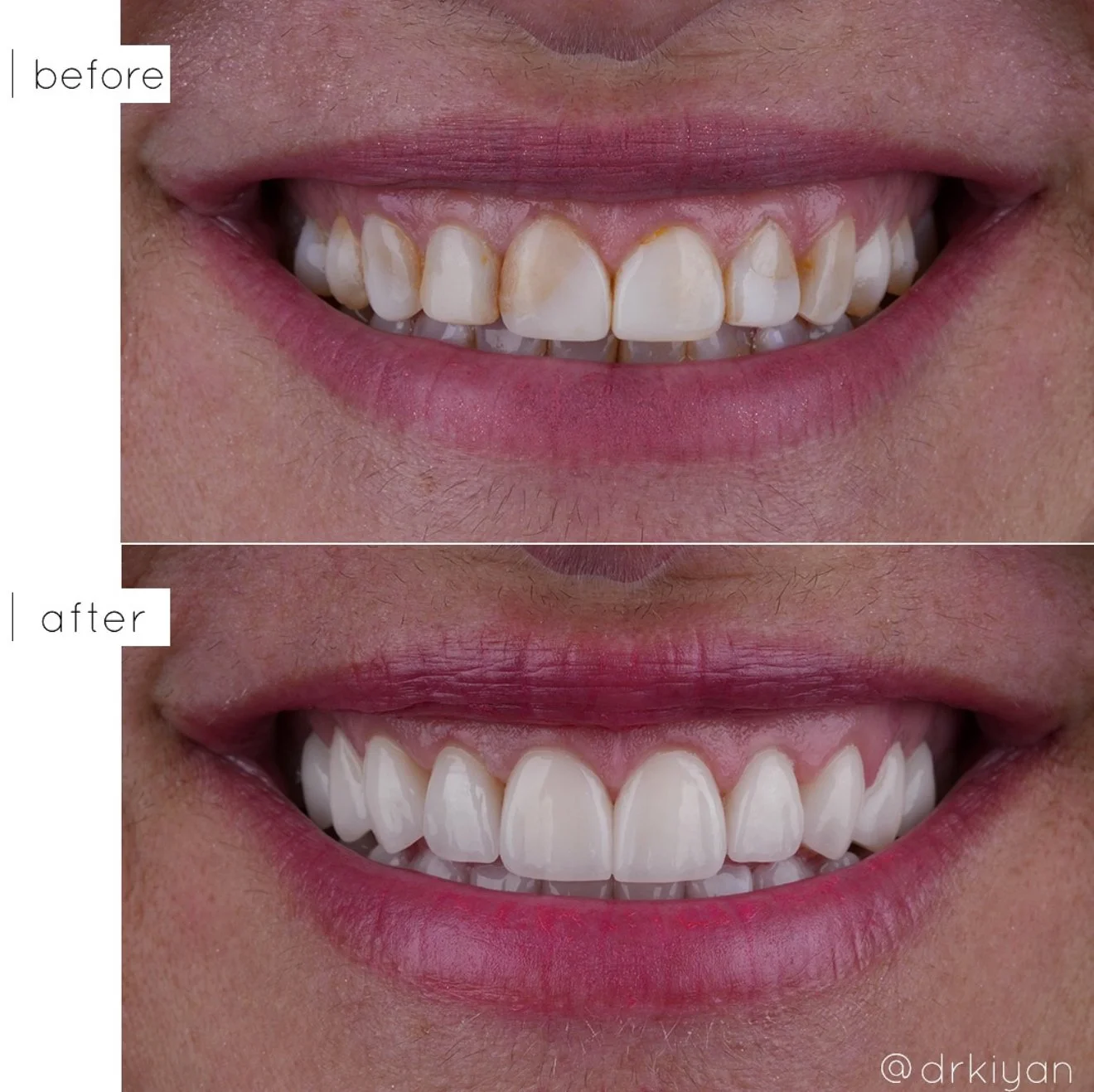
- Removal of existing discolored bonding
- Gum lift with bone recontouring to establish proper tooth proportions
- Upper porcelain veneers with natural surface texture
- Lower porcelain veneers for complete harmonization
- Surface characterization for proper light reflection
When Enhancement Should Whisper
She had tried the conservative approach first—dental bonding to address her smile concerns. It seemed like a reasonable choice at the time, attempting to preserve tooth structure while making improvements. But resin bonding has fundamental limitations that become apparent over time. The composite material absorbed stains from coffee, wine, and everyday foods. Edges began to chip and wear. The color shifted, becoming yellowed and dull while her natural teeth remained relatively stable. What began as a subtle enhancement had become a source of self-consciousness—her smile looked older than she did.
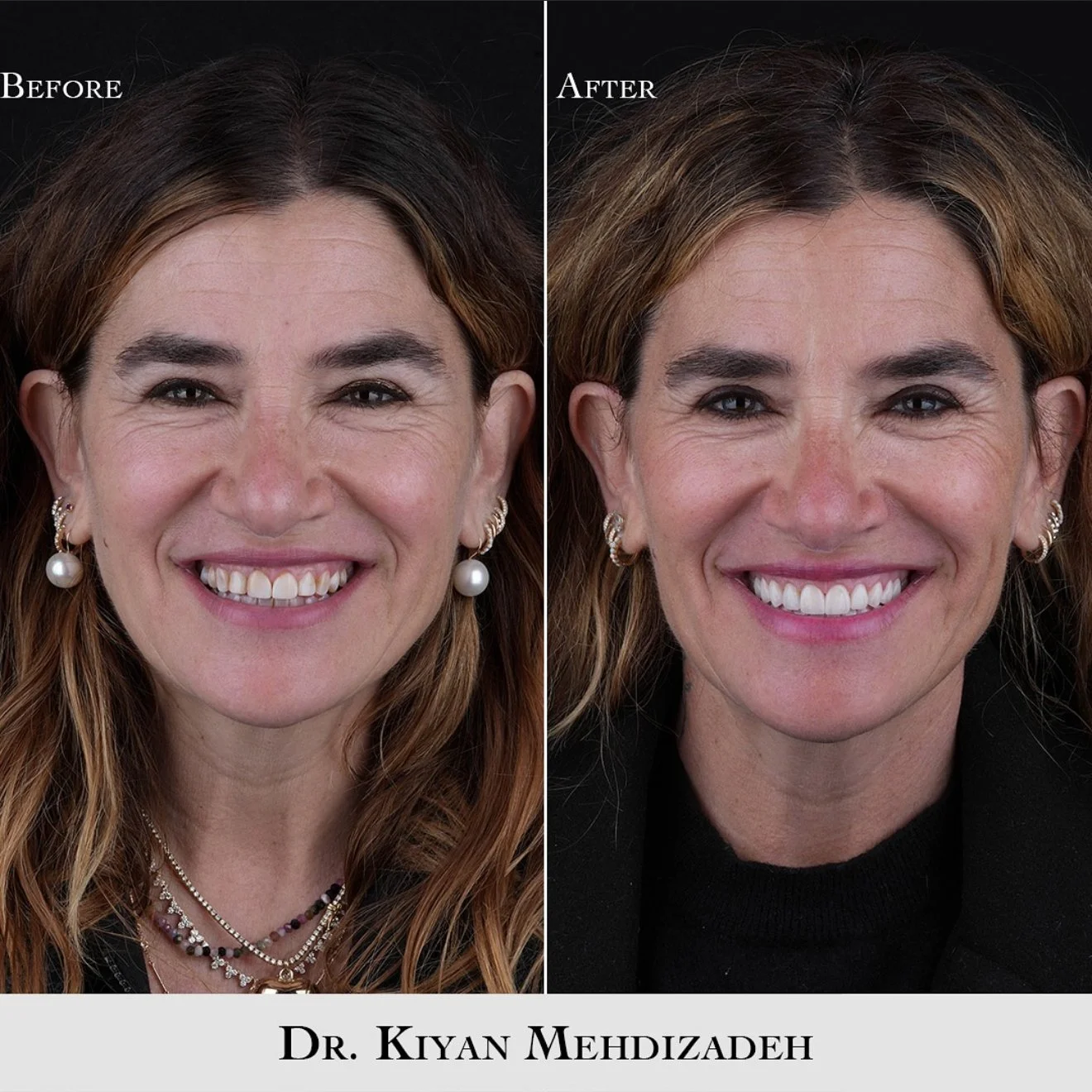
At 50, she knew exactly what she wanted: natural results that looked age-appropriate. Not the bright, uniform look that announces cosmetic work, but something that would blend seamlessly—enhancement that whispers rather than shouts.
"If someone compliments your teeth, we haven't done our job. The compliment should be that you look great."
Why Dental Bonding Fails Over Time
Dental bonding uses composite resin—the same material used for tooth-colored fillings. It's applied directly to teeth and shaped by hand, making it a quick, affordable option for minor cosmetic improvements. But the material itself has inherent weaknesses that become problematic over time.
Composite resin is porous. It absorbs pigments from coffee, tea, red wine, berries, and countless other foods and beverages. Unlike natural enamel, which can be polished and whitened, stained bonding cannot be restored to its original color. The only solution is replacement. The material also lacks the structural integrity of porcelain. It chips at the edges, wears down from normal biting forces, and develops micro-fractures that collect stains. Surface polish fades, leaving a dull, matte appearance that contrasts with the natural luster of surrounding teeth.
Perhaps most frustrating: bonding ages differently than natural teeth. Even when teeth and bonding start at the same shade, they diverge over years. The bonding yellows and dulls while teeth may stay relatively stable—or vice versa. Either way, the mismatch becomes increasingly obvious. Bonding typically lasts 3-7 years before needing replacement, compared to 15-20 years for porcelain veneers.
The Challenge of Achieving Natural-Looking Veneers
Achieving "natural" is paradoxically more difficult than achieving "dramatic." Anyone can make teeth whiter and more uniform. Creating teeth that look like beautiful natural teeth—complete with subtle color variations, surface texture, and age-appropriate characteristics—requires a deeper understanding of dental anatomy and light physics. It requires a fundamentally different design philosophy—one that starts with the patient's face, not a template.
Patient Goals
Natural, age-appropriate results. Under-the-radar enhancement. Replace discolored bonding that had aged her smile. No obvious "work done" appearance. Porcelain chosen for long-term color stability and light transmission properties.
How Dr. Mehdizadeh Built the Foundation
Before placing any restorations, the underlying architecture had to be addressed first. A gum lift with bone recontouring established the proper framework—the canvas upon which he would create her new smile. This step is often overlooked by general dentists, but it's essential for achieving truly natural proportions.
The bone recontouring exposed more natural tooth structure and create the ideal gum-to-tooth relationships. Without this foundation work, even the most beautifully crafted veneers would appear off—the proportions would be wrong, and the gum line would undermine the result.
The Art of Surface Texture and Light
One detail that separates natural-looking veneers from artificial ones is surface texture. Natural teeth aren't perfectly smooth—they have subtle ridges, depressions, and surface characteristics that affect how light interacts with them. Deliberate texture was added to the porcelain surfaces to achieve proper light reflection and glare patterns. This is the kind of detail most people never consciously notice, but subconsciously register as "real" versus "fake."
- Surface texture matched to natural tooth anatomy
- Light reflection calibrated for authentic appearance
- Color graduation from gum line to incisal edge
- Subtle translucency variations mimicking natural enamel
- Age-appropriate characterization avoiding overly uniform appearance
The Result: Enhancement That Whispers
Upper and lower veneers, fully integrated with her natural appearance. The discolored bonding is gone, replaced by porcelain that will maintain its appearance for 15-20 years. But more importantly, she achieved exactly what she wanted: a beautiful smile that looks entirely natural.
When friends noticed something different, they couldn't quite identify what it was. "You look great—did you do something different?" That's the response that defines success in this kind of work. Not "your teeth look amazing" but simply "you look great." The best cosmetic dentistry serves the person, not the other way around.
"Natural-looking results are harder to achieve than dramatic ones. Restraint is a skill."
Frequently Asked Questions About Natural Veneers
Why did bonding discolor while porcelain won't?
Composite bonding is made from porous resin that absorbs stains from coffee, tea, wine, and everyday foods. It also chips, wears down, and loses its surface polish over time. Porcelain is glass-ceramic—completely non-porous and highly resistant to staining. It maintains its color, luster, and structural integrity for 15-20 years or longer, making it the superior long-term choice despite higher initial cost.
What is bone recontouring and why was it necessary?
Bone recontouring reshapes the alveolar bone underlying the gum tissue to establish proper tooth proportions and gum architecture. In this case, it was performed to reveal more natural tooth structure and create the ideal foundation for veneer placement. Without addressing the bone, the gum tissue would not stay in its corrected position long-term.
How much do natural-looking porcelain veneers cost in Beverly Hills?
This case was $42,000, covering a gum lift with bone recontouring and twenty porcelain veneers, ten upper and ten lower. Porcelain veneers in Beverly Hills range from $1,800 to $3,500 per tooth. A consultation provides a personalized treatment plan and accurate quote based on your specific needs.
How long does the veneer process take from start to finish?
A comprehensive veneer case with gum lift and bone recontouring typically takes 6-10 weeks. The gum and bone surgery requires 4-6 weeks of healing before veneer preparation can begin. Veneer fabrication takes an additional 2-3 weeks. Provisional restorations are worn during the fabrication period so patients are never without teeth.
How do you achieve natural-looking results with veneers?
Natural appearance comes from attention to details most people never consciously notice: surface texture that matches natural tooth anatomy, color gradation from the gum line to the incisal edge, translucency variations that mimic natural enamel, and proportions matched to the patient's age and facial characteristics. These details are what separate veneers that look real from veneers that look like veneers.
Can veneers look age-appropriate for patients over 40?
Age-appropriate design is essential for natural results. The key is adjusting shade, translucency, surface texture, and proportions to complement the patient's overall appearance rather than creating teeth that look out of place. The goal is enhancement that blends seamlessly—not teeth that look 20 years younger than the rest of your face.
How long do porcelain veneers last compared to bonding?
High-quality porcelain veneers typically last 15-20 years or longer with proper care. Dental bonding typically lasts 3-7 years before staining, chipping, or discoloration requires replacement. Over a 20-year period, bonding may need 3-5 replacements while veneers may need none, making porcelain more cost-effective long-term despite higher initial investment.
Is bonding or porcelain a better alternative for my situation?
Bonding is appropriate for minor, temporary cosmetic fixes on a budget. Porcelain veneers are the better choice when you want lasting results, stain resistance, and natural aesthetics. Each case should be evaluated individually—if bonding can achieve your goals, it's the more conservative option. But for comprehensive smile transformations, porcelain consistently delivers superior long-term outcomes.
Who is the best cosmetic dentist for natural veneers in Beverly Hills?
Look for a dentist with advanced prosthodontic training and a portfolio showing subtle, natural-looking results—not just bright, uniform Hollywood smiles. The ability to create age-appropriate, natural veneers requires a different skill set than dramatic cosmetic work. Ask to see cases similar to your age and goals.
Do I need a gum lift with my veneers?
Not always. A gum lift is recommended when the gum line is uneven, too low, or creates disproportionate tooth-to-gum ratios. The gum architecture should be evaluated during consultation—a gum lift is only recommended when it will meaningfully improve the final result. Some patients achieve excellent outcomes with veneers alone.
Last Updated: August 2026

Dr. Kiyan Mehdizadeh, DMD
Doctor of Dental Medicine
Most cosmetic dentists refer out for surgery. Most surgeons don't do cosmetic work. Dr. Mehdizadeh trained in both — implantology and bone grafting at Loma Linda and UCLA, fixed prosthodontics under Mauro Fradeani in Italy, periodontal microsurgery with Hürzeler and Zuhr in Munich, and IV sedation at the University of Alabama. That combination means complex cases involving surgery, grafting, implants, and restorative work are planned and executed by a single provider with full command of every phase.
Technical skill produces function. Taste is what produces beauty. The difference between dental work that looks like dental work and a result that looks entirely natural comes down to aesthetic judgment — proportion, texture, translucency, how light moves across a surface. That sensibility runs through everything here, from the way cases are designed to the office itself.
An in-house master ceramist and on-site laboratory allow restorations to be designed, fabricated, and refined with direct collaboration between doctor and technician — no outsourced lab work, no guesswork, no compromise on the final product. Dr. Mehdizadeh is one of few dentists with the refined ability to provide care across multiple specialties, resulting in cohesive and holistic outcomes.
Education & Credentials
- Doctor of Dental Medicine (DMD), cum laude — Boston University
- Bachelor of Science in Biology — Emory University
- Mastership in Implant Dentistry & Grafting — Loma Linda University / gIDE Institute
- Advanced Implant Therapy & Grafting — UCLA / gIDE Institute
- Implant Placement & Restoration — UCLA / Nobel Biocare
- Guided Bone Regeneration & Ridge Augmentation — gIDE Institute
- Sinus Elevation & Augmentation — gIDE Institute
- Soft Tissue Management & Grafting — gIDE Institute
- Minimally Invasive Augmentation & Autogenous Bone Management — IDEA, San Francisco
- Master Program in Fixed Prosthodontics — Fradeani Education, Italy
- Aesthetic Dentistry — UCLA School of Dentistry
- Advanced Occlusion & Bite Design — UCLA
- Periodontal Micro-Surgery — Hürzeler/Zuhr, Munich
- Micro-Endodontic Training — University of Pennsylvania
- IV Sedation — University of Alabama at Birmingham
- Injectable Therapy for TMJ & Facial Pain — American Academy of Facial Esthetics
Considering similar treatment?
Send Dr. Mehdizadeh a photo and ask what’s possible for your case.
Other cases like this one
When Straight Teeth Still Aren't Right: Veneers After Braces
Finished braces and still not happy?
View case →Replacing Old Bonding With Veneers - and Rebuilding the Back Teeth
Tired of re-fixing the same chipped tooth?
View case →Closing a Gap and Evening the Color With Veneers
A gap and uneven color you're ready to change?
View case →