An End to Patching Teeth One at a Time
Periodontal disease was taking her dentition tooth by tooth. The decision that shaped this case was when to stop treating teeth and start preserving the bone that would hold their replacements.
By Dr. Kiyan Mehdizadeh, DMD · 9460 Wilshire Blvd, Suite 850, Beverly Hills, CA 90212 · (310) 770-3335
Last Updated: September 2026
Is gum disease taking your teeth one at a time?
Periodontal disease destroys the bone that holds teeth, so the teeth go one after another and each repair buys less time than the last. The question worth answering early is how much bone is left, because that decides whether implants can be placed without grafting. Send us a photo of your smile and we will tell you what the options are and what they cost.
- A response within one business day. Usually much sooner.
- A real cost estimate, not a range designed to get you in the door.
- No obligation. Many patients take months to decide. That is normal.
Ask about your case
Reviewed by our treatment coordination team. Call or text (310) 770-3335 if you would rather speak now.
Request received
Our treatment coordination team will review what you sent and call you
within one business day.
If you would like to hold a consultation time now, you can do that below.
Treatment Plan by Dr. Kiyan Mehdizadeh
- Periodontal assessment and imaging of the bone volume remaining in each arch.
- Extraction of the failing dentition, upper and lower.
- Eight implants placed, four in each arch, the posterior pair in every arch angled to engage available bone.
- Healing and osseointegration.
- Fixed zirconia bridges, upper and lower.
The Patient's Journey
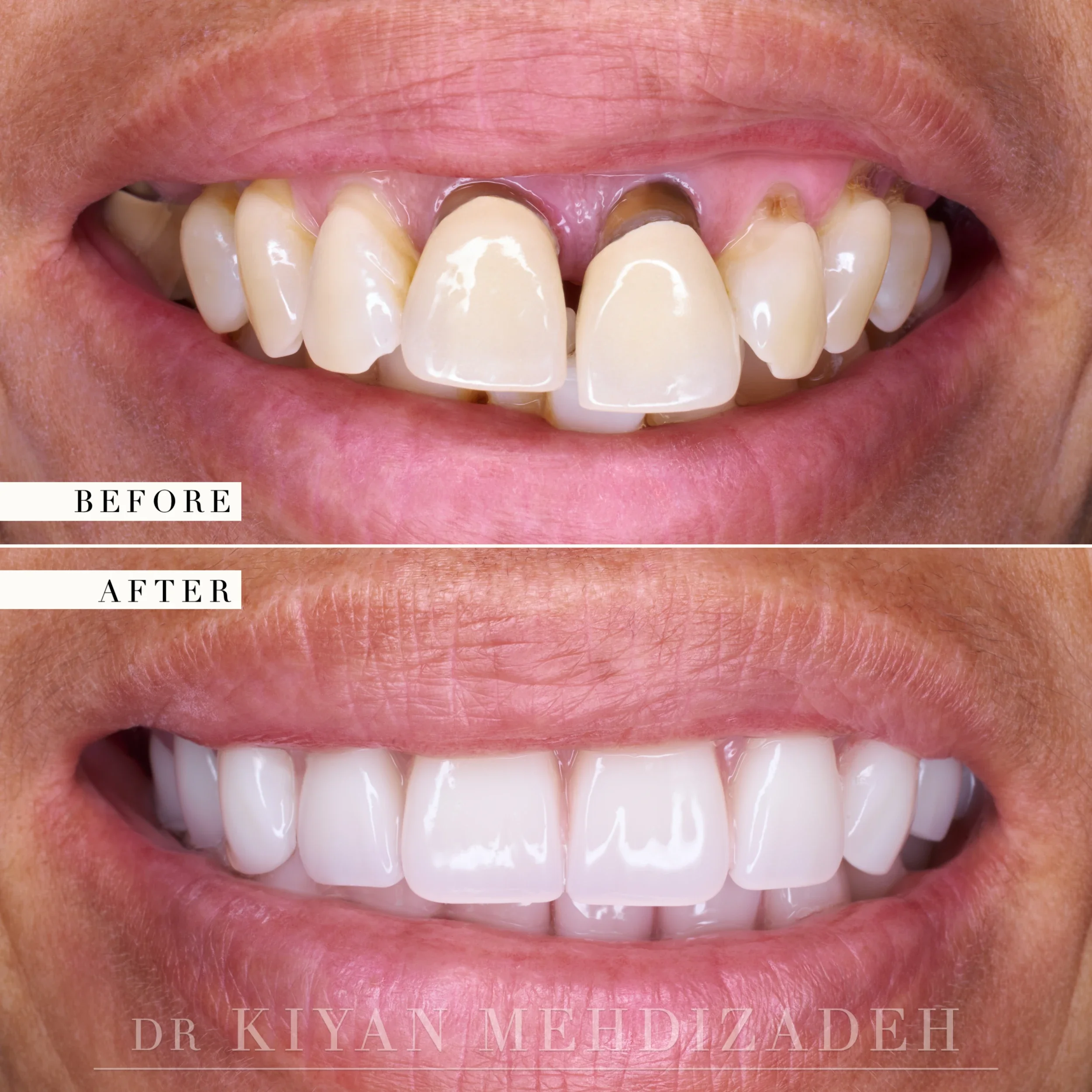
This patient arrived with periodontal disease that was still advancing. She had been treated for it before, and she had had crowns placed on teeth the disease had already compromised. Her dentition was failing anyway. What she said she was tired of was patchwork dentistry that had never made her look better, and what she wanted was a solution with some finality to it, where she could smile and eat without thinking about either.
Periodontitis does not destroy teeth. It destroys the alveolar bone and the periodontal attachment that hold them, and the teeth are lost as a consequence of that. The distinction explains why the previous work had not helped her. A crown restores the portion of a tooth visible above the gingival margin, and it does nothing whatever about the support disappearing beneath it. Restoring the visible part of a tooth whose attachment is being consumed treats the appearance and leaves the disease undisturbed.
Understanding the Challenge
The decision in this case concerned timing rather than technique. Dental implants require alveolar bone to integrate with, and periodontal resorption is progressive. Every month spent retaining teeth that will be lost regardless is a month spent consuming the bone their replacements will need, which converts a straightforward reconstruction into a grafting case.
That produces a conclusion patients rarely expect. The appropriate moment to remove a periodontally failing dentition is generally earlier than the teeth themselves force the issue, because the ridge is still intact enough to receive implants. Waiting until the teeth are genuinely hopeless usually means augmenting the bone before implants can be placed at all, which adds months and considerable expense to the treatment and still does not reproduce the original ridge volume.
Her remaining bone was assessed in both arches before anything was extracted. Each arch retained sufficient volume to receive four implants without augmentation, and that finding is what made the sequence below possible on the timescale it ran.
Remove the failing dentition while the bone still supports implants. Place four implants in each arch without grafting. Restore a fixed bite, upper and lower. Nothing removable. Complete treatment within seven months.
How Dr. Mehdizadeh Approached Treatment
The failing dentition was extracted from both arches and four implants placed in each. The two posterior implants in every arch were angled rather than positioned vertically. Angulation allows a posterior implant to engage a longer span of denser bone, and it keeps the implant clear of the maxillary sinus above and the inferior alveolar nerve below. It is also what permits four implants to carry a full arch where six vertical implants would otherwise be required.
Four implants per arch is not a reduction from eight. Distribution governs the outcome more than quantity does, because a fixed prosthesis transfers occlusal load along its length to the implants supporting each end. Four implants distributed correctly in sound bone carry a full arch reliably. The number is determined by the bone available at assessment rather than by preference, and in this patient the assessment supported four.
Both arches were restored in monolithic zirconia. Monolithic means milled from a single block, so there is no layered porcelain that can separate from a framework beneath it. Zirconia does not stain and does not abrade against an opposing arch the way acrylic teeth on a metal substructure eventually do. On a reconstruction intended to be the last one this patient undergoes, that durability is the reason for choosing it.
The Result After Seven Months
She has a fixed prosthesis in each arch, carried on four implants apiece, and nothing that comes out. The occlusion was rebuilt across both arches simultaneously, which is the only way to establish a bite when every tooth in the mouth is being replaced at once.
Maintenance differs from maintaining natural teeth, and it is not lighter. The tissue surrounding the implants is cleaned professionally on a set recall with instruments intended for implant surfaces, the retaining screws and connections are assessed annually, and home care runs through a water flosser and interdental brushes rather than conventional floss. Implants do not decay, but the tissue around them can still become inflamed, and detecting that early is what the recall interval exists for.
Frequently Asked Questions About Full-Arch Implants and Gum Disease
Why remove teeth that are still in the mouth?
Because periodontal bone loss is progressive and implants need bone. Teeth held on to past the point of usefulness continue to consume the support their replacements will require. Removing them while the ridge still carries implants avoids grafting and shortens treatment.
Why did crowns and periodontal treatment not solve this?
A crown restores the part of a tooth that shows. Periodontitis destroys the attachment and bone beneath it. Restoring the visible part of a tooth whose support is disappearing treats the symptom and leaves the disease in place.
What is an All-on-4 bridge?
A full arch of fixed teeth carried on four implants. The two posterior implants are angled to engage a longer span of bone and to stay clear of the maxillary sinus and the inferior alveolar nerve. The bridge is screwed to the implants and is not removed by the patient.
Why four implants and not six or eight?
Because distribution matters more than count. A fixed bridge transfers load along its length to the implants at each end, and four well-placed implants in sound bone carry a full arch reliably. The number is decided from the bone available at assessment rather than from a preference.
Why zirconia rather than an acrylic hybrid?
Zirconia is milled from a single block, so there is no porcelain layer that can chip away from a framework. It does not stain and does not wear against itself the way acrylic teeth on a metal frame do. Hybrids are lighter and easier to repair, and they generally need refurbishment sooner.
Were both arches treated at the same time?
Yes. When every tooth in the mouth is being replaced there is no existing bite to work against, so the occlusion has to be established across both arches together. Treating one arch and then the other would mean setting the bite twice.
How long does treatment like this take?
This case ran seven months from assessment to the final bridges. Most of that period is osseointegration, which cannot be compressed. Cases that need bone grafting before implants can be placed run considerably longer.
How are implant bridges cleaned?
Professional cleaning on a set recall using instruments made for implant surfaces, an annual check of the screws and connections, and home care with a water flosser and interdental brushes. Implants do not decay, but the tissue around them can become inflamed, and that is what the recall is for.
How long do full-arch implant bridges last?
The implants are intended to remain in service indefinitely once integrated. A zirconia bridge is a wearing component and is expected to need replacement eventually, with the interval determined by the bite and by maintenance.
How much does full-arch implant treatment cost?
This case was $44,000, covering the extractions, eight implants and fixed zirconia bridges in both arches. Full-arch treatment ranges from $29,000 to $50,000 per arch depending on the materials chosen, whether extractions or grafting are required, and the complexity of the case. Financing options are available and a detailed breakdown is provided at the consultation.
Last Updated: September 2026

Dr. Kiyan Mehdizadeh, DMD
Doctor of Dental Medicine
Most cosmetic dentists refer out for surgery. Most surgeons don't do cosmetic work. Dr. Mehdizadeh trained in both — implantology and bone grafting at Loma Linda and UCLA, fixed prosthodontics under Mauro Fradeani in Italy, periodontal microsurgery with Hürzeler and Zuhr in Munich, and IV sedation at the University of Alabama. That combination means complex cases involving surgery, grafting, implants, and restorative work are planned and executed by a single provider with full command of every phase.
Technical skill produces function. Taste is what produces beauty. The difference between dental work that looks like dental work and a result that looks entirely natural comes down to aesthetic judgment — proportion, texture, translucency, how light moves across a surface. That sensibility runs through everything here, from the way cases are designed to the office itself.
An in-house master ceramist and on-site laboratory allow restorations to be designed, fabricated, and refined with direct collaboration between doctor and technician — no outsourced lab work, no guesswork, no compromise on the final product. Dr. Mehdizadeh is one of few dentists with the refined ability to provide care across multiple specialties, resulting in cohesive and holistic outcomes.
Education & Credentials
- Doctor of Dental Medicine (DMD), cum laude — Boston University
- Bachelor of Science in Biology — Emory University
- Mastership in Implant Dentistry & Grafting — Loma Linda University / gIDE Institute
- Advanced Implant Therapy & Grafting — UCLA / gIDE Institute
- Implant Placement & Restoration — UCLA / Nobel Biocare
- Guided Bone Regeneration & Ridge Augmentation — gIDE Institute
- Sinus Elevation & Augmentation — gIDE Institute
- Soft Tissue Management & Grafting — gIDE Institute
- Minimally Invasive Augmentation & Autogenous Bone Management — IDEA, San Francisco
- Master Program in Fixed Prosthodontics — Fradeani Education, Italy
- Aesthetic Dentistry — UCLA School of Dentistry
- Advanced Occlusion & Bite Design — UCLA
- Periodontal Micro-Surgery — Hürzeler/Zuhr, Munich
- Micro-Endodontic Training — University of Pennsylvania
- IV Sedation — University of Alabama at Birmingham
- Injectable Therapy for TMJ & Facial Pain — American Academy of Facial Esthetics
Considering similar treatment?
Send Dr. Mehdizadeh a photo and ask what’s possible for your case.
Other cases like this one
All-on-4 Implant-Supported Bridges
Full-arch reconstruction in both jaws after extractions and a healing phase
View case →All-on-4 Dental Implants: A Fresh Start After Gum Disease
Full arch restoration with an implant-supported fixed prosthesis after periodontal disease
View case →Pink Porcelain Bridge & Veneers
Rebuilding a lost gum line in ceramic where bone could not be restored
View case →