Restoring Solid Teeth on Dental Implants
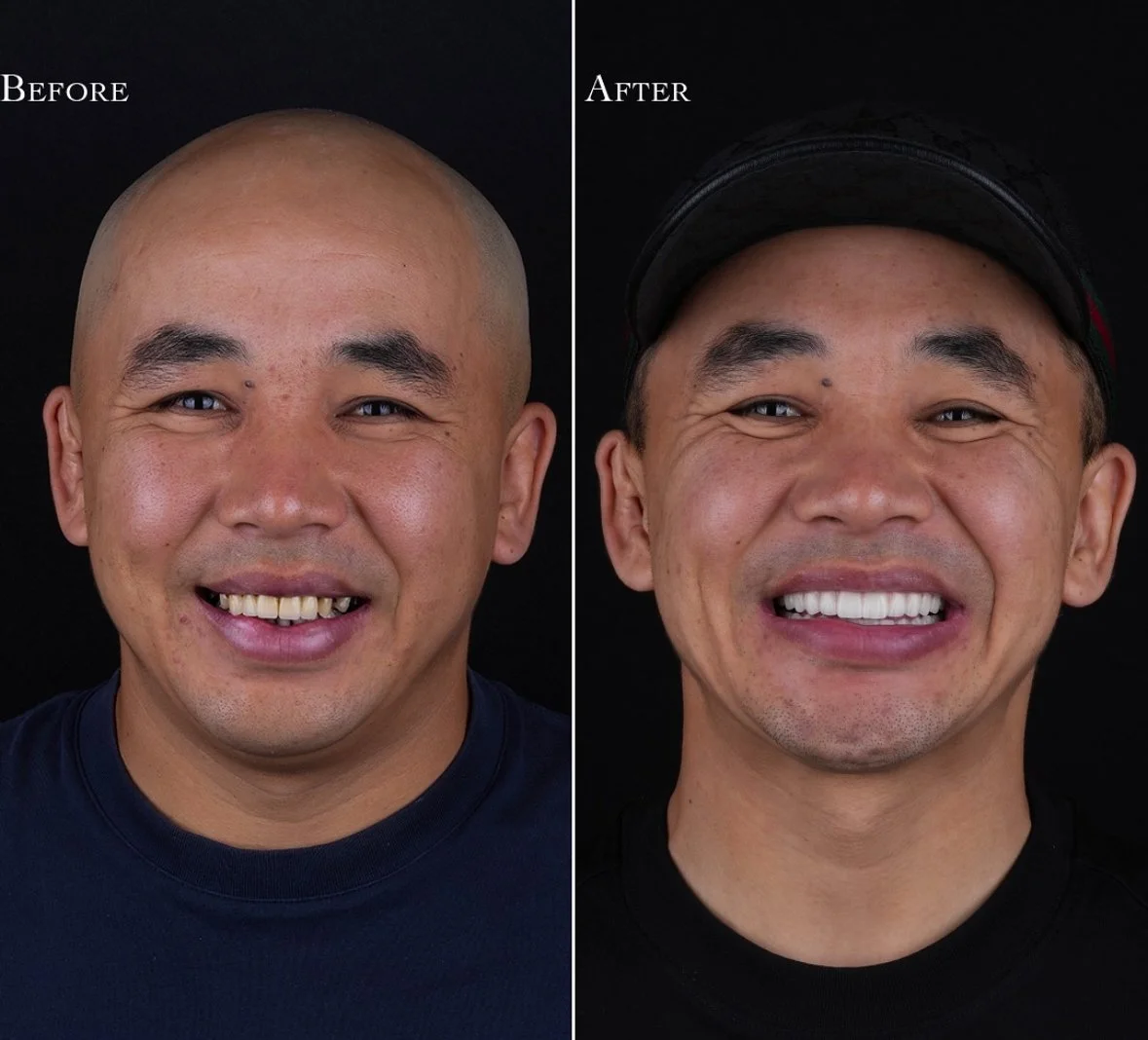
Complete dental rehabilitation from infected teeth to natural-looking smile
By Dr. Kiyan Mehdizadeh, DMD · 9460 Wilshire Blvd, Suite 850, Beverly Hills, CA 90212 · (310) 770-3335

Last Updated: August 2026
Facing the loss of most of your teeth?
When both arches are failing, patching them one crown at a time is expensive and it does not hold. There is a point where rebuilding is the cheaper and more honest answer. Send us a photo and we will tell you where you actually are.
- A response within one business day. Usually much sooner.
- A real cost estimate, not a range designed to get you in the door.
- No obligation. Many patients take months to decide. That is normal.
Ask about your case
Reviewed by our treatment coordination team. Call or text (310) 770-3335 if you would rather speak now.
Request received
Our treatment coordination team will review what you sent and call you
within one business day.
If you would like to hold a consultation time now, you can do that below.
Treatment Plan by Dr. Kiyan Mehdizadeh
- Extraction of infected teeth causing progressive bone loss and systemic health concerns
- Healing period to establish optimal bone and soft tissue foundation for implant placement
- Strategic placement of 4 implants per arch using angled posterior positioning to maximize bone contact
- Custom bite and smile design mapped to facial proportions, lip dynamics, and aesthetic goals
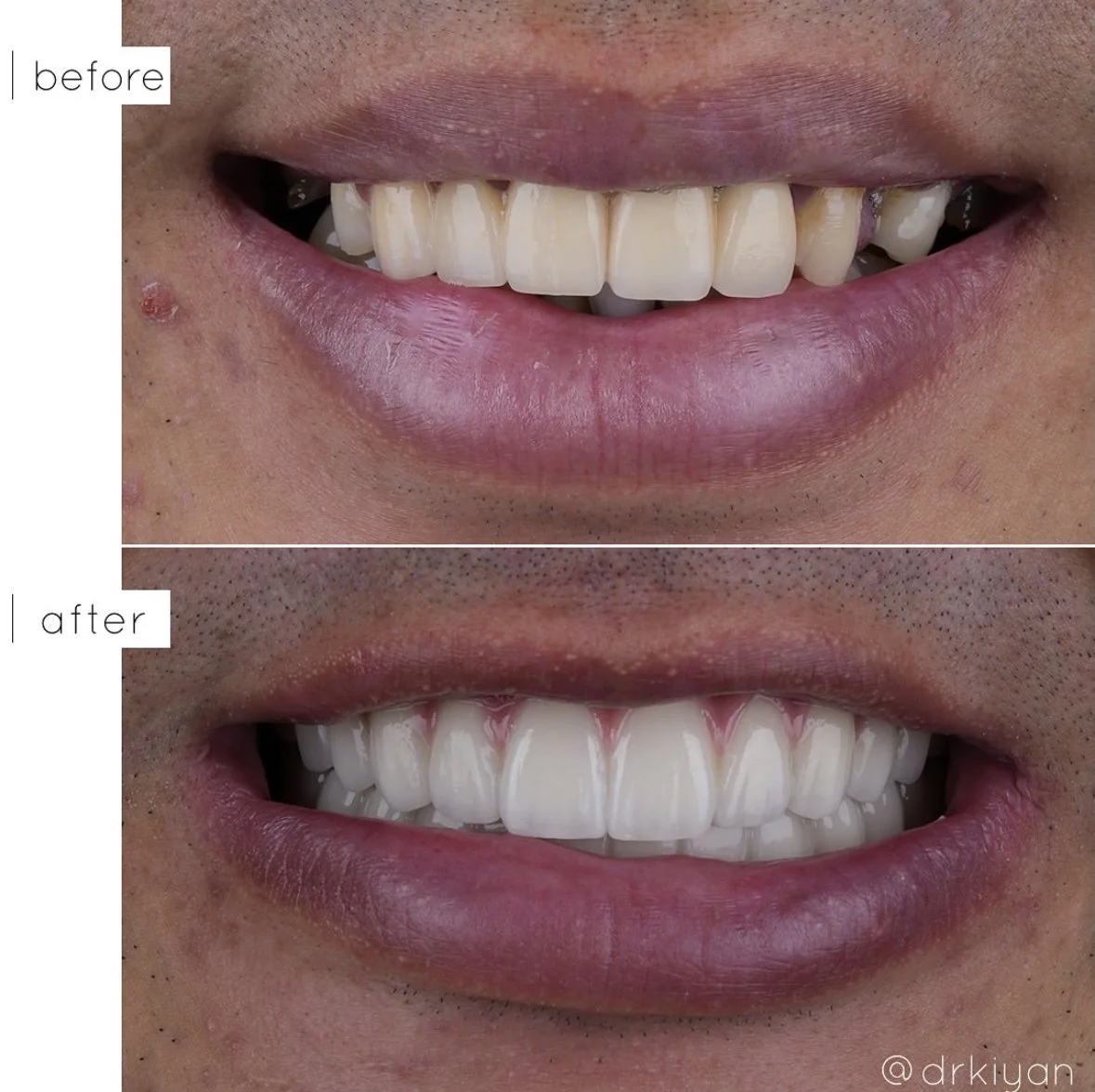
- Upper and lower implant-supported bridge fabrication with natural translucency and custom gum tissue
- In-house laboratory collaboration for real-time adjustments during prosthetic fabrication
What Is All-on-4 Full Mouth Reconstruction and Who Needs It?
All-on-4 implant-supported bridges represent one of the most significant advances in full mouth reconstruction for patients who have lost most or all of their teeth. This patient presented with multiple infected teeth causing progressive bone loss that affected both his oral and systemic health. Years of deterioration had left him overwhelmed and uncertain about where to begin. A comprehensive treatment plan was developed to address the immediate dental problems and restore full function and aesthetics within a single coordinated treatment.
The All-on-4 technique uses four strategically placed dental implants per arch to support a complete bridge of teeth. Rather than requiring one implant per missing tooth—which would mean 12–14 implants per arch—the protocol positions four implants at calculated angles that maximize contact with available bone. The two posterior implants are tilted at approximately 30–45 degrees to engage longer spans of bone and avoid anatomical structures such as the maxillary sinus in the upper jaw and the inferior alveolar nerve in the lower jaw. This angled placement often eliminates the need for separate bone grafting procedures, reducing both treatment time and surgical complexity.
“It is important in a case like his to work with a team who has experience handling all aspects of the case—surgery, prosthetics, and laboratory work—under one roof.”
Why Were the Infected Teeth Extracted First?
The first critical step involved removing all infected teeth that were actively destroying jawbone. Chronic dental infections do not remain localized; the bacteria progressively dissolve surrounding bone, and the longer compromised teeth remain in place, the less bone is available for future implant placement. The infections had already caused significant bone loss in multiple areas. The compromised teeth were extracted and adequate healing time allowed for the bone and soft tissue to stabilize before proceeding with implant surgery.
The All-on-4 Advantage Over Traditional Implant Approaches
Traditional full-arch implant reconstruction may require 6–8 implants per arch, multiple bone grafting surgeries, and 9–12 months of treatment. The All-on-4 protocol achieves comparable results with 4 implants per arch, frequently eliminates the need for grafting by utilizing angled posterior implants, and can be completed in 12–20 weeks.
How Was the Smile Designed to Match His Face?
Once healed, a custom bite and smile were designed specifically tailored to this patient’s facial features. Full mouth reconstruction is not a one-size-fits-all procedure. Every patient has unique facial proportions, lip dynamics, midline position, and aesthetic preferences that determine what the final teeth should look like. The patient’s face was analyzed from multiple angles, studying how his lips moved during speech and smiling, and teeth were designed that would look completely natural in both static and dynamic views.
The final prosthetics feature natural translucency and surface texture that mimic real enamel. Teeth are not uniformly white or opaque—natural teeth have subtle color gradients, translucent incisal edges, and surface characterization that catch light realistically. Perhaps most importantly, the gum tissue portion of the bridges was designed to look indistinguishable from natural tissue. This means no pink acrylic flanges, no visible transition lines, and no bulky contours that signal dental work.
Why Does In-House Laboratory Work Matter for All-on-4 Cases?
What distinguishes this approach is the complete integration of surgical and laboratory services within a single practice. All surgery and prosthetic fabrication was completed by the same team. This eliminates the communication gaps that occur when cases are sent to external laboratories: the surgeon describes what is needed, the technician interprets those instructions, and the result may require multiple remakes to achieve the intended outcome.
With in-house fabrication, the clinician works directly alongside the ceramist, making real-time adjustments to shade, contour, texture, and fit. The prosthetic can be tried in, modified, and refined chairside rather than shipped back and forth. For full-arch cases where millimeters of adjustment affect both function and aesthetics, this direct collaboration produces consistently superior results.
- Complete surgical planning, implant placement, and prosthetic delivery by one provider
- In-office laboratory for custom prosthetic design and real-time adjustments
- Direct collaboration between clinician and ceramist throughout fabrication
- Immediate chairside modifications for optimal fit, function, and aesthetics
- Continuity of care from initial consultation through final delivery and follow-up
What Was the Final Result After 16 Weeks?
After 16 weeks from initial consultation to final delivery, this patient has a complete set of natural-looking teeth supported by dental implants in both upper and lower arches. He can eat without restriction, speak clearly, and smile with complete confidence. The transformation extends beyond aesthetics: removing the chronic infections eliminated a source of systemic inflammation, and the stable implant foundation will serve him for decades with proper maintenance.
Full mouth reconstruction cases like this are the most complex procedures in implant dentistry, and they are also the most rewarding. Taking a patient from a state of dental failure—where infected teeth are actively harming their health—to a fully restored, functional, natural-looking smile represents the full scope of what modern implant dentistry can achieve.
“Natural translucency, realistic texture, gum tissue that mimics nature—nothing fake, nothing bulky.”
Frequently Asked Questions About All-on-4 Implant-Supported Bridges
What is All-on-4 dental implant treatment?
All-on-4 is a full-arch restoration technique that uses four strategically placed dental implants per arch to support a complete bridge of teeth. The two posterior implants are tilted at approximately 30–45 degrees to maximize bone contact and avoid anatomical structures like the maxillary sinus and inferior alveolar nerve, often eliminating the need for bone grafting. This provides a fixed, long-lasting solution for patients who have lost most or all of their teeth and is considered the standard of care for full-arch implant reconstruction.
How long does All-on-4 treatment take from start to finish?
Complete All-on-4 treatment typically takes 12–20 weeks depending on individual healing, whether extractions are required, and case complexity. This case was completed in 16 weeks, which included extractions, a healing period, implant placement, prosthetic fabrication, and final delivery. Some patients may receive temporary teeth on the same day as implant surgery, providing immediate function while the permanent bridges are fabricated.
How much do All-on-4 implant-supported bridges cost?
Full-arch All-on-4 treatment typically ranges from $29,000 to $50,000 per arch. The total cost depends on case complexity, the materials selected for the final prosthetic (zirconia versus hybrid acrylic-over-metal), whether additional procedures such as extractions or bone grafting are required, and the type of temporary prosthesis provided during healing. Financing options are available, and detailed cost breakdowns are provided during the consultation.
Why choose implant-supported bridges over removable dentures?
Implant-supported bridges are permanently fixed to the implants and function like natural teeth. They do not require adhesives, do not slip during eating or speaking, and do not need to be removed for cleaning. Most importantly, implants preserve jawbone by providing the mechanical stimulation that prevents bone resorption—traditional dentures actually accelerate bone loss because they sit on the gum surface without engaging the bone. Over 10–20 years, denture patients typically lose significant jaw volume, causing facial collapse, whereas implant patients maintain their bone structure and facial proportions.
Am I a candidate for All-on-4 if I have significant bone loss?
Many patients with significant bone loss are excellent candidates for All-on-4 precisely because the angled posterior implants can engage available bone that straight implants cannot reach. The tilted placement maximizes contact with existing bone in areas like the anterior maxilla and the mental foramen region of the mandible. However, each case requires individual evaluation with a CBCT scan to assess bone density, volume, and the positions of critical anatomical structures.
What is the difference between All-on-4 and All-on-6 implants?
All-on-4 uses four implants per arch while All-on-6 uses six. The choice depends on bone availability and the distribution of forces across the arch. Four implants are sufficient for the majority of patients when properly positioned. Six implants may be recommended when bone quality is compromised, the arch is particularly long, or the patient has heavy bite forces. Both approaches support the same type of fixed full-arch bridge. The optimal number of implants is determined based on each patient’s anatomy and functional requirements.
What materials are used for All-on-4 bridges?
The two primary options are monolithic zirconia and hybrid bridges (acrylic teeth over a titanium or cobalt-chrome framework). Monolithic zirconia is the strongest and most natural-looking option, with excellent translucency and resistance to staining and chipping. Hybrid bridges are lighter and easier to repair but may require refurbishment after 7–10 years. The advantages and trade-offs of each material are discussed during treatment planning so patients can make an informed decision.
How long do All-on-4 implant-supported bridges last?
The implants themselves are designed to last a lifetime with proper care. The prosthetic bridges typically last 15–25 years depending on the material used and how well the patient maintains them. Zirconia bridges tend toward the longer end of that range. Maintenance includes professional cleanings every 6 months with specialized instruments, annual evaluation of the prosthetic screws and connections, and diligent home hygiene with water flossers and interdental brushes.
What makes in-house laboratory work important for All-on-4 cases?
Full-arch prosthetics require precise fit across 4 implant connections, accurate shade matching, natural gum tissue contouring, and proper occlusal contacts across all teeth simultaneously. When laboratory work is outsourced, each adjustment requires shipping the prosthetic back and forth, adding weeks to treatment and introducing communication errors. An in-office laboratory allows direct collaboration between surgeon and ceramist, with real-time adjustments to fit, shade, contour, and texture.
Can infected teeth be extracted and implants placed on the same day?
In some cases, immediate implant placement after extraction is possible, but it depends on the severity of the infection and the condition of the surrounding bone. Active infections can compromise implant integration, so a healing period is often recommended to allow the bone and soft tissue to stabilize. This patient required a healing phase between extractions and implant placement due to the extent of infection and bone loss. The appropriate timing is determined individually based on clinical findings.
Last Updated: August 2026

Dr. Kiyan Mehdizadeh, DMD
Doctor of Dental Medicine
Most cosmetic dentists refer out for surgery. Most surgeons don't do cosmetic work. Dr. Mehdizadeh trained in both — implantology and bone grafting at Loma Linda and UCLA, fixed prosthodontics under Mauro Fradeani in Italy, periodontal microsurgery with Hürzeler and Zuhr in Munich, and IV sedation at the University of Alabama. That combination means complex cases involving surgery, grafting, implants, and restorative work are planned and executed by a single provider with full command of every phase.
Technical skill produces function. Taste is what produces beauty. The difference between dental work that looks like dental work and a result that looks entirely natural comes down to aesthetic judgment — proportion, texture, translucency, how light moves across a surface. That sensibility runs through everything here, from the way cases are designed to the office itself.
An in-house master ceramist and on-site laboratory allow restorations to be designed, fabricated, and refined with direct collaboration between doctor and technician — no outsourced lab work, no guesswork, no compromise on the final product. Dr. Mehdizadeh is one of few dentists with the refined ability to provide care across multiple specialties, resulting in cohesive and holistic outcomes.
Education & Credentials
- Doctor of Dental Medicine (DMD), cum laude — Boston University
- Bachelor of Science in Biology — Emory University
- Mastership in Implant Dentistry & Grafting — Loma Linda University / gIDE Institute
- Advanced Implant Therapy & Grafting — UCLA / gIDE Institute
- Implant Placement & Restoration — UCLA / Nobel Biocare
- Guided Bone Regeneration & Ridge Augmentation — gIDE Institute
- Sinus Elevation & Augmentation — gIDE Institute
- Soft Tissue Management & Grafting — gIDE Institute
- Minimally Invasive Augmentation & Autogenous Bone Management — IDEA, San Francisco
- Master Program in Fixed Prosthodontics — Fradeani Education, Italy
- Aesthetic Dentistry — UCLA School of Dentistry
- Advanced Occlusion & Bite Design — UCLA
- Periodontal Micro-Surgery — Hürzeler/Zuhr, Munich
- Micro-Endodontic Training — University of Pennsylvania
- IV Sedation — University of Alabama at Birmingham
- Injectable Therapy for TMJ & Facial Pain — American Academy of Facial Esthetics
Considering similar treatment?
Send Dr. Mehdizadeh a photo and ask what’s possible for your case.
Other cases like this one
All-on-4 Dental Implants: A Fresh Start After Gum Disease
Losing teeth to gum disease?
View case →An End to Patching Teeth One at a Time
Is gum disease taking your teeth one at a time?
View case →New Teeth Without Touching the Healthy Ones
Do you want teeth replaced without touching the healthy ones?
View case →