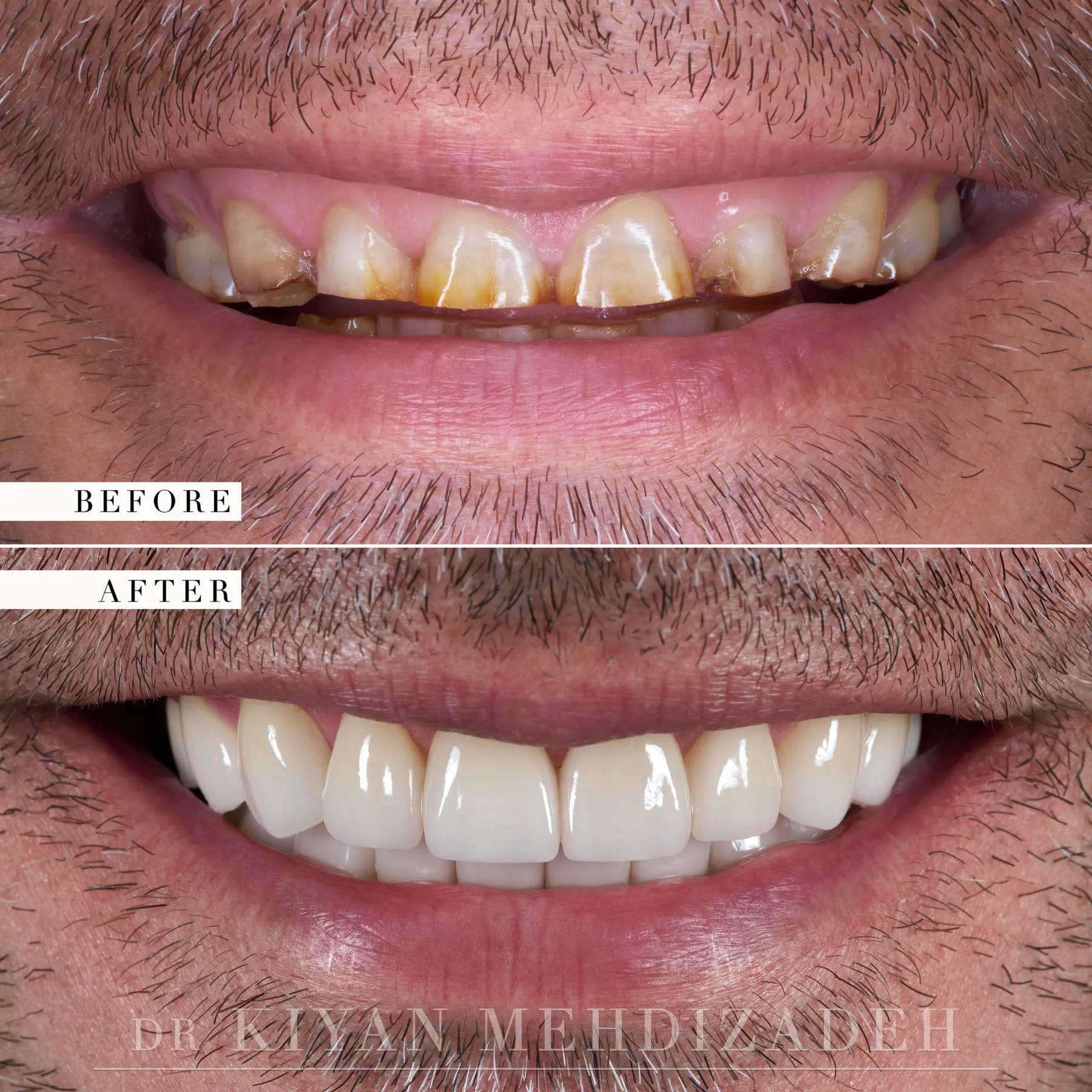
Have your teeth worn down from grinding?
Teeth worn by grinding cannot be fixed one at a time, because the bite they meet in has changed too. We rebuild the bite first, then the teeth. Send us a photo and we will tell you how we would need to plan it, and what it would cost.
- A call within two hours during office hours.
- A written cost from us, before you commit to anything.
- No obligation. Many patients take weeks to decide. That is normal.
What this case cost
$454/month
144 payments at 9.99% APR, on approved credit.
Total: $38,000 for the bite record, the smile and bite design, temporary crowns, the implant and twenty-four e.max crowns.
How full-mouth reconstruction works, and what it costs today →
Ask about your case
Reviewed by our treatment coordination team. Call or text (310) 770-3335 if you would rather speak now.
Request received
A treatment coordinator will call you within two hours during office hours (Monday to Friday, 9 to 4).
To talk now, call (310) 770-3335.
Treatment Plan by Dr. Mehdizadeh
- A bite record to re-establish the bite as it was before the wear.
- Smile and bite design, setting the shape and function of the new teeth.
- Removal of decay, contouring of the teeth and temporary crowns in both arches, worn as the design and adjusted until approved.
- An implant replacing the upper left first molar, lost to a crack.
- Twenty-four e.max crowns, twelve upper and twelve lower, one of them on the implant, made in our laboratory from the approved design.
- Balancing of the bite, and a retainer that works as a night guard.
The Patient's Journey
He had worn his teeth down to the point where he was embarrassed to smile. The upper front teeth had worn short and flat, several had decay, and his smile had become something he worked around rather than something he used. He wanted his confidence back.
Understanding the Challenge
Everything in his mouth traced back to one cause: bruxism, the grinding and clenching of the teeth, which often happens during sleep and goes unnoticed. Grinding removes enamel from the biting edges a little at a time. Once the enamel is gone, the softer dentin underneath wears faster, darkens and picks up stain, which is why worn teeth look both short and yellow. The same forces crack teeth. His upper left first molar had cracked beyond saving, and he lost it.
Grinding also takes something less visible: height. As the back teeth wear, the jaws can close a little further together and the front teeth come to meet in a new place. Rebuilding worn teeth one at a time onto that collapsed bite rebuilds the problem, because each new tooth takes its shape from a bite that grinding created.
How Dr. Mehdizadeh Approached Teeth Worn by Grinding
Dr. Mehdizadeh began with the bite, not the teeth. He took a record of how the upper and lower jaws relate to each other so he could re-establish the bite as it was before the wear, then designed the smile and the bite together: how long each tooth should be, how the edges should line up with the lips, and where the upper and lower teeth should meet. That design decided the shape and the function of every new tooth before any tooth was prepared.
The order is what made the result predictable. Once the design existed, building the new teeth became a matter of carrying it out. He removed the decay, contoured the teeth and placed temporary crowns in both arches that reproduced the design, so the patient could wear his new smile, speak and eat with it, and ask for changes while changing it still cost nothing. Dr. Mehdizadeh refined the design in the temporaries until both of them were satisfied, and our laboratory then made the final crowns as a copy of it. Designing first and building second is the difference between a planned reconstruction and one improvised tooth by tooth.
Dr. Mehdizadeh replaced the lost molar with an implant, so the new bite had full support on both sides of the upper arch rather than relying on the teeth around the gap.
The Result After Three Months
In three months he went from worn, decayed teeth to twenty-four e.max crowns, twelve upper and twelve lower, one of them on the new implant. The teeth have their length back, the edges follow his smile, and the upper and lower teeth meet where the design placed them. Dr. Mehdizadeh balanced the bite at delivery, adjusting the contacts until the forces spread evenly across the new teeth instead of landing on a few of them. All twenty-four are e.max, a lithium disilicate ceramic that is strong enough for a full bite and translucent enough to read as natural teeth.
Because bruxism caused the damage, protecting the new teeth from it is part of the treatment. He wears a retainer at night that also works as a night guard, taking the grinding forces that would otherwise fall on the porcelain. Porcelain does not last forever, and grinding is the habit that shortens its life most; the guard is what keeps the result in place.
Frequently Asked Questions About Teeth Worn by Bruxism
What is bruxism?
Bruxism is grinding or clenching the teeth, most often during sleep. Over years it wears the biting edges flat, shortens the teeth, cracks them and closes the bite. Many people do not know they grind until the wear shows.
Why did his treatment cover both arches?
Grinding wears the upper and lower teeth against each other, so both arches had lost length and the bite between them had changed. Rebuilding only one arch would have fitted new teeth to worn opponents.
Why was the bite recorded and designed before any tooth was treated?
Grinding lets the jaws close further together as the teeth wear. Recording the bite and designing the new teeth first re-established it, so we shaped every crown to the right bite rather than to the worn one.
What are the temporaries for?
They carry the new design in the mouth. He could wear it, speak and eat with it, and ask for changes before our laboratory made the final porcelain; the final crowns copy the approved temporaries.
Why was an implant needed?
The upper left first molar had cracked beyond repair, and he lost it. An implant replaced it so the rebuilt bite had support on both sides of the upper arch.
How long did the treatment take?
Three months from start to finish.
How much did this case cost?
$38,000. $454/month: 144 payments at 9.99% APR, on approved credit.
What material are the crowns made of?
All twenty-four are e.max, a lithium disilicate ceramic, made in our own laboratory.
How does he protect the new teeth?
He wears a retainer at night that also works as a night guard, so the grinding forces fall on the guard rather than on the porcelain.
Am I a candidate if my teeth are worn from grinding?
Most people with worn teeth are. The consultation, including a 3D X-ray (CT scan), shows how much of the bite has worn away and what rebuilding it would take. Send us photographs and we will tell you how we would plan it and what it would cost.