Correcting a Tilted Midline Without Braces
The line between her two front teeth sat off center, and she had disliked it for years. Whether that can be corrected by redesigning the teeth instead of moving them depends on how much width is available to redistribute.
By Dr. Kiyan Mehdizadeh, DMD · 9460 Wilshire Blvd, Suite 850, Beverly Hills, CA 90212 · (310) 770-3335
Last Updated: September 2026
Is the center of your smile off to one side?
A midline that sits off center can sometimes be corrected by redesigning the width of the teeth rather than by moving them, which is a matter of weeks instead of a year or more in orthodontics. Whether it is possible depends on how much width there is to redistribute. Send us a photo of your smile and we will tell you which answer applies to you.
- A response within one business day. Usually much sooner.
- A real cost estimate, not a range designed to get you in the door.
- No obligation. Many patients take months to decide. That is normal.
Ask about your case
Reviewed by our treatment coordination team. Call or text (310) 770-3335 if you would rather speak now.
Request received
Our treatment coordination team will review what you sent and call you
within one business day.
If you would like to hold a consultation time now, you can do that below.
Treatment Plan by Dr. Kiyan Mehdizadeh
- Measurement of the midline against the face and of the width available across the upper anterior teeth.
- Smile design redistributing that width so the center line fell where it belonged.
- Whitening of the lower natural teeth, with the shade allowed to stabilize.
- Provisional restorations on the upper arch, revised in the mouth.
- Ten porcelain veneers in e.max on the upper arch.
- The lower teeth left natural, whitened rather than restored.
The Patient's Journey
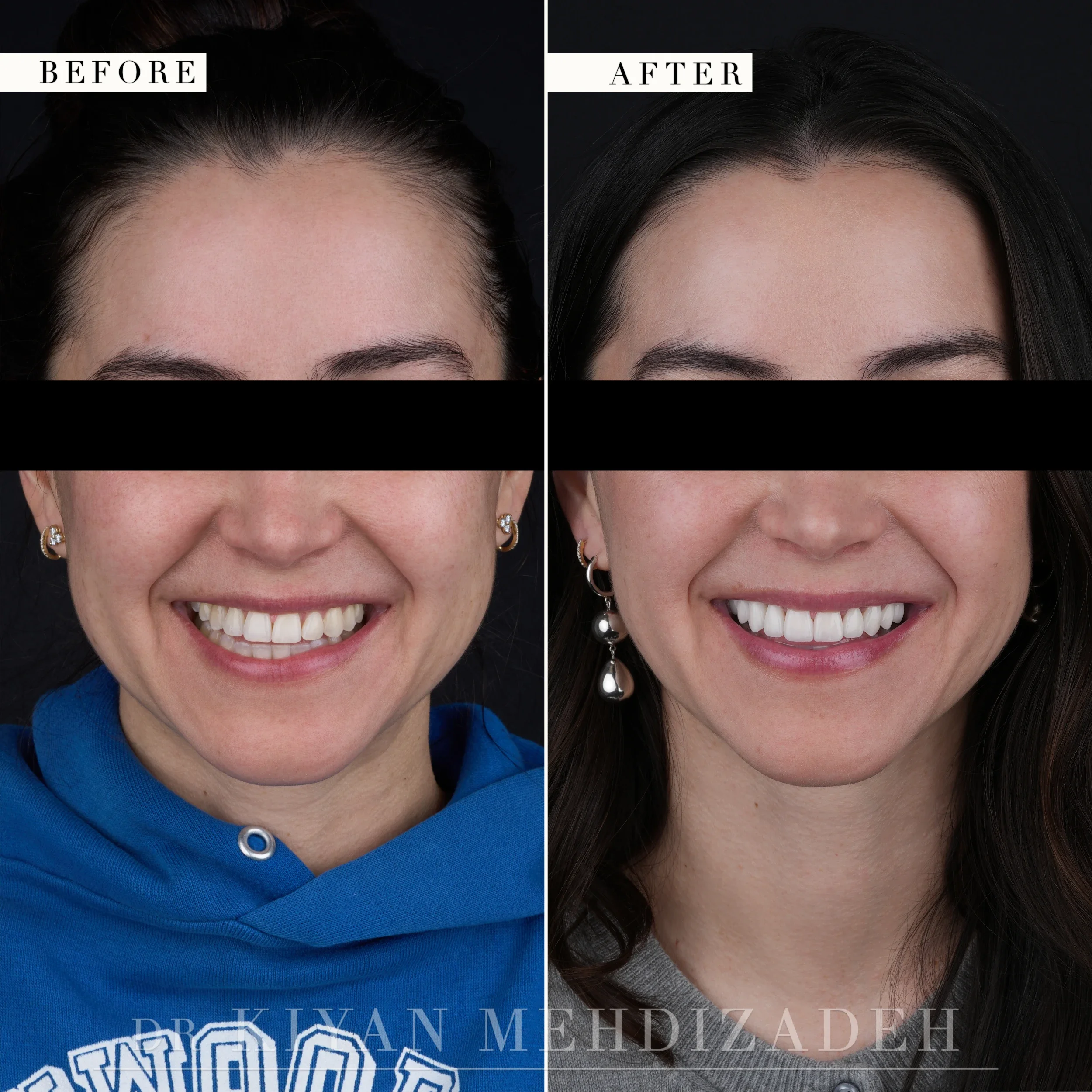
This patient had disliked her smile for years, and she was specific about the underlying reason. The line between her two front teeth sat off center, which tilted the appearance of the entire smile and made her persistently self-conscious about it. She had assumed the correction required orthodontics and a year or more of appliances.
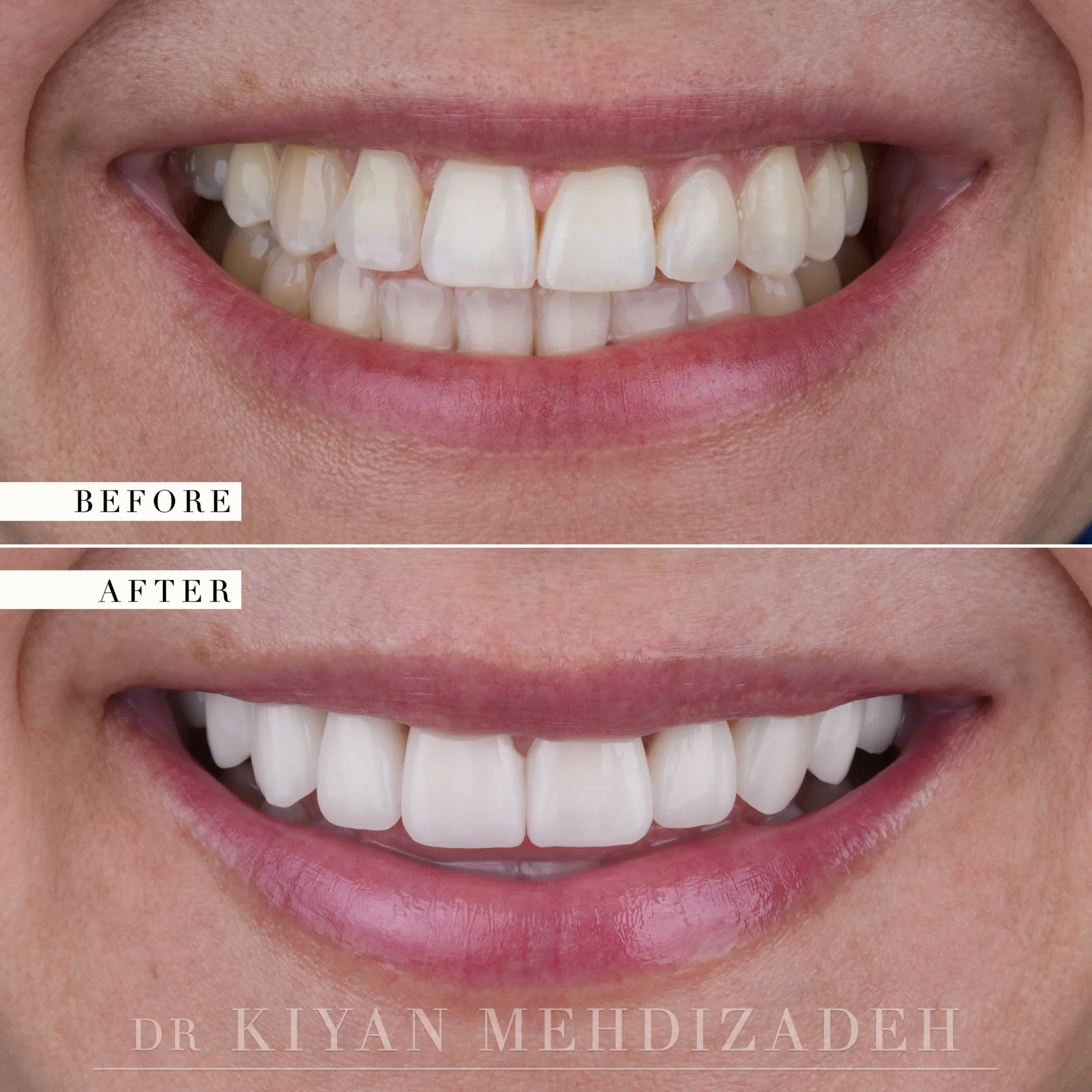
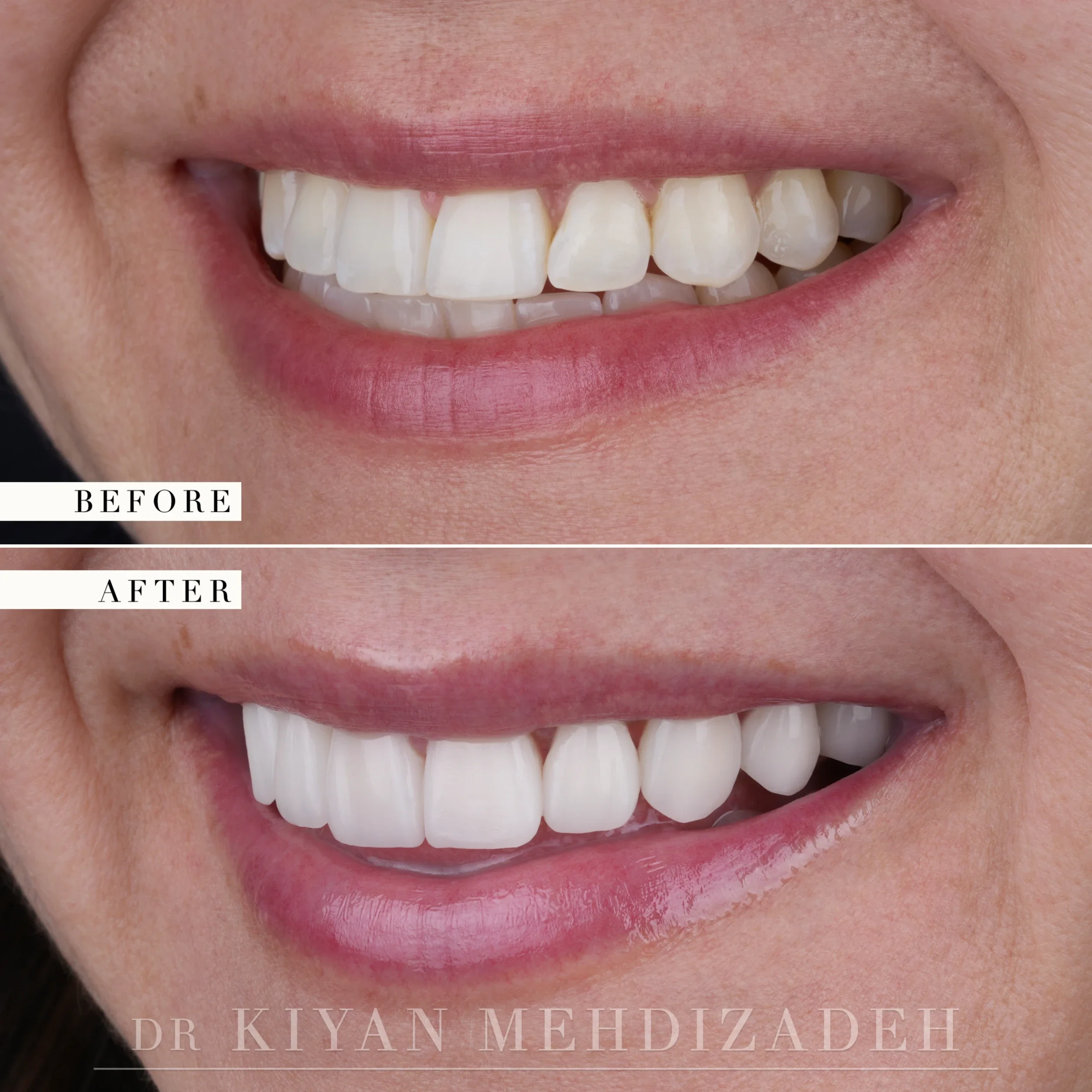
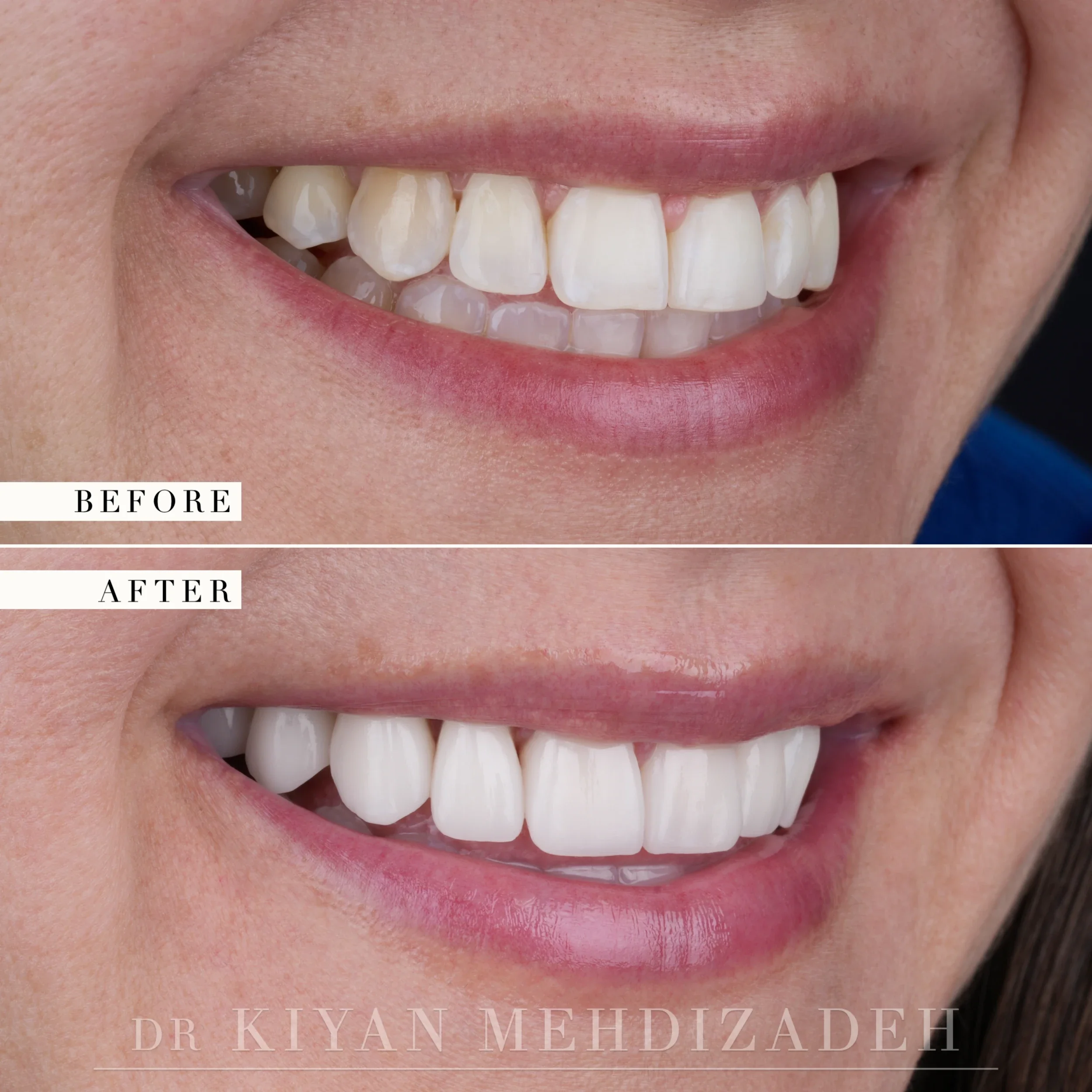
There was a dark interproximal space between the central incisors as well, and the teeth on either side of the midline were discolored and irregular along their edges. The photographs display all three problems simultaneously, which is part of why the tilt had been difficult for her to describe to anyone.
Understanding the Challenge
A midline discrepancy can be corrected in two ways. The teeth themselves can be repositioned, which is orthodontics. Alternatively the width of the teeth can be redistributed so the center line falls where it belongs without any movement. The restorative approach requires weeks rather than a year, and it is not available in every case.
What determines it is how much width is available across the upper anterior teeth. A midline sitting off center means the widths on one side of it do not correspond to the widths on the opposite side, and correcting it in ceramic means redistributing width from the teeth carrying too much to the teeth carrying too little.
Where the total available width is sufficient, the design absorbs the discrepancy across ten restorations and the correction becomes undetectable. Where it is insufficient, the teeth have to be repositioned, and saying so is the honest answer rather than attempting a correction the arch cannot accommodate. Hers had sufficient width.
The second difficulty was the one she cared about most. A midline correction changes the position of the most conspicuous feature of a smile, and if the restorations carrying it look manufactured, the change announces itself.
Establish whether the width available allowed a restorative correction. Move the center line without moving any teeth. Close the dark space between the central incisors. Match ten new restorations to the natural lower teeth. Keep the surface texture and translucency convincing at close range.
How Dr. Mehdizadeh Approached Treatment
The midline was measured against her face rather than against the teeth. The reference that matters is the center of the face and not the center of the existing arch. The available width was then measured across the upper anterior teeth, and the design redistributed that width so the center line fell on the facial midline rather than on the center of the arch she had arrived with.
The lower teeth were whitened next and the shade was allowed to stabilize. They were not restored. Ten veneers on the upper arch had to match natural teeth below them. Natural teeth have to reach their final color before anything is matched to them, because ceramic does not respond to peroxide afterwards.
Provisional restorations were placed on the upper arch and revised in the mouth. The midline correction was confirmed there, in her own face, before any definitive ceramic was fabricated. A correction of this kind is measured on paper and judged in a mirror, and the provisional stage is where those two assessments are reconciled.
The approved provisional shapes were reproduced as ten porcelain veneers in e.max, designed and fabricated in the practice's own laboratory by its master ceramist. Surface texture and translucency were specified deliberately rather than left to a standard finish, because at conversational distance those two properties are what distinguish restored teeth from manufactured ones.
The Result After Six Weeks
The center line falls on the center of her face, the dark interproximal space between the central incisors is closed, and the incisal edges run evenly across the arch, which together eliminate the tilt she had been unable to describe for years. Five appointments across six weeks covered the measurement and design, the whitening, the provisional phase and the final cementation of the restorations. No teeth were repositioned and no orthodontic appliances were worn.
Only the upper teeth carry restorations. The lower teeth are her own, whitened rather than covered with ceramic, and natural teeth gradually accumulate stain again while porcelain does not. The match between the two arches is therefore something she maintains with hygiene and occasional re-whitening rather than something that was completed in September.
Frequently Asked Questions About Midline Correction and Porcelain Veneers
What is a tilted or off-center midline?
The line between the two upper front teeth sitting to one side of the center of the face. It tilts the appearance of the whole smile, which is why it is often noticed as a general impression rather than identified as a specific problem.
Can a midline be corrected without braces?
Sometimes. The width of the teeth can be redistributed in the design so the center line falls where it belongs without any tooth moving. Whether that is possible depends on how much width is available across the upper anterior teeth.
How do you know whether it is possible in my case?
By measuring the midline against the face and the available width across the upper teeth. Where the total width is sufficient, the discrepancy can be absorbed across the restorations. Where it is not, orthodontics is the correct answer and we say so.
Why measure the midline against the face rather than the teeth?
Because the center of the face is the reference a viewer uses. An arch can be internally consistent and still sit off center in the face, which is exactly the situation that produces a smile that looks tilted for no obvious reason.
How long does a restorative midline correction take?
This case was six weeks across five appointments. Orthodontic correction of the same problem is typically measured in months to years, which is the main reason patients ask whether the restorative route is available.
Why were the lower teeth whitened instead of restored?
Because they did not need restoring. Whitening them brought them to a color the upper restorations could be matched to, which is a considerably more conservative approach than covering sound teeth in order to control their shade.
Why was the whitening done before the veneers were made?
Ceramic does not lighten. The natural teeth have to reach their final color and the shade has to stabilize before restorations that must match them are fabricated.
Will the veneers look obviously different from my natural teeth?
Not where surface texture and translucency are specified rather than left to a standard finish. At conversational distance those two properties are what separate restored teeth from manufactured ones, and they were designed deliberately in this case.
Will the upper and lower teeth stay matched?
The porcelain holds its color. The natural lower teeth gradually take up stain again, so the match is maintained with hygiene and occasional re-whitening rather than being finished at cementation.
How much does a midline correction with veneers cost?
This case was $28,000, covering the measurement and design, whitening of the lower teeth, the provisional phase and ten porcelain veneers. Porcelain veneers range from $1,800 to $3,500 per tooth and a course of whitening runs $500 to $1,000. Financing options are available and a detailed breakdown is provided at the consultation.
Last Updated: September 2026
Dr. Kiyan Mehdizadeh, DMD
Doctor of Dental Medicine
Most cosmetic dentists refer out for surgery. Most surgeons don't do cosmetic work. Dr. Mehdizadeh trained in both — implantology and bone grafting at Loma Linda and UCLA, fixed prosthodontics under Mauro Fradeani in Italy, periodontal microsurgery with Hürzeler and Zuhr in Munich, and IV sedation at the University of Alabama. That combination means complex cases involving surgery, grafting, implants, and restorative work are planned and executed by a single provider with full command of every phase.
Technical skill produces function. Taste is what produces beauty. The difference between dental work that looks like dental work and a result that looks entirely natural comes down to aesthetic judgment — proportion, texture, translucency, how light moves across a surface. That sensibility runs through everything here, from the way cases are designed to the office itself.
An in-house master ceramist and on-site laboratory allow restorations to be designed, fabricated, and refined with direct collaboration between doctor and technician — no outsourced lab work, no guesswork, no compromise on the final product. Dr. Mehdizadeh is one of few dentists with the refined ability to provide care across multiple specialties, resulting in cohesive and holistic outcomes.
Education & Credentials
- Doctor of Dental Medicine (DMD), cum laude — Boston University
- Bachelor of Science in Biology — Emory University
- Mastership in Implant Dentistry & Grafting — Loma Linda University / gIDE Institute
- Advanced Implant Therapy & Grafting — UCLA / gIDE Institute
- Implant Placement & Restoration — UCLA / Nobel Biocare
- Guided Bone Regeneration & Ridge Augmentation — gIDE Institute
- Sinus Elevation & Augmentation — gIDE Institute
- Soft Tissue Management & Grafting — gIDE Institute
- Minimally Invasive Augmentation & Autogenous Bone Management — IDEA, San Francisco
- Master Program in Fixed Prosthodontics — Fradeani Education, Italy
- Aesthetic Dentistry — UCLA School of Dentistry
- Advanced Occlusion & Bite Design — UCLA
- Periodontal Micro-Surgery — Hürzeler/Zuhr, Munich
- Micro-Endodontic Training — University of Pennsylvania
- IV Sedation — University of Alabama at Birmingham
- Injectable Therapy for TMJ & Facial Pain — American Academy of Facial Esthetics
Considering similar treatment?
Send Dr. Mehdizadeh a photo and ask what’s possible for your case.
Other cases like this one
When Straight Teeth Still Aren't Right: Veneers After Braces
Straight teeth that still look wrong?
View case →Closing a Gap and Evening the Color With Veneers
Have a gap between your front teeth?
View case →Correcting an Underbite With Full-Mouth Veneers - Without Surgery
Hoping to avoid orthodontics?
View case →