Diastema ClosureA closed gap, in natural proportions.
A gap between the front teeth can be closed so that no tooth looks wide and nothing reads as dental work. Whether that means moving teeth, adding width, or both depends on why the gap is there.
Four veneers from $16,000
$192/month 144 payments at 9.99% APR, on approved credit.
Your consultation, including a 3D X-ray (CT scan), is free.
Send photos if you have them. Either way, we reply with a cost. No obligation.
Ask about veneers
Reviewed by our treatment coordination team. Call or text (310) 770-3335 if you would rather speak now.
Request received
A treatment coordinator will call you within two hours during office hours (Monday to Friday, 9 to 4).
To talk now, call (310) 770-3335.
- A call within two hours during office hours.
- A written cost from us, before you commit to anything.
- No obligation. Many patients take weeks to decide. That is normal.
- Free consultation and 3D X-ray (CT scan)
- Private practice since 2012
- IV sedation in our own office
- In-house dental laboratory
Before, and after.
Every smile on this site was made here: our patients, our laboratory, our work.
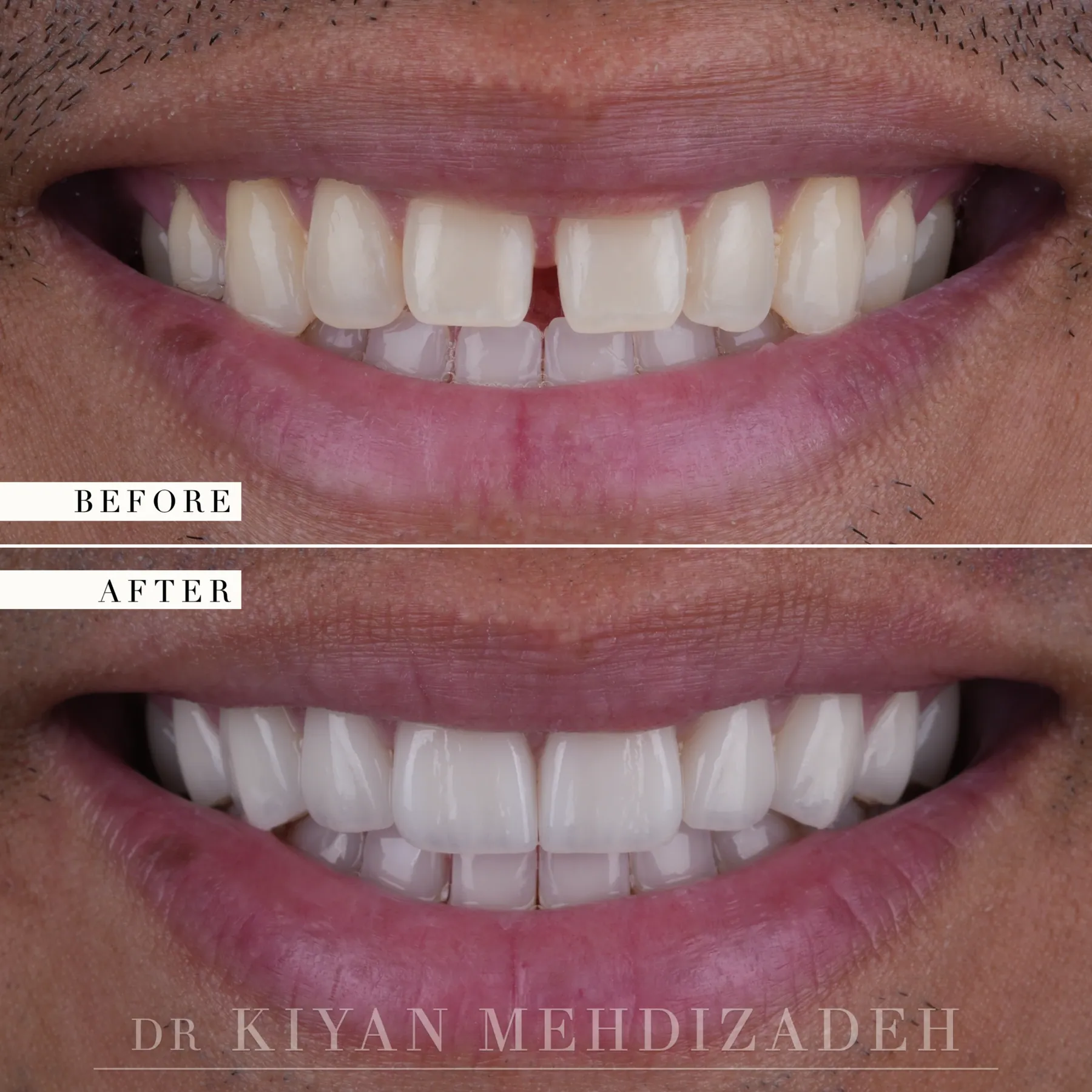 A gap clear aligners could not close, closed with porcelain veneers.See the case →
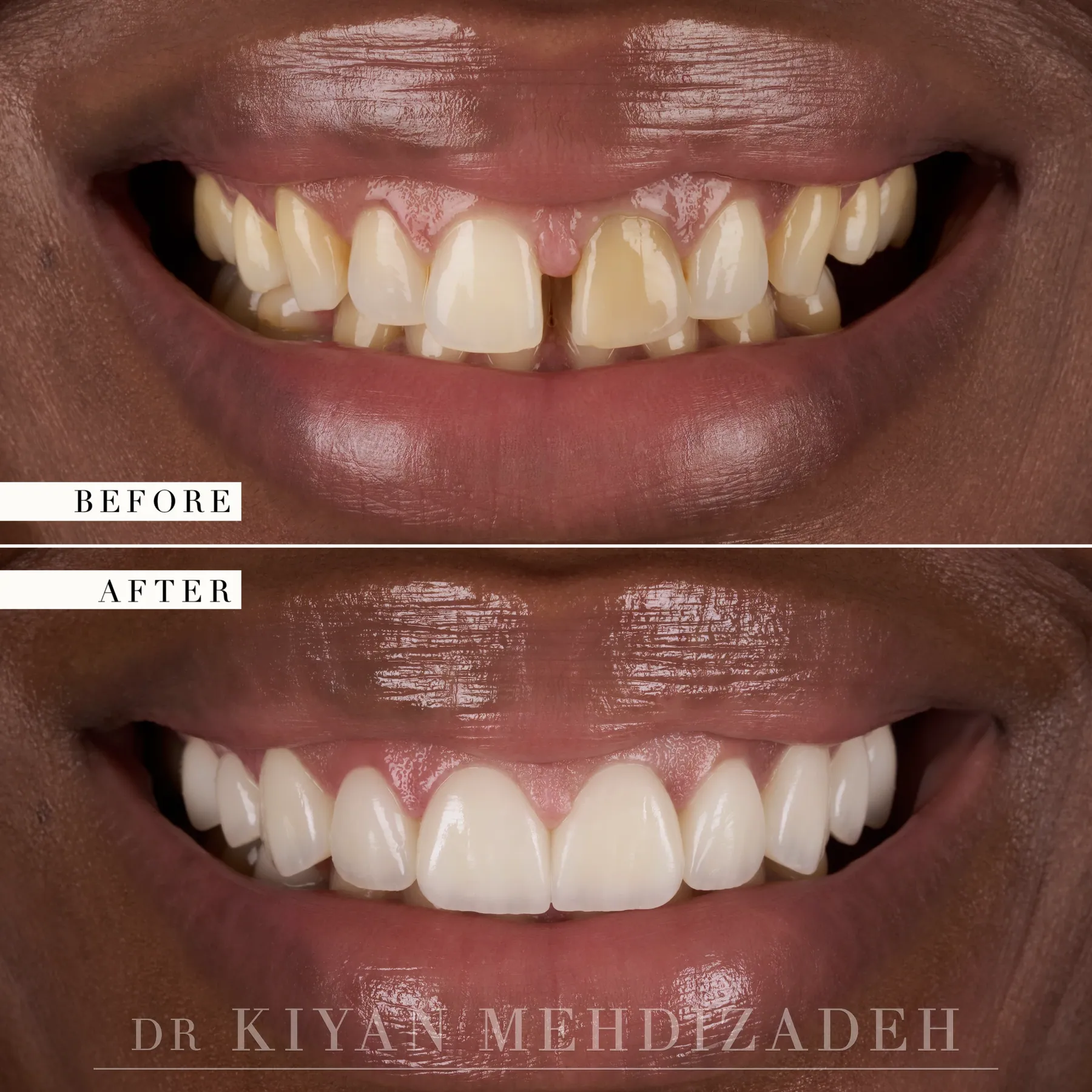 A gap closed and the color evened, after one dark tooth was bleached from within.See the case →
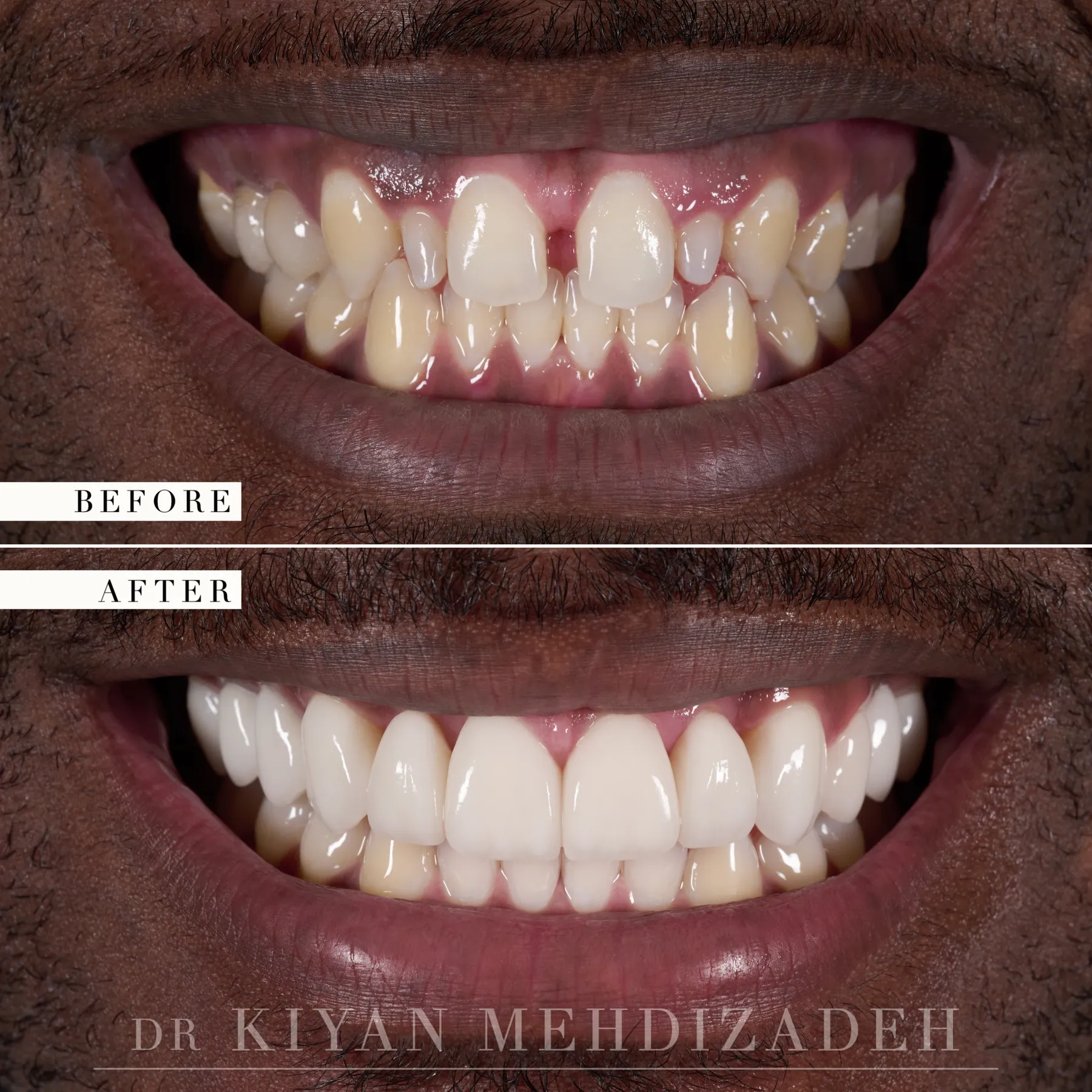 A central gap left by undersized lateral incisors, closed after a gum lift.See the case →
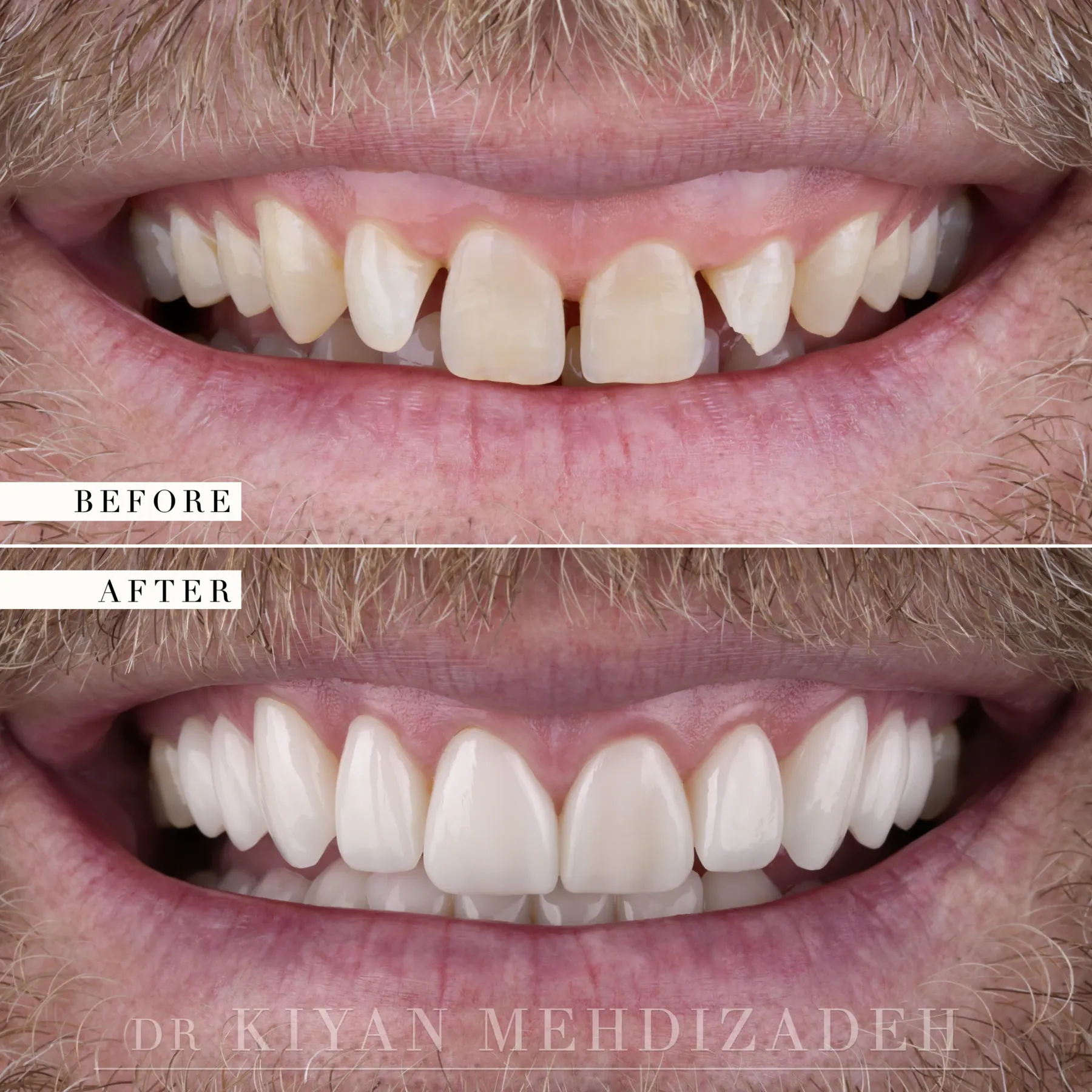 Spaces left by peg laterals, closed after the gum line was set.See the case →
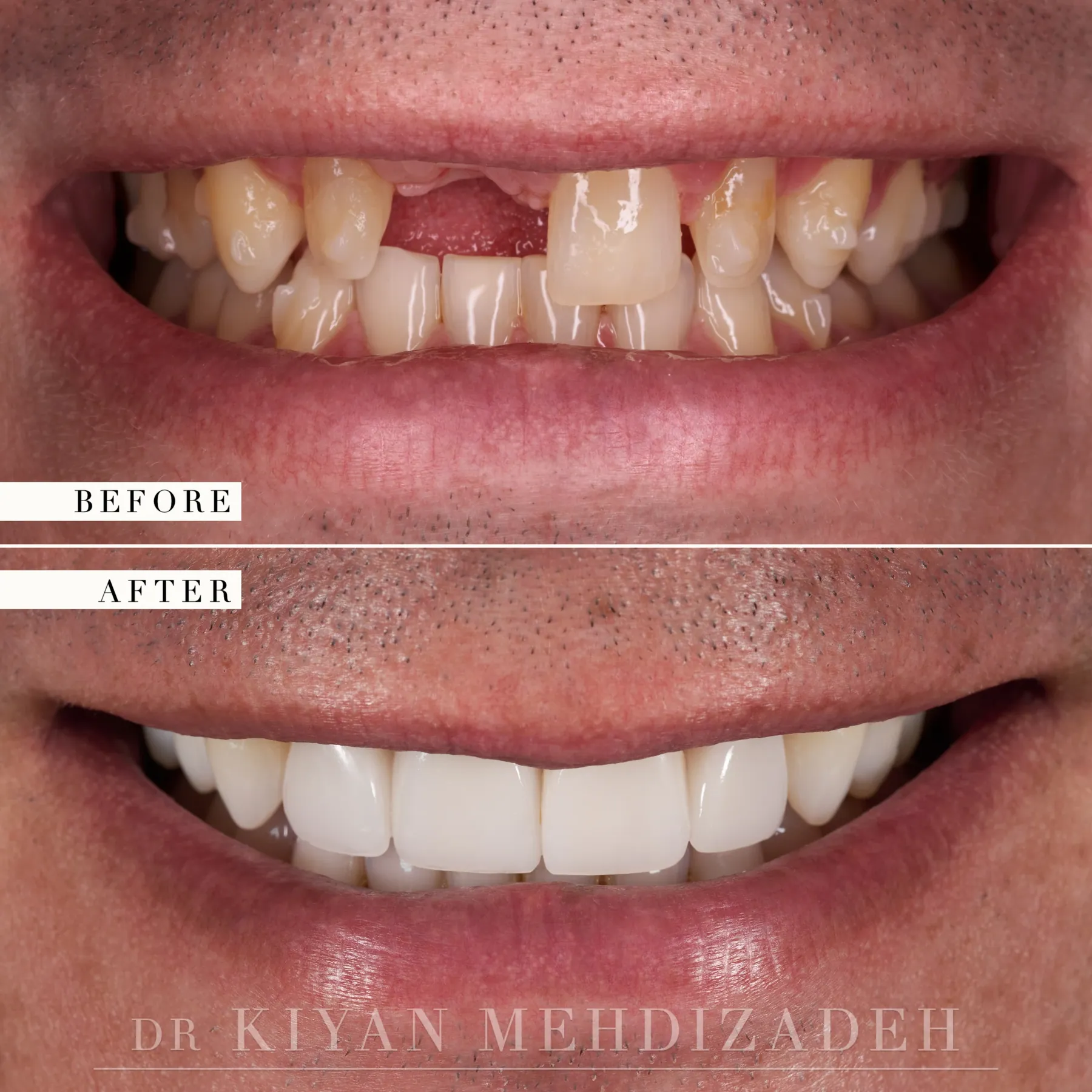 Gaps braces could not close, closed with an implant crown and three veneers.See the case →
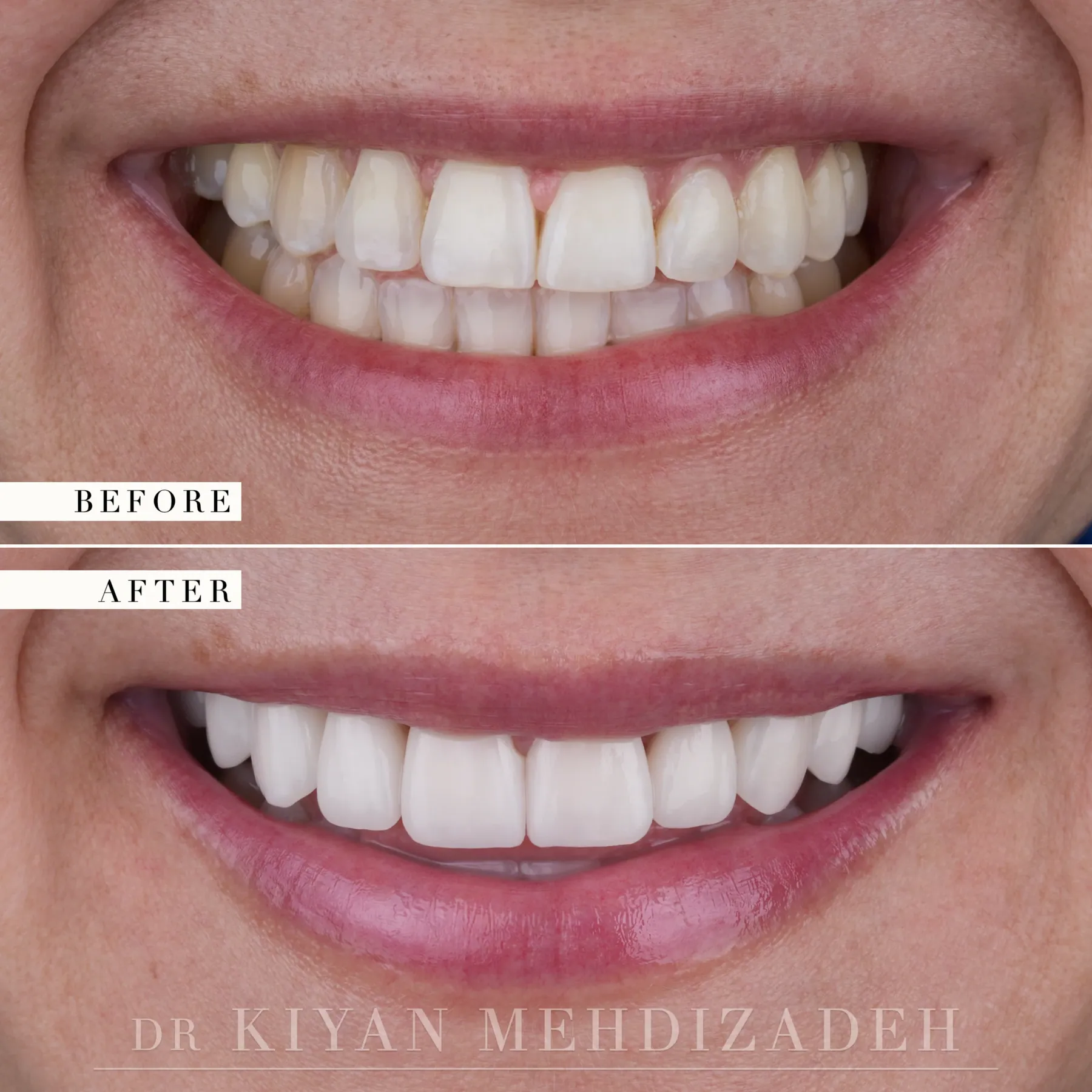 An off-center midline and a dark space between the front teeth, corrected with veneers.See the case →
A gap has a cause, and the cause decides the treatment.
This page explains what causes a gap between the front teeth, when moving the teeth closes it and when width has to be added, why the design matters more than the material, and what treatment costs.
A diastema is a space between two teeth, most often between the two upper front teeth. In children it is common and often closes as the adult teeth come in. In adults it has a cause, and the common ones are these: teeth that are too narrow for the arch they sit in; lateral incisors that are undersized or missing, which lets the front teeth drift apart; a band of gum tissue, the frenum, attached low between the front teeth; habits such as tongue thrusting; and gum disease, which lets teeth drift as the bone around them is lost.
The causes fall into two groups. Some are about where the teeth sit; others are about how wide they are. That distinction decides the treatment. Gum disease is treated before anything else, and a habit that pushes teeth apart has to stop, or a closed gap can reopen.
When aligners close a gap, and when they cannot.
Where the teeth are the right size and the space is a matter of position, moving the teeth closes it. Clear aligners (Invisalign or ClearCorrect) or braces bring the teeth together, and no tooth is altered.
A gap closed by moving teeth tends to reopen, a gap between the front teeth more than most. One study found measurable reopening in 60% of patients after orthodontic closure of a gap between the front teeth, about half a millimeter on average. Retainers are part of the treatment for the long term.
Where the teeth are too narrow for the arch, moving them together does not remove the spare space; it moves it. In this case, closing the gap by moving the front teeth would have opened new spaces between the lateral incisors and the canines. The only way to close that kind of gap is to make the teeth wider.
Why two wide front teeth look like dentistry.
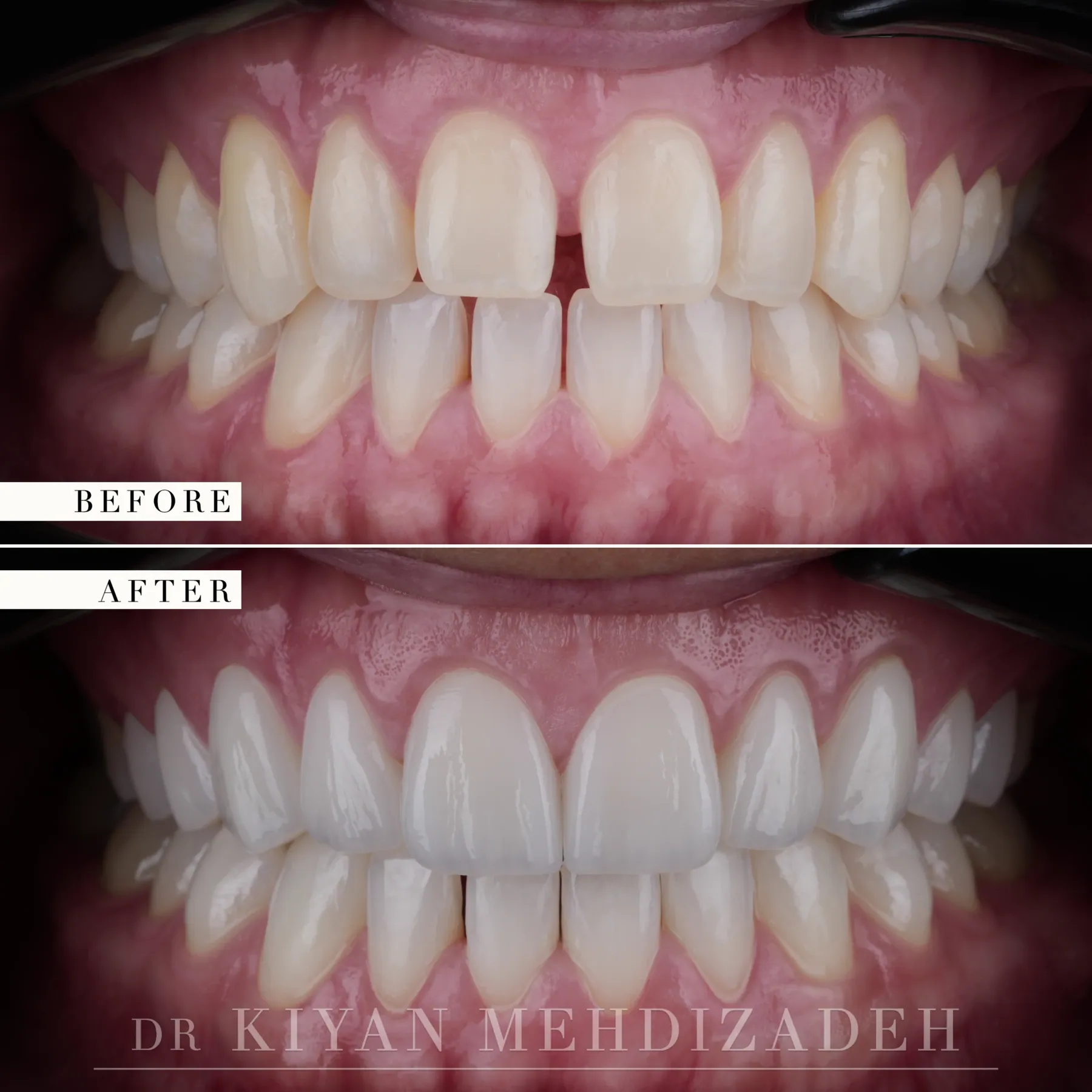
Closing a diastema well is a proportion problem, not a filling problem. The two central incisors are already the widest teeth in the smile. Add all of the missing width to them and they become oversized, the most common sign of a poorly planned closure.
The design shares the width out instead. Each tooth across the smile takes a little, so every tooth stays in proportion to its neighbors. In this case, ten upper veneers closed the gap: the central incisors were widened slightly, the lateral incisors and canines in proportion, and the first premolars took some of the width at the corners of the smile. That is why closing a gap is rarely a matter of two veneers.
Width needs length. Widening a short tooth without lengthening it produces a square tooth. Where the gum line sits low, a gum lift comes first. In this case, undersized lateral incisors had let the front teeth drift apart; the gum lift gave the laterals and the central incisors the length to be widened in proportion, and the gap closed without enlarging the two teeth that were already the widest.
The gum between the teeth. Where a gap closes, the small peak of gum between the teeth, the papilla, has to fill the space above the new contact, or a dark triangle can be left. In this case, the gum lift also shaped those peaks for symmetry.
Color, the center line, and a design you test first.
Color. Porcelain does not respond to whitening, so natural teeth that stay are whitened first and the veneers are matched to them. A single tooth darkened from within is treated at its source: in this case, internal bleaching evened one dark front tooth before ten veneers closed the gap.
The center line. A gap often sits off the center of the face. The design measures the midline against the face, not against the existing teeth, and places the new contact there. In this case, ten veneers moved an off-center midline and closed a dark space between the front teeth without moving a tooth.
Where the porcelain ends. Four veneers end at the canines, where natural color already changes; eight or ten end behind the corner of the smile. Two and six are avoided. How many veneers do you need? explains why.
You see it before it is final. You wear the new design as temporary veneers, and it is adjusted in the mouth before the final porcelain is made.
Bonding, orthodontics, and the limits of veneers.
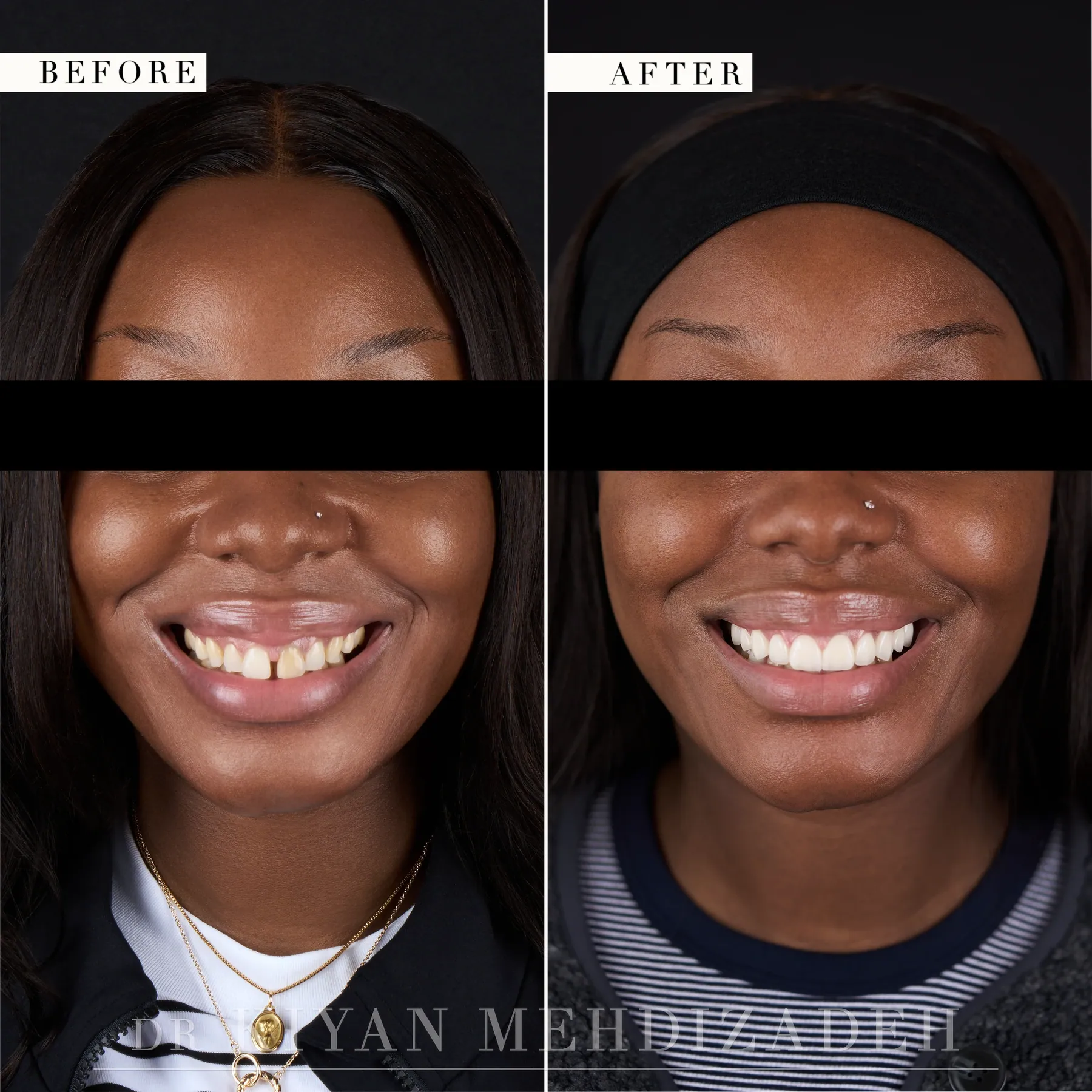
Composite bonding closes small gaps by adding tooth-colored resin to the sides of the teeth, with little or no preparation. It costs less at the start; it also stains and chips more readily than porcelain and typically needs replacing within a few years. For a large gap, where several teeth have to change together, porcelain is more predictable.
Veneers change width, not position. They do not move a tooth, and they do not stop teeth drifting where gum disease or a habit is the cause. A gap too large to share out without making teeth wide needs orthodontics first, to bring the teeth closer, and then veneers for what remains.
Veneers are a commitment. Minimal-preparation veneers remove 0.3 to 0.5mm of enamel, and less at the sides where the gap already leaves space, but enamel does not grow back, and a tooth that has had a veneer will need one again when it is replaced. In return, a closure in porcelain does not depend on a retainer, because the width is in the restorations rather than in the position of the teeth.
What closing a gap costs.
We quote each case as a whole, by the number of veneers it needs, never per tooth. Four veneers start at $16,000. $192/month: 144 payments at 9.99% APR, on approved credit. Ten veneers, the number many gap closures need, start at $24,000. Most cases also include a gum lift or whitening. Every number and its price is set out in the full price table.
As examples, the total for this case was $24,000, covering ten upper veneers, and the total for another was $26,000, covering internal bleaching, a gum lift and ten veneers.
The consultation, including a 3D X-ray (CT scan), is complimentary. Most PPO plans contribute toward the cost of treatment. Financing is available. Porcelain veneers covers the treatment itself.

One doctor, from the design to the final porcelain.
Dr. Mehdizadeh designs every veneer case himself, and our laboratory, in the same building, makes the veneers.
Tell us about your gap.
Tell us what is going on. Add photos if you have them; if not, we will call and talk it through.
Or call (310) 770-3335.
Ask about veneers
Reviewed by our treatment coordination team. Call or text (310) 770-3335 if you would rather speak now.
Request received
A treatment coordinator will call you within two hours during office hours (Monday to Friday, 9 to 4).
To talk now, call (310) 770-3335.
Frequently Asked Questions
What is a diastema?
A space between two teeth, most often between the two upper front teeth.
Can veneers close a gap between the front teeth?
Yes, when the design shares the width across several teeth so that no tooth looks oversized. Where the teeth are the right size and simply apart, moving them with clear aligners or braces may be the better route.
Why not just two veneers on the front teeth?
The two front teeth are already the widest in the smile. Adding all of the missing width to them makes them look oversized, which is the most common sign of a poorly planned closure.
Will the gap come back after veneers?
A closure in porcelain does not depend on a retainer, because the width is in the restorations rather than in the position of the teeth. Where gum disease or a habit pushed the teeth apart, that cause still has to be treated, or the teeth can keep moving.
Can bonding close a diastema?
For a small gap, yes. Bonding costs less at the start, but it stains and chips more readily than porcelain and typically needs replacing within a few years.
How long does diastema closure with veneers take?
About six weeks without gum work, as in one of the cases on this page. A gum lift or internal bleaching adds healing time; another case here took ten weeks.
How much does diastema closure cost?
Four veneers start at $16,000. $192/month: 144 payments at 9.99% APR, on approved credit. Ten veneers, the number many gap closures need, start at $24,000. Most cases also include a gum lift or whitening.
Last Updated: October 2026