Closing a Gap Caused by Peg Laterals
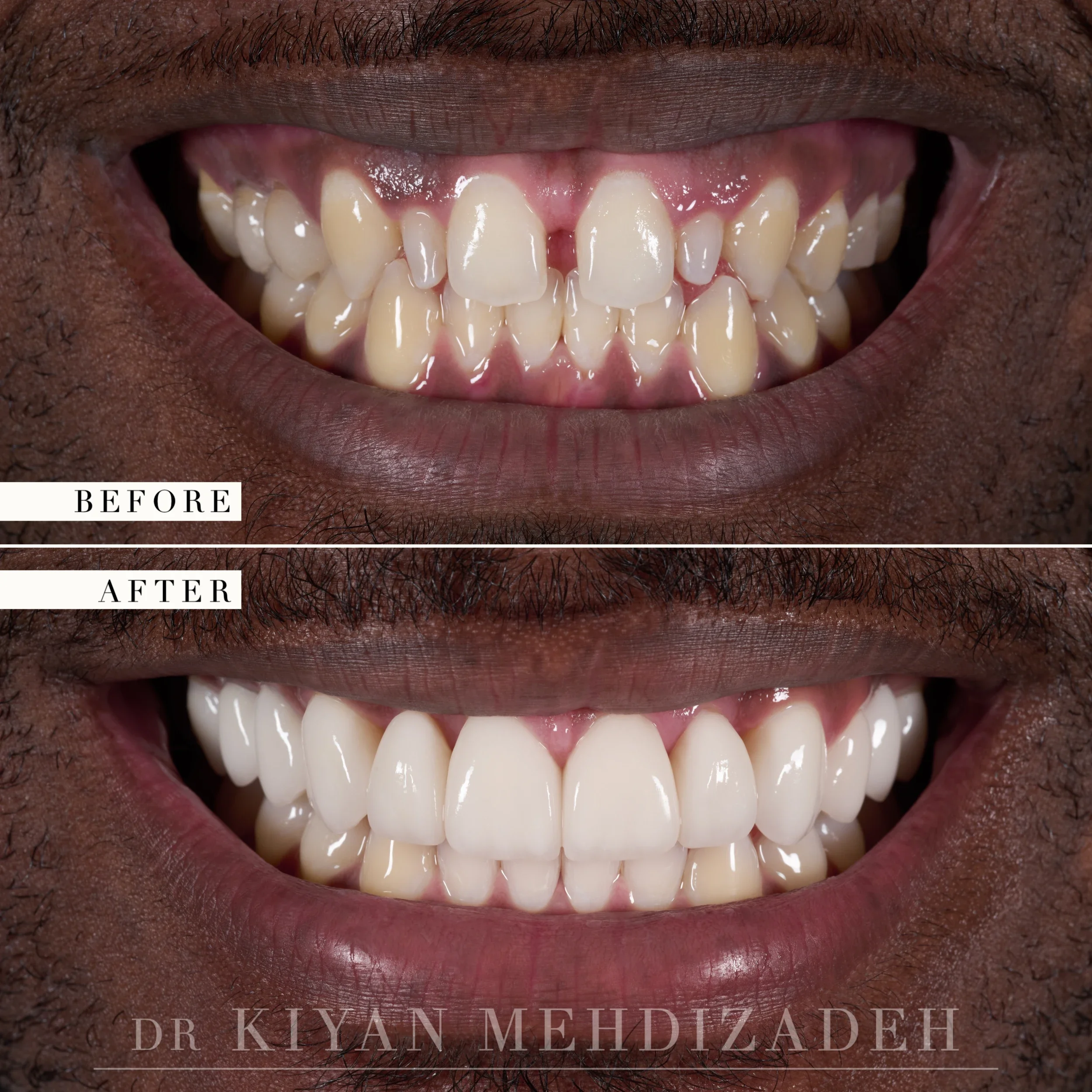
His lateral incisors were undersized, which left spacing across the arch and allowed the central incisors to drift apart. Widening a short tooth produces a square tooth, so the length had to be established before the width could be corrected.
By Dr. Kiyan Mehdizadeh, DMD · 9460 Wilshire Blvd, Suite 850, Beverly Hills, CA 90212 · (310) 770-3335
Last Updated: September 2026
Have you been told your gap cannot be closed properly?
Spacing caused by undersized lateral incisors is frequently quoted as veneers on the two front teeth, which closes the visible gap and leaves the laterals looking small. Correcting the proportions requires establishing how long each tooth should be before deciding how wide it can become. Send us a photo of your smile and we will tell you what a complete correction would involve.
- A response within one business day. Usually much sooner.
- A real cost estimate, not a range designed to get you in the door.
- No obligation. Many patients take months to decide. That is normal.
Ask about your case
Reviewed by our treatment coordination team. Call or text (310) 770-3335 if you would rather speak now.
Request received
Our treatment coordination team will review what you sent and call you
within one business day.
If you would like to hold a consultation time now, you can do that below.
Treatment Plan by Dr. Kiyan Mehdizadeh
- Diagnosis of undersized lateral incisors, the resulting spacing and the central diastema.
- Smile design establishing the finished length and width of every upper tooth.
- Whitening of the lower natural teeth, with the shade allowed to stabilize.
- Gum lifting to provide the additional length the laterals and centrals required.
- Provisional restorations, revised in the mouth against the design.
- Twelve porcelain veneers in e.max across the upper arch.
The Patient's Journey
This patient was self-conscious about his smile and had consulted several dentists beforehand without being offered a plan he considered acceptable. That is a recognizable pattern where the visible complaint and the underlying cause are different things. A proposal addressing only the visible complaint sounds inadequate to the person living with it.
The visible complaint was spacing, including a distinct gap between the two central incisors. The cause was elsewhere.
Understanding the Challenge
His lateral incisors were peg laterals, a developmental variation in which the tooth forms narrower and more conical than normal instead of developing a full width. Two undersized teeth leave an arch containing more space than teeth to occupy it, and that surplus space redistributes itself. In his case the central incisors had drifted apart into the territory a full-width lateral would have occupied, which produced the diastema he had come in about.
The obvious proposal is veneers on the central incisors, closing the visible gap. It also leaves the laterals conspicuously undersized, and it widens two teeth that were already the widest in the arch, so the proportions deteriorate rather than improve.
Correcting the proportions properly runs into a geometric constraint. A tooth has a characteristic ratio of width to length, and widening a short tooth without lengthening it produces a square tooth that looks wrong for reasons most people cannot articulate but register immediately. The laterals could not simply be made wider. They had to become longer first.
The additional length was not available from the teeth, which were already fully erupted, so it had to come from the tissue above them, which is the only other place in the mouth where length can be obtained.
Establish the finished proportions of every upper tooth before any treatment began. Obtain the additional length surgically rather than compromising the widths. Widen the laterals proportionally rather than approximately. Close the central diastema by redistributing width, not by enlarging two teeth. Leave the lower teeth unrestored.
How Dr. Mehdizadeh Approached Treatment
The design came first, and it specified the finished length and width of all twelve upper restorations. Designing before any intervention is what made the remainder of the treatment measurable, because the amount of tissue repositioning required is calculated from the finished proportions rather than estimated in advance of knowing them.
The lower teeth were whitened and the shade allowed to stabilize. They were not restored. Twelve upper veneers had to be matched to natural teeth below them, and natural teeth have to reach their final color before anything is matched to them.
The gum lifting followed, providing the additional length the design required at the laterals and the centrals. Lengthening the laterals permitted a proportional increase in their width, and lengthening the centrals permitted them to be widened sufficiently to eliminate the diastema without becoming disproportionate. The width was redistributed across the arch instead of being concentrated on the two teeth that already had the most of it.
Provisional restorations were placed and revised in the mouth against the design. The approved shapes were then reproduced as twelve porcelain veneers in e.max. All of them were designed and fabricated in the practice's own laboratory by its master ceramist.
The Result After Ten Weeks
The spacing is eliminated, the diastema is closed, and the lateral incisors are proportionate to the teeth surrounding them rather than conspicuously narrow. Six appointments across ten weeks covered the design, the whitening of the lower teeth, the gum lifting and its healing period, the provisional phase and the final cementation of all twelve restorations.
Only the upper teeth carry restorations. The lower teeth are his own, whitened rather than covered with ceramic, and natural teeth gradually accumulate stain again while porcelain retains its color. Maintaining the match between the arches is therefore a matter of hygiene and occasional re-whitening rather than something concluded at cementation.
Frequently Asked Questions About Peg Laterals, Gum Lifting and Diastema Closure
What are peg laterals?
A developmental variation in which the lateral incisors form narrower and more conical than normal instead of developing a full width. The teeth are healthy and simply undersized, and the consequence is an arch containing more space than teeth to occupy it.
Why did the gap between my front teeth appear?
Because the surplus space left by undersized laterals redistributes itself. In this case the central incisors drifted apart into the territory a full-width lateral would have occupied, which produced the visible diastema.
Why not simply put veneers on the two front teeth?
That closes the visible gap and leaves the laterals conspicuously undersized. It also widens the two teeth that were already the widest in the arch, so the proportions deteriorate even though the gap disappears.
Why did the teeth have to be lengthened before being widened?
A tooth has a characteristic ratio of width to length. Widening a short tooth without lengthening it produces a square tooth, which looks wrong for reasons most people register immediately without being able to articulate. Length had to be established first.
Where does the additional length come from?
From repositioning the gum line, since the teeth were already fully erupted. Gum lifting exposes more of the existing tooth, which provides the length the design requires without altering the teeth themselves.
Is a gum lift cosmetic or functional here?
Neither description is quite right. It was a proportional requirement. Without the additional length the laterals could not be widened proportionally, so the gum lifting is what made the restorative correction possible rather than an aesthetic addition to it.
Why was the smile designed before anything was done?
Because the amount of tissue repositioning required is calculated from the finished proportions. Designing afterwards means estimating how much length to obtain before knowing how much length the restorations need.
Why were the lower teeth whitened rather than restored?
They did not require restoration. Whitening brought them to a color the upper veneers could be matched to, which is considerably more conservative than covering sound teeth in order to control their shade.
Will my upper and lower teeth stay matched?
The porcelain retains its color. The natural lower teeth gradually accumulate stain again, so the match is maintained with hygiene and occasional re-whitening rather than being concluded at cementation.
How much does this kind of treatment cost?
This case was $26,000, covering the design, whitening of the lower teeth, the gum lifting and its healing period, the provisional phase and twelve porcelain veneers. Gum lifting on its own ranges from $2,000 to $5,000 and a course of whitening runs $500 to $1,000, and the total depends chiefly on how many teeth are restored and how much tissue work is involved. Financing options are available and a detailed breakdown is provided at the consultation.
Last Updated: September 2026

Dr. Kiyan Mehdizadeh, DMD
Doctor of Dental Medicine
Most cosmetic dentists refer out for surgery. Most surgeons don't do cosmetic work. Dr. Mehdizadeh trained in both — implantology and bone grafting at Loma Linda and UCLA, fixed prosthodontics under Mauro Fradeani in Italy, periodontal microsurgery with Hürzeler and Zuhr in Munich, and IV sedation at the University of Alabama. That combination means complex cases involving surgery, grafting, implants, and restorative work are planned and executed by a single provider with full command of every phase.
Technical skill produces function. Taste is what produces beauty. The difference between dental work that looks like dental work and a result that looks entirely natural comes down to aesthetic judgment — proportion, texture, translucency, how light moves across a surface. That sensibility runs through everything here, from the way cases are designed to the office itself.
An in-house master ceramist and on-site laboratory allow restorations to be designed, fabricated, and refined with direct collaboration between doctor and technician — no outsourced lab work, no guesswork, no compromise on the final product. Dr. Mehdizadeh is one of few dentists with the refined ability to provide care across multiple specialties, resulting in cohesive and holistic outcomes.
Education & Credentials
- Doctor of Dental Medicine (DMD), cum laude — Boston University
- Bachelor of Science in Biology — Emory University
- Mastership in Implant Dentistry & Grafting — Loma Linda University / gIDE Institute
- Advanced Implant Therapy & Grafting — UCLA / gIDE Institute
- Implant Placement & Restoration — UCLA / Nobel Biocare
- Guided Bone Regeneration & Ridge Augmentation — gIDE Institute
- Sinus Elevation & Augmentation — gIDE Institute
- Soft Tissue Management & Grafting — gIDE Institute
- Minimally Invasive Augmentation & Autogenous Bone Management — IDEA, San Francisco
- Master Program in Fixed Prosthodontics — Fradeani Education, Italy
- Aesthetic Dentistry — UCLA School of Dentistry
- Advanced Occlusion & Bite Design — UCLA
- Periodontal Micro-Surgery — Hürzeler/Zuhr, Munich
- Micro-Endodontic Training — University of Pennsylvania
- IV Sedation — University of Alabama at Birmingham
- Injectable Therapy for TMJ & Facial Pain — American Academy of Facial Esthetics
Considering similar treatment?
Send Dr. Mehdizadeh a photo and ask what’s possible for your case.
Other cases like this one
Peg Laterals Widened Without Looking Bulky
Are your lateral incisors too small?
View case →Diastema Closure with Porcelain Veneers: When Invisalign Can’t Close the Gap
Have a gap you want closed?
View case →Conservative Porcelain Veneers for Peg Lateral Incisors: A Young Patient’s Transformation
Do you have peg laterals?
View case →