Peg Laterals Widened Without Looking Bulky
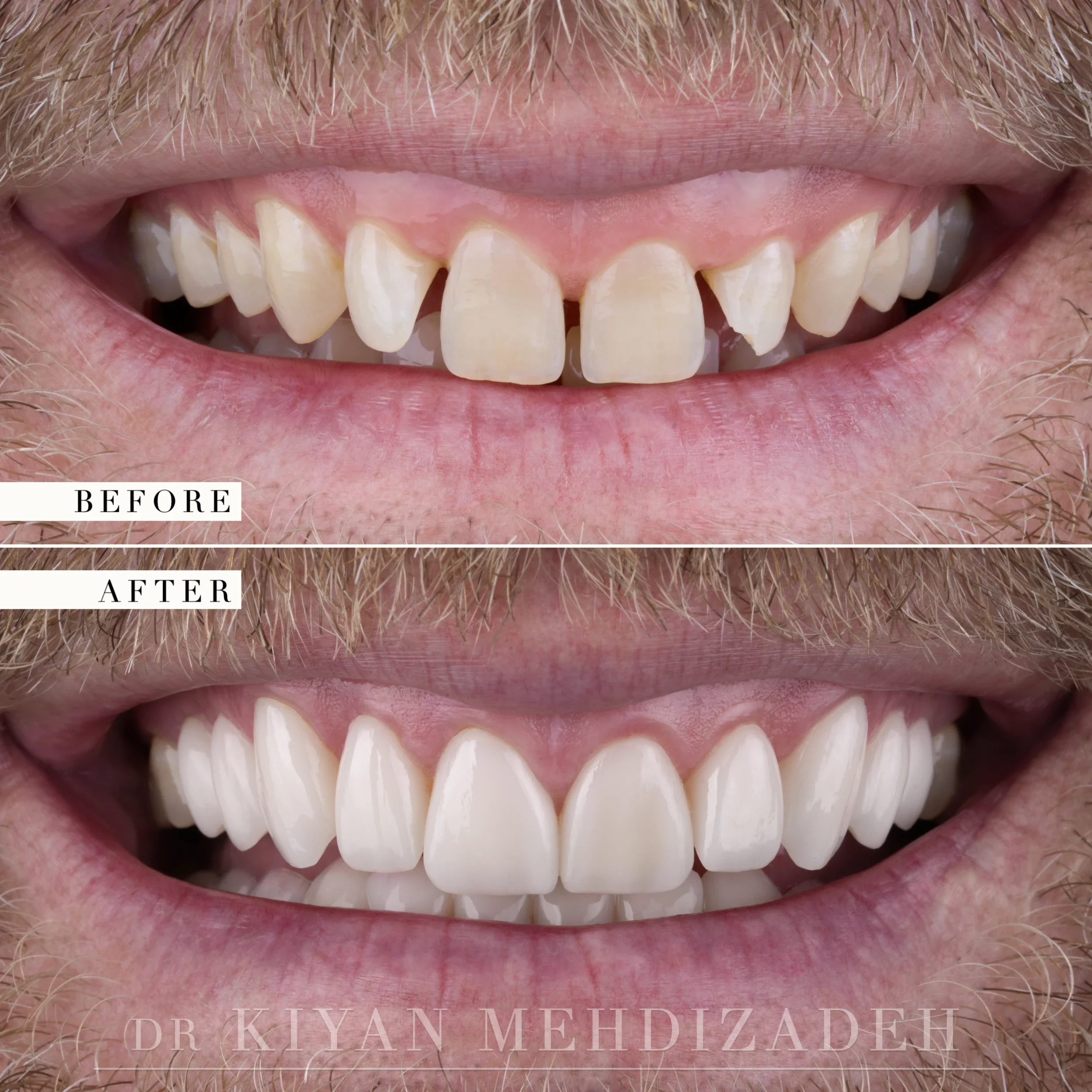
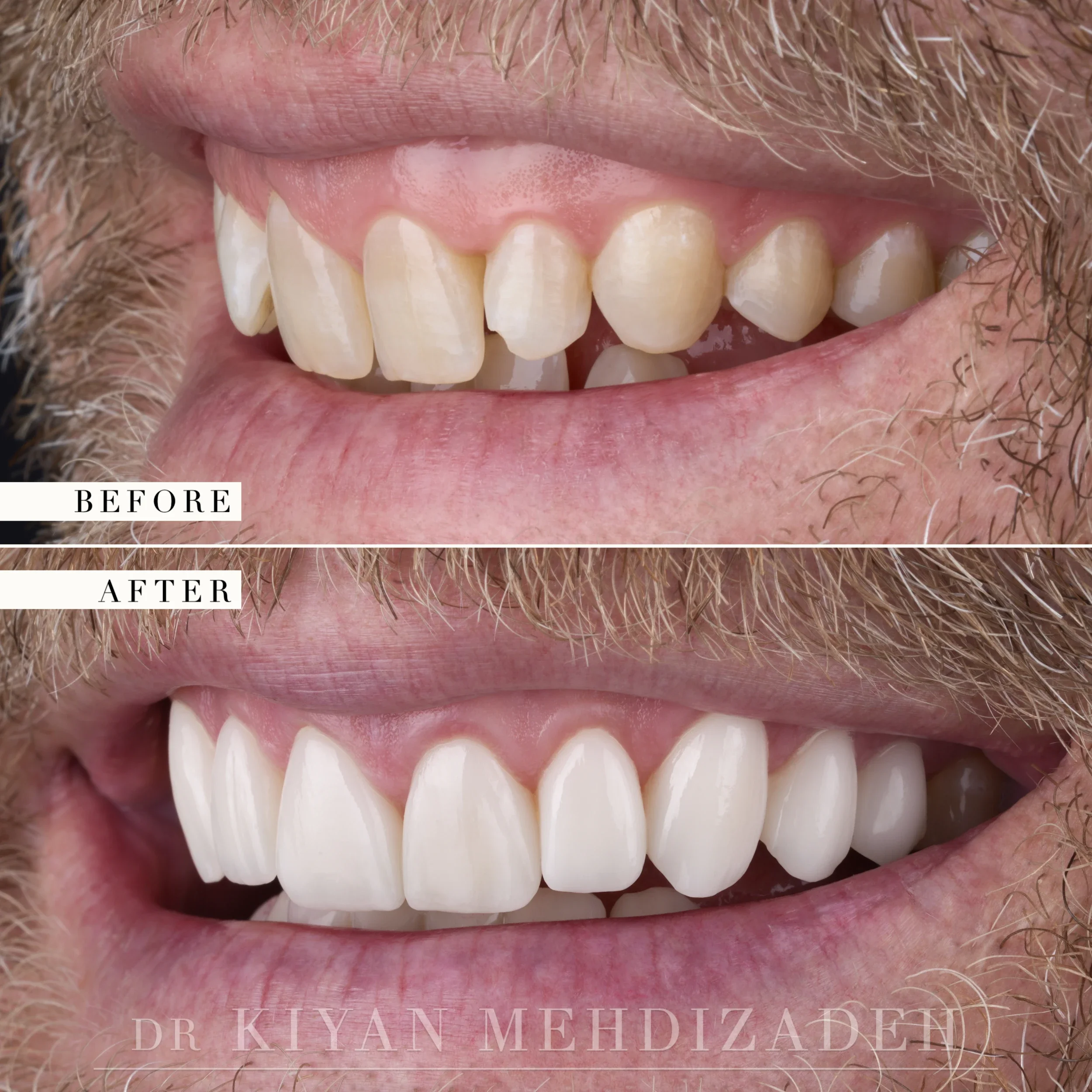
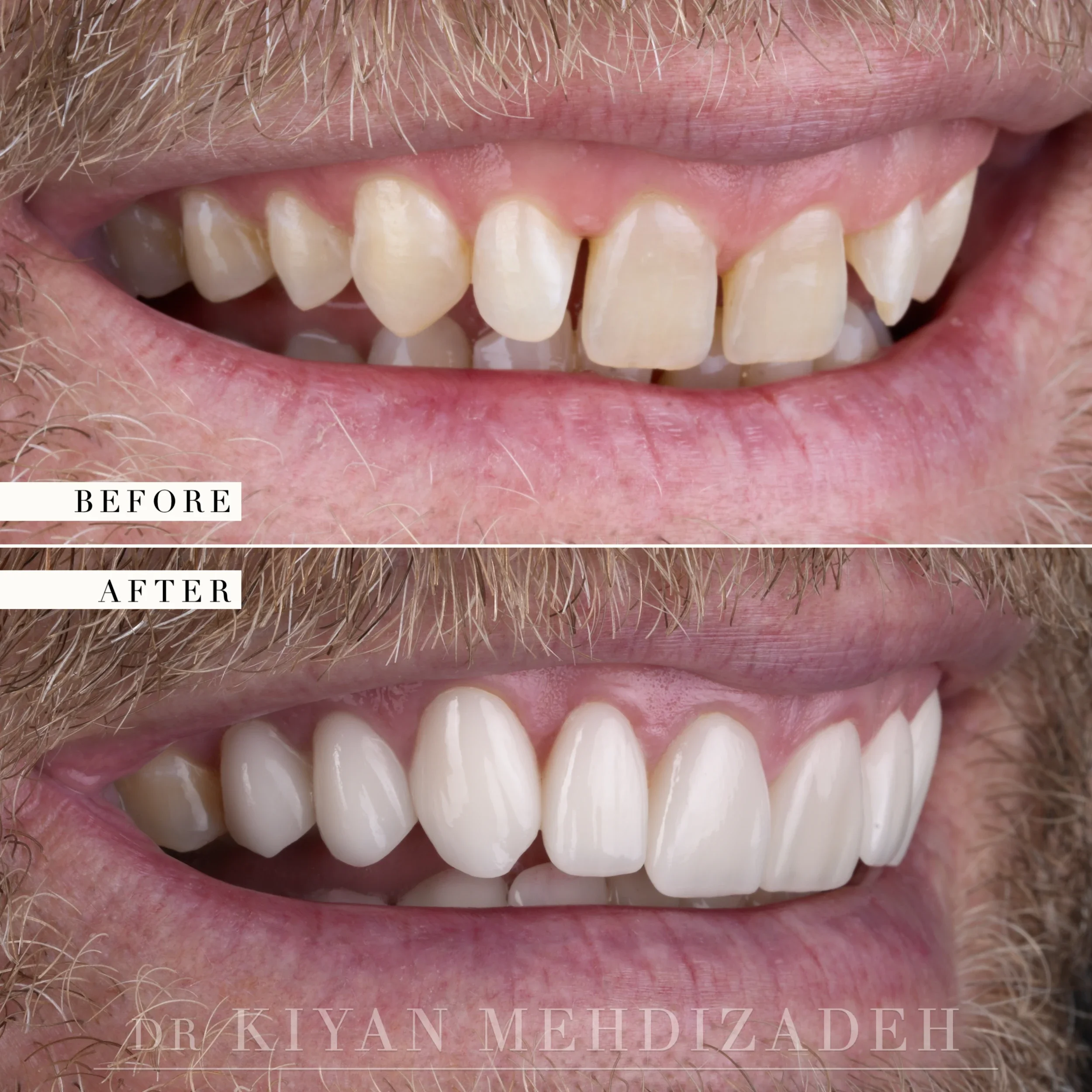
Undersized lateral incisors left spaces that would not close on their own, and a low gum line made the teeth look shorter than they were. Setting the gum line first is what allowed the teeth to be widened without looking bulky.
By Dr. Kiyan Mehdizadeh, DMD · 9460 Wilshire Blvd, Suite 850, Beverly Hills, CA 90212 · (310) 770-3335
Last Updated: August 2026
Do you have small lateral incisors and spaces that will not close?
Peg laterals are a size problem, not a spacing problem, which is why closing the gaps by moving teeth rarely satisfies anyone. The question is whether your teeth are long enough to take the extra width without going square. Send us a photo and we will tell you how the design would need to be handled, and what it would cost.
- A response within one business day. Usually much sooner.
- A real cost estimate, not a range designed to get you in the door.
- No obligation. Many patients take months to decide. That is normal.
Ask about your case
Reviewed by our treatment coordination team. Call or text (310) 770-3335 if you would rather speak now.
Request received
Our treatment coordination team will review what you sent and call you
within one business day.
If you would like to hold a consultation time now, you can do that below.
Treatment Plan by Dr. Kiyan Mehdizadeh
- Smile design, drawn from the facial proportions, establishing where the gum line and the tooth edges needed to sit.
- Guided crown lengthening, carried out to the positions set by that design rather than by eye.
- Six weeks of healing to allow the gum margins to stabilize.
- Temporary veneers, so the size, shape and shade could be tested in the mouth and revised before anything was finalized.
- Ten upper and ten lower porcelain veneers.
The Patient's Journey
This patient presented with spaces between his upper front teeth that would not close. His gum line also sat low, which made the visible portion of each tooth shorter than it should have been. The two problems were connected, and treating either one in isolation would have made the other more obvious rather than less.
The spacing was caused by peg lateral incisors, which are lateral incisors that developed narrower and more tapered than normal and are sometimes almost conical in form. Because each lateral incisor was undersized, the dental arch contained measurably less tooth material than the available space required. That surplus appeared as gaps distributed between the anterior teeth rather than concentrated in one place. This is a dimensional problem rather than a positional one. That is why it does not resolve on its own and why moving the teeth closer together relocates the spaces without eliminating them.
Understanding the Challenge
Tooth proportion is a ratio of width to length, and a porcelain restoration can only alter one of those two dimensions. Adding width to a tooth that is already short produces a square result. Adding enough width to close a diastema produces a tooth wider than it is tall, which most observers register as dental work immediately.
The length of a visible tooth is set by the gingival margin above it. That margin, not the porcelain, determines how much vertical dimension the design has to work with. Correcting the spacing without first addressing the gingival position would have required distributing the additional width across teeth with insufficient vertical dimension to carry it. The gingival position therefore had to be established surgically before any tooth was prepared for a restoration.
Treatment Goals
Establish an even gum line at a height that allows natural tooth proportions. Close the anterior spacing without producing square or oversized teeth. Correct the undersized lateral incisors. Brighten the shade while keeping the result understated. Complete treatment within ten weeks.
How Dr. Mehdizadeh Approached Treatment
A facially-driven smile design was drawn first, establishing where the gum margins and the incisal edges needed to sit. Guided crown lengthening was then carried out to the positions that design specified, rather than estimated during surgery. That distinction is the reason the gingival result matched the plan.
Crown lengthening removes excess gingival tissue and recontours the alveolar bone beneath it. This differs from a gingivectomy, which removes soft tissue only and tends to allow the tissue to migrate back toward its original position because the underlying bone level is unchanged. Recontouring the underlying alveolar bone, rather than the soft tissue alone, is what makes the new gingival position stable over time.
Six weeks of healing followed, because gingival margins continue to settle for several weeks after surgery, and porcelain bonded to a margin still in motion will show a visible line at its edge if the tissue recedes. Provisional restorations were then placed so the proposed length, width, incisal edge position and shade could be assessed intra-orally and revised before final fabrication. Twenty porcelain veneers, ten upper and ten lower, were delivered once those revisions had been agreed and transferred to the laboratory.
The Result After Ten Weeks
The gum line is even, at a height that gives the anterior teeth their proper vertical dimension, and it no longer dominates the smile. The spacing is closed, and because the teeth were lengthened before they were widened, the closure was achieved with restorations that hold a natural width-to-length ratio rather than square ones.
The shade is brighter without being uniform or flat. The additional width was distributed across several teeth rather than concentrated on the two undersized laterals. This prevents the oversized front teeth that characterize a poorly planned diastema closure. The finished result is symmetrical and unremarkable, which was the stated objective.
Frequently Asked Questions About Peg Laterals and Crown Lengthening
What are peg lateral incisors?
They are lateral incisors that formed narrower and more tapered than normal, sometimes almost conical. It is a developmental variation, it is common, and it is usually noticed because of the spaces it leaves between the front teeth.
Can veneers close spaces caused by peg laterals?
Yes, provided the width added is distributed across several teeth rather than dumped onto the two undersized ones. Adding all of the missing width to the laterals alone produces two conspicuously large teeth. The design distributes it so the proportions stay believable.
What is the difference between crown lengthening and a gingivectomy?
A gingivectomy removes gum tissue only. Crown lengthening also recontours the bone underneath, which is what makes the new gum position stable. Where the bone level is unchanged, the tissue tends to return toward where it started.
Why could the veneers not be made before the gum surgery?
Crown lengthening changes the length of every visible tooth, and the veneer design depends on that length. Veneers made beforehand would have been designed for a gum line that was about to move.
Why is there a six-week wait?
Gum margins continue to settle for several weeks after crown lengthening. Bonding porcelain before they have stabilized risks a visible line at the edge of each veneer if the tissue recedes further.
Does crown lengthening hurt?
It is carried out under local anesthesia. Most patients describe the recovery as mild soreness that settles within a few days.
Why were the lower teeth veneered as well?
Treating one arch changes its color, shape and proportion relative to the other. When the difference is visible in normal speech and smiling, treating both arches is what keeps the result coherent.
How long did treatment take?
About ten weeks in total, most of which was the healing period between the gum surgery and the final veneers.
What does treatment like this cost?
This case was $42,000, covering guided crown lengthening, temporaries and twenty porcelain veneers. Porcelain veneers range from $1,800 to $3,500 per tooth depending on complexity. We accept PPO insurance and offer financing through Proceed Finance, PatientFi, Happen Bank, CareCredit, and Cherry.
Is a gum lift always required for peg laterals?
No. Where the gum line is already at a normal height and the teeth are an appropriate length, veneers alone can redistribute the width and close the spaces. Crown lengthening is added when the visible tooth is too short for the width the design needs, because widening a short tooth without lengthening it produces a square result. It is a judgment made from measurements, not a routine step.
Last Updated: August 2026

Dr. Kiyan Mehdizadeh, DMD
Doctor of Dental Medicine
Most cosmetic dentists refer out for surgery. Most surgeons don't do cosmetic work. Dr. Mehdizadeh trained in both — implantology and bone grafting at Loma Linda and UCLA, fixed prosthodontics under Mauro Fradeani in Italy, periodontal microsurgery with Hürzeler and Zuhr in Munich, and IV sedation at the University of Alabama. That combination means complex cases involving surgery, grafting, implants, and restorative work are planned and executed by a single provider with full command of every phase.
Technical skill produces function. Taste is what produces beauty. The difference between dental work that looks like dental work and a result that looks entirely natural comes down to aesthetic judgment — proportion, texture, translucency, how light moves across a surface. That sensibility runs through everything here, from the way cases are designed to the office itself.
An in-house master ceramist and on-site laboratory allow restorations to be designed, fabricated, and refined with direct collaboration between doctor and technician — no outsourced lab work, no guesswork, no compromise on the final product. Dr. Mehdizadeh is one of few dentists with the refined ability to provide care across multiple specialties, resulting in cohesive and holistic outcomes.
Education & Credentials
- Doctor of Dental Medicine (DMD), cum laude — Boston University
- Bachelor of Science in Biology — Emory University
- Mastership in Implant Dentistry & Grafting — Loma Linda University / gIDE Institute
- Advanced Implant Therapy & Grafting — UCLA / gIDE Institute
- Implant Placement & Restoration — UCLA / Nobel Biocare
- Guided Bone Regeneration & Ridge Augmentation — gIDE Institute
- Sinus Elevation & Augmentation — gIDE Institute
- Soft Tissue Management & Grafting — gIDE Institute
- Minimally Invasive Augmentation & Autogenous Bone Management — IDEA, San Francisco
- Master Program in Fixed Prosthodontics — Fradeani Education, Italy
- Aesthetic Dentistry — UCLA School of Dentistry
- Advanced Occlusion & Bite Design — UCLA
- Periodontal Micro-Surgery — Hürzeler/Zuhr, Munich
- Micro-Endodontic Training — University of Pennsylvania
- IV Sedation — University of Alabama at Birmingham
- Injectable Therapy for TMJ & Facial Pain — American Academy of Facial Esthetics
Considering similar treatment?
Send Dr. Mehdizadeh a photo and ask what’s possible for your case.
Other cases like this one
Porcelain Veneers for Small Lateral Incisors: When Shape Matters More Than Position
Do you have peg laterals?
View case →Not All Veneers Are Equal
Unhappy with veneers you already have?
View case →Conservative Porcelain Veneers for Peg Lateral Incisors: A Young Patient’s Transformation
Do you have peg laterals?
View case →