Conservative Porcelain Veneers for Peg Lateral Incisors: A Young Patient’s Transformation
2 veneers, whitening, and gum lift for natural symmetry
By Dr. Kiyan Mehdizadeh, DMD · 9460 Wilshire Blvd, Suite 850, Beverly Hills, CA 90212 · (310) 770-3335
Last Updated: July 2026
Do you have peg laterals?
If your lateral incisors are undersized and orthodontics did not fix the proportions, you are looking at the same problem this patient had. Send us a photo and we will tell you what it would actually take, and what it would cost.
- A response within one business day. Usually much sooner.
- A real cost estimate, not a range designed to get you in the door.
- No obligation. Many patients take months to decide. That is normal.
Ask about your case
Reviewed by our treatment coordination team. Call or text (310) 770-3335 if you would rather speak now.
Request received
Our treatment coordination team will review what you sent and call you
within one business day.
If you would like to hold a consultation time now, you can do that below.
Treatment Plan by Dr. Kiyan Mehdizadeh
- Professional teeth whitening to establish optimal baseline shade for veneer matching
- Gum lift (gingival recontouring) to establish symmetrical tooth length between left and right
- Digital smile design to map spacing distribution and ideal lateral incisor proportions
- 2 custom shade-matched porcelain veneers on lateral incisors (#7 and #10)
What Are Peg Lateral Incisors and How Are They Treated Conservatively?
Peg lateral incisors are one of the most common dental developmental variations, affecting approximately 2% of the population. These congenitally undersized teeth, shaped like small cones or pegs, occur when the lateral incisors (#7 and #10, immediately adjacent to the central incisors) do not develop to their full width and shape. This young patient’s peg laterals had been a source of self-consciousness throughout her teenage years. She and her mother wanted a solution that would be both conservative, appropriate for her young age, and permanent enough to avoid repeated repairs throughout her adult life.
She had already completed orthodontic treatment to create adequate space for properly sized lateral teeth. However, orthodontics can only move teeth into position; it cannot change their inherent size or shape. The lateral incisors remained undersized at approximately 4–4.5mm in width versus the normal 6.5–7mm, and the spacing between her teeth was still asymmetrical. A conservative multi-phase plan was developed to achieve natural results with minimal intervention.
“The most conservative approach isn’t always the smallest—it’s the one that achieves lasting results with minimal intervention.”
Why Peg Lateral Incisors Require More Than Orthodontics
Peg lateral incisors result from genetic factors affecting tooth development during embryonic formation. The lateral incisors are the last of the anterior teeth to develop and are most susceptible to developmental variation. Instead of reaching their normal width of 6.5–7mm (approximately 60–65% of the central incisor width), peg laterals measure only 3–5mm and present as small, pointed teeth that appear disproportionate to the surrounding dentition. This creates visible gaps, asymmetry, and proportional imbalance that orthodontics can help manage by distributing space but cannot fundamentally resolve.
Treatment options range from composite bonding (least invasive but least durable) to porcelain veneers (moderately conservative and highly durable) to full crowns (most aggressive preparation). For a young patient with otherwise healthy teeth, the approach that preserves maximum tooth structure while delivering durable results is always preferred. In this case, that meant porcelain veneers: more durable and stain-resistant than composite bonding, but requiring far less tooth reduction than full crowns.
Patient Goals
Natural, symmetrical smile with properly proportioned lateral incisors that blend seamlessly with existing teeth. Conservative treatment appropriate for a young patient. A solution durable enough to avoid repeated repairs every few years.
How the Spacing Challenge Was Solved
Even after orthodontic treatment, the spacing between this patient’s teeth was not uniform. This is a common challenge with peg laterals: the orthodontist creates space for larger restorations, but the distribution of that space across the dental arch is not always symmetrical. Simply adding width to the undersized laterals without addressing the spacing pattern would create noticeable asymmetry that the eye detects even if the individual teeth look acceptable.
Digital smile design was used to analyze the spacing discrepancies down to fractions of a millimeter. The target was to bring each lateral incisor to approximately 6.5mm in width, achieving the ideal 60–65% ratio relative to the central incisors, while distributing any residual spacing evenly across the arch so no single gap appears larger than its counterpart.
Why Whitening Came Before Veneers
Treatment began with professional teeth whitening. This step served a critical practical purpose: porcelain veneers are fabricated to match the patient’s tooth shade at the time of treatment, and once bonded, porcelain does not respond to future whitening. By whitening all natural teeth first, the brightest possible shade was established as the baseline. The veneers were then shade-matched to the whitened teeth, ensuring seamless integration and a naturally luminous overall appearance.
How the Gum Lift Created Symmetrical Proportions
The next phase was gingival recontouring, commonly called a gum lift. Proper tooth proportions depend not just on the crown dimensions but on how much tooth is visible above the gum line. This patient’s gum levels were slightly asymmetric between left and right sides, which would have been visible in the final result even with perfectly crafted veneers. Approximately 0.5–1mm of tissue was reshaped on the affected side using microsurgery techniques. The healing period for a conservative gum lift is typically 2–3 weeks before veneer preparation can proceed.
- Professional whitening to establish optimal shade baseline for veneer matching
- Gum lift for symmetrical tooth display between left and right lateral incisors
- Digital planning to distribute spacing evenly and achieve 60–65% lateral-to-central width ratio
- 2 custom porcelain veneers shade-matched to whitened natural teeth
The Result After 8 Weeks of Treatment
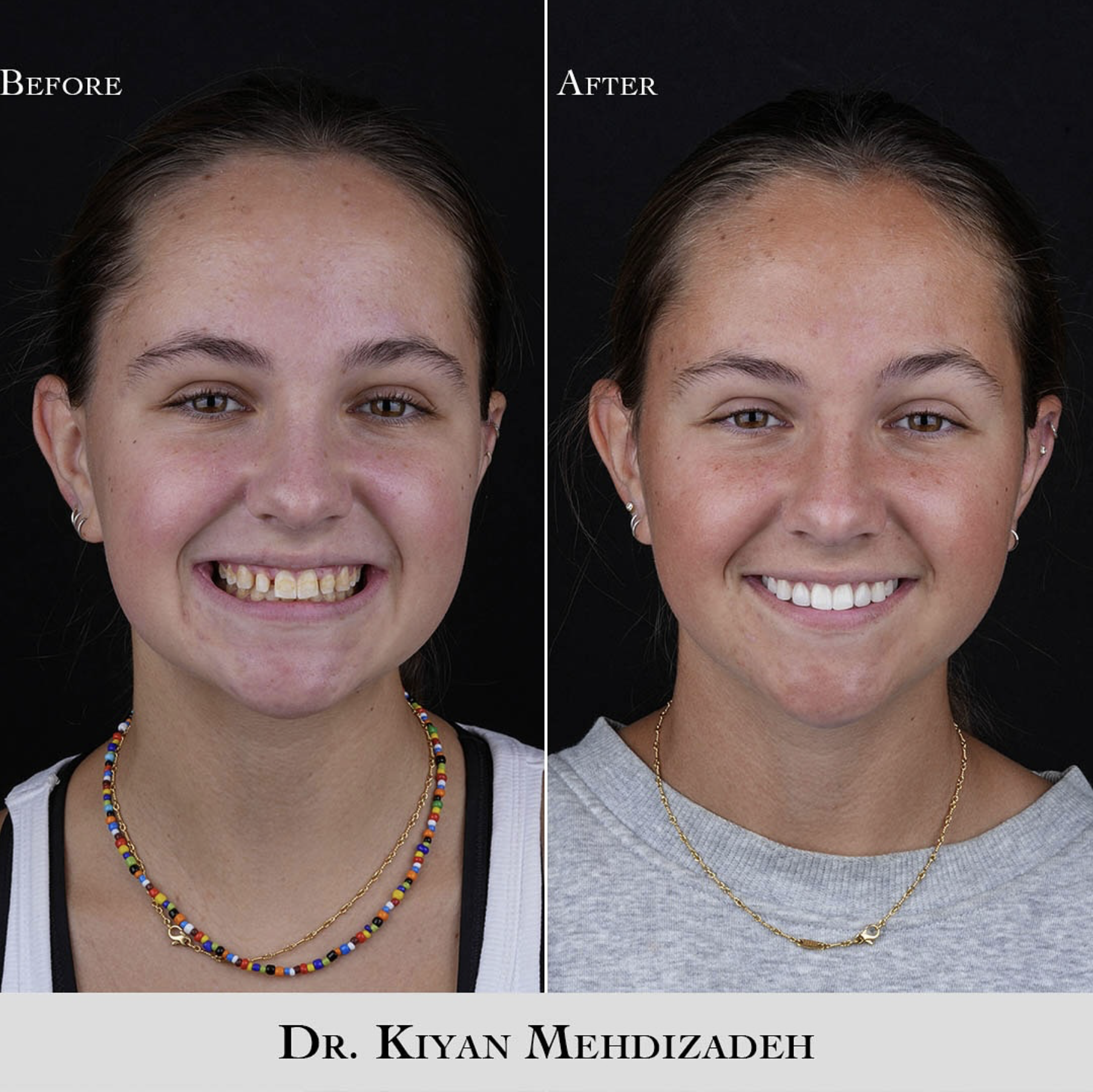
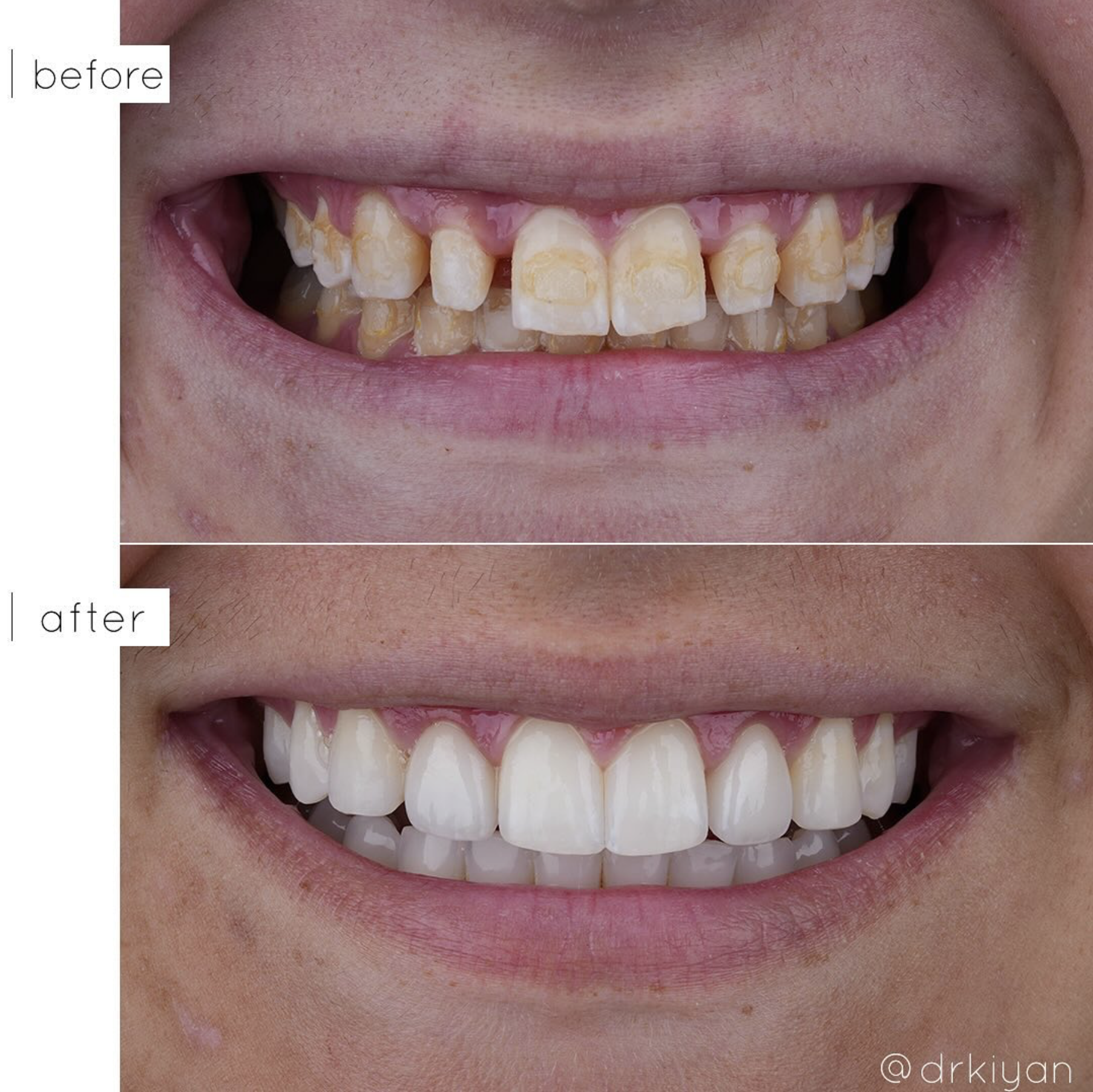
Two porcelain veneers transformed this young patient’s smile completely yet subtly. The undersized peg laterals are now properly proportioned teeth at approximately 6.5mm width that integrate seamlessly with her natural dentition. The spacing is even. The symmetry is natural. The shade blends perfectly with her whitened teeth. Most importantly, she has a smile that looks like it was always meant to be there.
For a young patient, this conservative approach preserves maximum natural tooth structure while delivering results that will last 15–20 years or longer. Unlike composite bonding, which would require replacement every 3–7 years due to staining and chipping, porcelain veneers maintain their color, surface, and structural integrity over time. This is the kind of minimal intervention that delivers maximum impact: two veneers, one complete transformation.
“Two veneers. One complete transformation.”
Frequently Asked Questions About Peg Lateral Veneers for Young Patients
What are peg lateral incisors?
Peg laterals are congenitally undersized lateral incisors (#7 and #10, the teeth immediately adjacent to the two front teeth). Instead of developing to their normal width of 6.5–7mm, they remain small at approximately 3–5mm and often present as cone-shaped or pointed teeth. This is a genetic variation affecting approximately 2% of the population, and it is slightly more common in women than men. Peg laterals are one of the most frequent reasons young patients seek cosmetic dental treatment.
Why choose porcelain veneers over composite bonding for peg laterals?
Composite bonding is less expensive upfront, but it stains over time, chips easily, and typically needs replacement every 3–7 years. For a young patient who will live with these restorations for decades, porcelain veneers offer significantly better value: they maintain their color and structural integrity for 15–20 years or longer. Porcelain is also harder than composite (6–7 GPa versus 1–2 GPa), making it far more resistant to daily biting forces.
Why was teeth whitening done before the porcelain veneers?
Porcelain veneers are custom-fabricated to match the patient’s tooth shade at the time of treatment, and once bonded, porcelain does not respond to future whitening treatments. By whitening all natural teeth first, the brightest possible baseline shade was established. The veneers were then matched to the whitened teeth, ensuring seamless color integration. If whitening were done after veneer placement, the natural teeth would lighten but the veneers would not, creating a visible mismatch.
What does a gum lift involve for peg lateral cases?
A gum lift (gingival recontouring) reshapes the gum tissue to establish symmetrical tooth display between left and right sides. For peg lateral cases, it creates the proper framework for the veneers to follow. The procedure typically removes 0.5–1mm of tissue using microsurgery techniques, heals in 2–3 weeks, and produces permanent results.
How much do porcelain veneers for peg laterals cost?
A 2-veneer peg lateral case typically ranges from $4,000 to $8,000 for the veneers (approximately $2,000–$4,000 per tooth), plus additional costs for whitening ($500–$1,000) and gum lift ($1,500–$3,000) if needed. The total treatment cost is significantly lower than full-arch veneer cases because only two teeth require restoration. Financing options are available, and detailed cost breakdowns are provided during the consultation.
How long does peg lateral veneer treatment take?
This case was completed in approximately 8 weeks. The timeline includes whitening treatment (1–2 weeks), gum lift healing (2–3 weeks), veneer preparation and laboratory fabrication (2–3 weeks), and final bonding. Cases without a gum lift component can often be completed in 4–5 weeks. Each case varies based on the specific combination of preparatory procedures needed.
How long do porcelain veneers for peg laterals last?
High-quality porcelain veneers typically last 15–20 years or longer with proper care. This is significantly longer than composite bonding (3–7 years). Porcelain does not stain from coffee, wine, or food, and maintains its surface texture and structural integrity over time. Proper maintenance includes professional cleanings every 6 months, avoiding using teeth to open packages, and wearing a night guard if grinding is present.
Are there alternatives to porcelain veneers for fixing peg laterals?
Yes. Composite bonding is the least invasive and least expensive option, but requires replacement every 3–7 years. Full porcelain crowns provide maximum coverage but require significantly more tooth reduction than veneers. For cases where the peg lateral is extremely small (under 3mm width), a no-prep or minimal-prep veneer technique may be possible since there is mostly space to fill rather than existing tooth to cover. Each case is evaluated individually to determine the most conservative effective approach.
Is 2 veneers enough or should all front teeth be treated?
When only the lateral incisors are undersized and the remaining teeth are well-shaped and properly aligned, treating just the 2 affected teeth is the most conservative and appropriate approach, particularly for young patients. Treating additional healthy teeth unnecessarily removes tooth structure that does not need modification. This case demonstrates that targeted 2-veneer treatment can achieve dramatic results when the surrounding teeth are already in good condition from prior orthodontics.
At what age can peg lateral veneers be placed?
Porcelain veneers for peg laterals can typically be placed once the teeth and jaw have finished developing, usually around age 18–20. Placing veneers too early risks complications if the teeth shift during remaining growth. For younger patients, composite bonding can serve as an interim solution until they are old enough for permanent porcelain veneers. The timing is evaluated individually based on dental maturity and development.
Last Updated: July 2026

Dr. Kiyan Mehdizadeh, DMD
Doctor of Dental Medicine
Most cosmetic dentists refer out for surgery. Most surgeons don't do cosmetic work. Dr. Mehdizadeh trained in both — implantology and bone grafting at Loma Linda and UCLA, fixed prosthodontics under Mauro Fradeani in Italy, periodontal microsurgery with Hürzeler and Zuhr in Munich, and IV sedation at the University of Alabama. That combination means complex cases involving surgery, grafting, implants, and restorative work are planned and executed by a single provider with full command of every phase.
Technical skill produces function. Taste is what produces beauty. The difference between dental work that looks like dental work and a result that looks entirely natural comes down to aesthetic judgment — proportion, texture, translucency, how light moves across a surface. That sensibility runs through everything here, from the way cases are designed to the office itself.
An in-house master ceramist and on-site laboratory allow restorations to be designed, fabricated, and refined with direct collaboration between doctor and technician — no outsourced lab work, no guesswork, no compromise on the final product. Dr. Mehdizadeh is one of few dentists with the refined ability to provide care across multiple specialties, resulting in cohesive and holistic outcomes.
Education & Credentials
- Doctor of Dental Medicine (DMD), cum laude — Boston University
- Bachelor of Science in Biology — Emory University
- Mastership in Implant Dentistry & Grafting — Loma Linda University / gIDE Institute
- Advanced Implant Therapy & Grafting — UCLA / gIDE Institute
- Implant Placement & Restoration — UCLA / Nobel Biocare
- Guided Bone Regeneration & Ridge Augmentation — gIDE Institute
- Sinus Elevation & Augmentation — gIDE Institute
- Soft Tissue Management & Grafting — gIDE Institute
- Minimally Invasive Augmentation & Autogenous Bone Management — IDEA, San Francisco
- Master Program in Fixed Prosthodontics — Fradeani Education, Italy
- Aesthetic Dentistry — UCLA School of Dentistry
- Advanced Occlusion & Bite Design — UCLA
- Periodontal Micro-Surgery — Hürzeler/Zuhr, Munich
- Micro-Endodontic Training — University of Pennsylvania
- IV Sedation — University of Alabama at Birmingham
- Injectable Therapy for TMJ & Facial Pain — American Academy of Facial Esthetics
Considering similar treatment?
Send Dr. Mehdizadeh a photo and ask what’s possible for your case.