Not All Veneers Are Equal
Replacing bulky, opaque veneers with natural, harmonized restorations
By Dr. Kiyan Mehdizadeh, DMD · 9460 Wilshire Blvd, Suite 850, Beverly Hills, CA 90212 · (310) 770-3335
Last Updated: August 2026
Unhappy with veneers you already have?
Veneers that are too white, too bulky, or too uniform do not look like teeth. They look like dental work. Replacing them well is harder than doing it right the first time. Send us a photo and we will tell you honestly what it would take.
- A response within one business day. Usually much sooner.
- A real cost estimate, not a range designed to get you in the door.
- No obligation. Many patients take months to decide. That is normal.
Ask about your case
Reviewed by our treatment coordination team. Call or text (310) 770-3335 if you would rather speak now.
Request received
Our treatment coordination team will review what you sent and call you
within one business day.
If you would like to hold a consultation time now, you can do that below.
Treatment Plan by Dr. Kiyan Mehdizadeh
- Removal of existing upper veneers
- Gum lift (gingivectomy) to harmonize gum line architecture
- Upper veneer replacement with refined proportions and translucency
- Lower veneers to complete the smile harmonization
When Veneers Don't Feel Like You
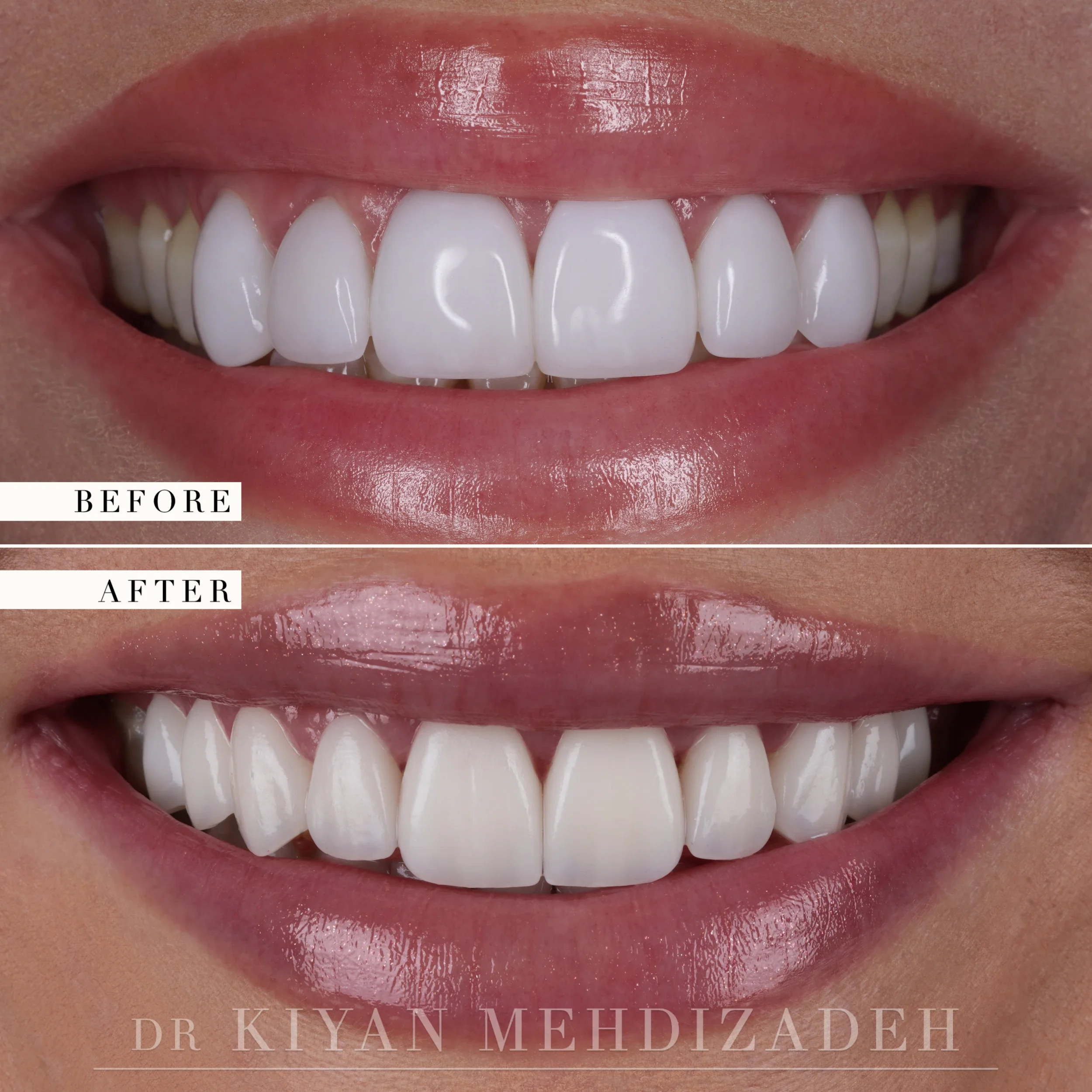
Not all veneers are equal. This young patient arrived with a recent set of upper veneers from another provider that never felt right—bulky, opaque, and not hers. She had lost confidence in her smile and never accustomed to the veneers. What should have been a transformative experience had instead left her feeling disconnected from her own appearance.
The challenge wasn't simply replacing one set of veneers with another. It required understanding why the original work failed aesthetically and functionally, then designing an approach that would restore both her smile and her confidence in cosmetic dentistry.
"The work should disappear. What remains should simply look like you."
Why Do Some Veneers Look Fake?
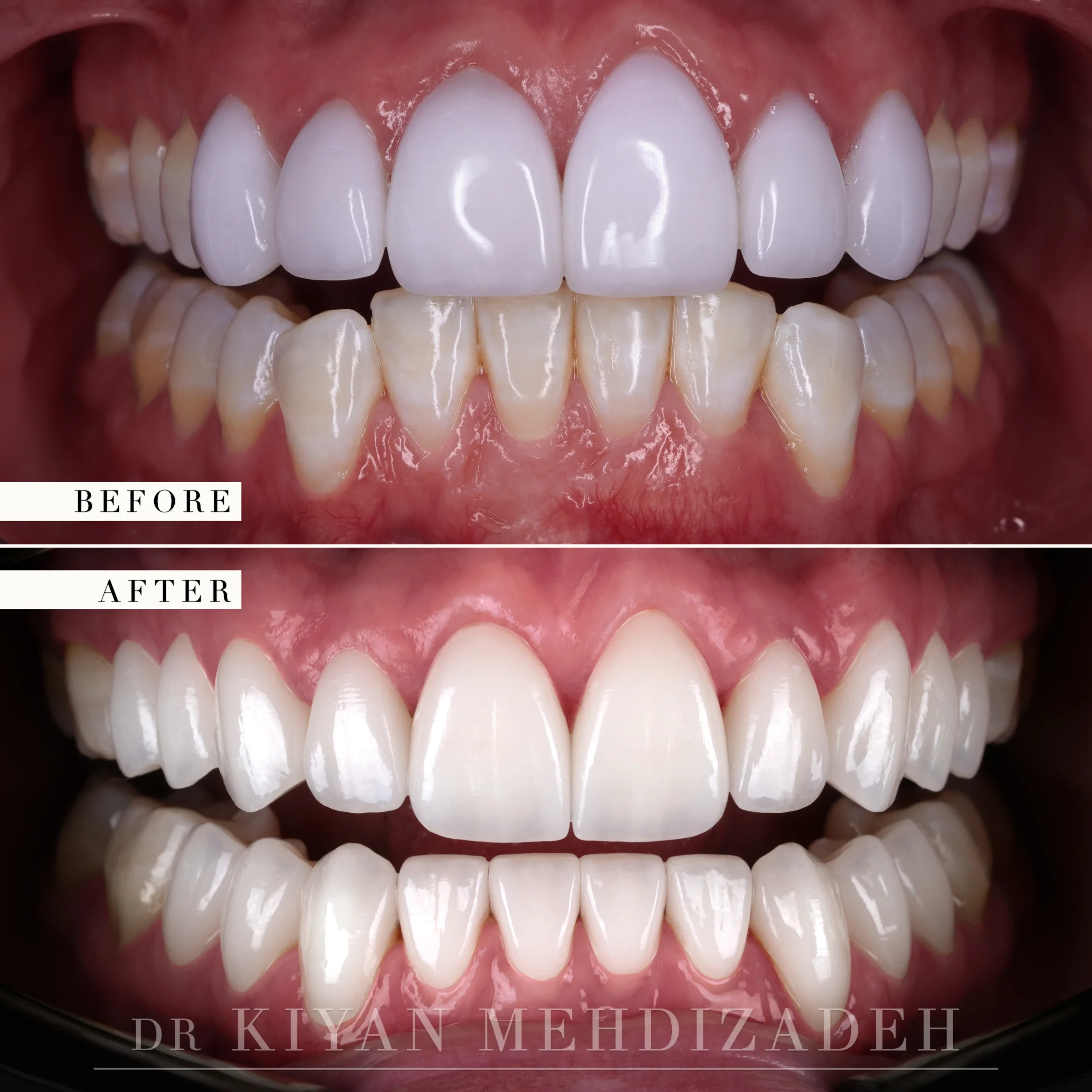
Upon examination, Dr. Mehdizadeh identified several issues with the existing veneers. The proportions were too bulky, creating an artificial appearance that stood out rather than blended. The opacity blocked the natural light transmission that gives teeth their vitality. And the shape didn't complement her natural facial anatomy—they looked like veneers, not teeth. These are common problems when veneers are designed from a one-size-fits-all approach rather than being customized to the individual patient's facial structure, lip dynamics, and skin tone.
Poor veneer outcomes typically stem from one or more of these factors: insufficient tooth preparation creating excessive thickness, use of opaque porcelain that blocks light transmission, failure to consider the patient's natural tooth color underneath, and ignoring the relationship between gum architecture and tooth proportions. In this case, the gum line itself also needed correction to establish the proper framework for truly natural-looking restorations.
Initial Findings
Comprehensive examination revealed: bulky veneer proportions creating artificial appearance, excessive porcelain opacity blocking natural light transmission, shade mismatch with patient's natural complexion, shape inconsistent with facial anatomy, and gum line asymmetry requiring correction before veneer replacement.
How Dr. Mehdizadeh Approached the Replacement
Rather than simply matching what was there, Dr. Mehdizadeh started from first principles: what would naturally beautiful teeth look like on this particular patient? This meant analyzing her facial proportions, lip line, skin tone, and the way light interacts with her existing dental structures. The facially-driven digital smile design mapped out exactly what the final result should look like before any dental work began.
The treatment involved several coordinated steps, each building on the previous one:
- Careful removal of existing veneers and evaluation of underlying tooth structure
- Slimmed the proportions to eliminate the bulky appearance
- Corrected the color to match her natural complexion
- Restored translucency for lifelike light interaction
- Shaped each tooth to complement her natural anatomy
- Performed a gum lift to harmonize the gum line architecture
- Extended treatment to lower arch for complete harmonization
- Provisional restorations to verify aesthetics before final bonding
The gum lift was a critical component that is frequently overlooked in veneer cases. Even perfectly crafted veneers will look wrong if the gum line framing them is uneven or positioned incorrectly. A gingivectomy was performed to reshape the gum tissue, creating symmetrical gum margins that would provide the ideal framework for the new restorations.
The Result: Veneers That Look Like Natural Teeth
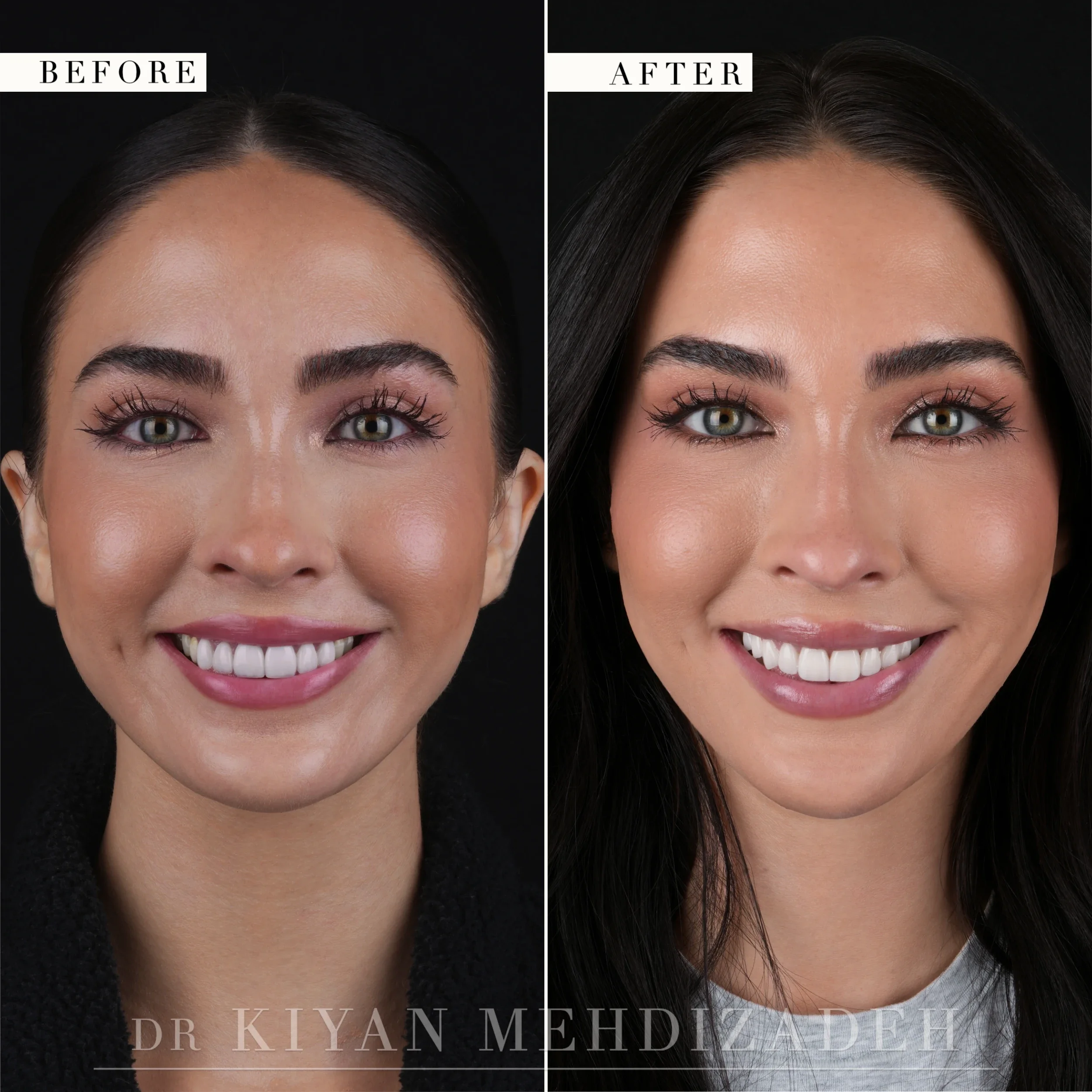
Upper and lower, fully harmonized. The new restorations don't announce themselves—they simply look like beautiful natural teeth. The patient regained not just an improved smile, but trust in cosmetic dentistry and comfort in her own appearance. The translucency of the new porcelain allows light to pass through the way it does with natural enamel, and the refined proportions integrate seamlessly with her facial features.
This case underscores an important principle: cosmetic dentistry isn't just about making teeth whiter or more uniform. It's about understanding individual anatomy, facial harmony, and the subtle qualities that make teeth look natural. When done correctly, the best compliment is when no one notices the work at all.
"Replacing veneers is harder than placing them. You're correcting someone else's decisions."
Choosing the Right Cosmetic Dentist for Veneer Replacement
Veneer replacement is more complex than initial veneer placement. The dentist must assess the condition of the underlying tooth structure after the old veneers are removed, manage any damage from the previous preparation, and design restorations that correct the specific aesthetic failures of the original work. It demands both prosthodontic training and a refined understanding of dental material science—how porcelain interacts with light, how thickness affects translucency, and how shade and surface texture create the illusion of natural enamel.
Frequently Asked Questions About Veneer Replacement
Can existing veneers be replaced?
Yes, veneers can be replaced if they are damaged, aesthetically unsatisfactory, or outdated. The process involves carefully removing the existing veneers, evaluating the underlying tooth structure for any damage or decay, and designing new restorations that address the specific shortcomings of the original work. The quality of the replacement depends heavily on the precision of the removal process and the design methodology used for the new restorations.
What causes veneers to look fake or bulky?
Several factors contribute to unnatural-looking veneers: insufficient tooth preparation creating excessive thickness, use of opaque porcelain that blocks light transmission, poor shade matching, and failure to consider individual facial anatomy. Quality veneers should be virtually indistinguishable from natural teeth, with appropriate translucency and proportions customized to each patient.
How much does veneer replacement cost in Beverly Hills?
This case was $38,000, covering a gum lift and twenty porcelain veneers, ten upper and ten lower. Porcelain veneers range from $1,800 to $3,500 per tooth, depending on the complexity of the case and whether additional procedures like gum lifts are needed. A consultation provides a personalized treatment plan and accurate quote based on your specific needs.
How long does a veneer replacement take?
A veneer replacement typically requires 2-4 appointments over 3-6 weeks. The first visit involves removing the old veneers and taking impressions. Provisional restorations are placed while the permanent veneers are fabricated by the ceramist. If a gum lift is needed, additional healing time of 2-4 weeks may be required before final veneer placement.
What is a gum lift and why is it needed with veneers?
A gum lift (gingivectomy) reshapes the gum line to create better symmetry and proportion. Even perfectly crafted veneers will look wrong if the gum line framing them is uneven or positioned incorrectly. The procedure establishes the proper framework for the veneers and achieves harmonious gum-to-tooth relationships across the entire smile.
Why treat upper and lower teeth together?
A harmonized smile requires coordination between upper and lower arches. Treating only one arch can create mismatches in color, size, or shape that are visible when speaking or smiling. Comprehensive upper and lower treatment ensures the entire visible smile works together aesthetically and functionally.
How long do replacement porcelain veneers last?
High-quality porcelain veneers typically last 15-20 years or longer with proper care. Longevity depends on material quality, precision of placement, oral hygiene habits, and avoiding habits that stress the restorations like nail biting, ice chewing, or teeth grinding without a night guard.
Are there alternatives to replacing bad veneers?
In some cases, minor issues like surface staining or small chips can be addressed with polishing or bonding without full replacement. However, if the underlying problems are structural—bulky proportions, poor opacity, or incorrect shape—replacement is typically the only option that produces a satisfactory result. Each case should be evaluated individually to determine the most conservative effective approach.
Is it safe to replace veneers? Will it damage my teeth?
Veneer replacement is safe when performed by an experienced cosmetic dentist. The old veneers are carefully removed to preserve as much natural tooth structure as possible. The remaining tooth structure is evaluated before proceeding, and the treatment plan is adjusted based on what is found underneath to ensure the new veneers are both beautiful and structurally sound.
Who is the best dentist for veneer replacement in Beverly Hills?
Look for a dentist with advanced prosthodontic training, experience in corrective veneer work specifically, and an in-house ceramist or laboratory. Veneer replacement requires different skills than initial placement—the dentist must manage compromised tooth structure, correct previous design failures, and produce restorations that surpass the original work. Ask to see before-and-after cases of veneer replacements, not just initial veneer placements.
Last Updated: August 2026

Dr. Kiyan Mehdizadeh, DMD
Doctor of Dental Medicine
Most cosmetic dentists refer out for surgery. Most surgeons don't do cosmetic work. Dr. Mehdizadeh trained in both — implantology and bone grafting at Loma Linda and UCLA, fixed prosthodontics under Mauro Fradeani in Italy, periodontal microsurgery with Hürzeler and Zuhr in Munich, and IV sedation at the University of Alabama. That combination means complex cases involving surgery, grafting, implants, and restorative work are planned and executed by a single provider with full command of every phase.
Technical skill produces function. Taste is what produces beauty. The difference between dental work that looks like dental work and a result that looks entirely natural comes down to aesthetic judgment — proportion, texture, translucency, how light moves across a surface. That sensibility runs through everything here, from the way cases are designed to the office itself.
An in-house master ceramist and on-site laboratory allow restorations to be designed, fabricated, and refined with direct collaboration between doctor and technician — no outsourced lab work, no guesswork, no compromise on the final product. Dr. Mehdizadeh is one of few dentists with the refined ability to provide care across multiple specialties, resulting in cohesive and holistic outcomes.
Education & Credentials
- Doctor of Dental Medicine (DMD), cum laude — Boston University
- Bachelor of Science in Biology — Emory University
- Mastership in Implant Dentistry & Grafting — Loma Linda University / gIDE Institute
- Advanced Implant Therapy & Grafting — UCLA / gIDE Institute
- Implant Placement & Restoration — UCLA / Nobel Biocare
- Guided Bone Regeneration & Ridge Augmentation — gIDE Institute
- Sinus Elevation & Augmentation — gIDE Institute
- Soft Tissue Management & Grafting — gIDE Institute
- Minimally Invasive Augmentation & Autogenous Bone Management — IDEA, San Francisco
- Master Program in Fixed Prosthodontics — Fradeani Education, Italy
- Aesthetic Dentistry — UCLA School of Dentistry
- Advanced Occlusion & Bite Design — UCLA
- Periodontal Micro-Surgery — Hürzeler/Zuhr, Munich
- Micro-Endodontic Training — University of Pennsylvania
- IV Sedation — University of Alabama at Birmingham
- Injectable Therapy for TMJ & Facial Pain — American Academy of Facial Esthetics
Considering similar treatment?
Send Dr. Mehdizadeh a photo and ask what’s possible for your case.
Other cases like this one
Complete Smile Redesign: Correcting Bulky, Unnatural Veneers from Abroad
Veneers done abroad that do not look like you?
View case →Natural, Under the Radar
Want it to look like nothing was done?
View case →Replacing Old Bonding With Veneers - and Rebuilding the Back Teeth
Tired of re-fixing the same chipped tooth?
View case →