Ceramic (Zirconia) Dental ImplantsA metal-free implant, and when it is the right one.
A zirconia implant does the same job as a titanium one: it sits in the bone where the root used to be and carries a crown. It is white, and it contains no metal. Dr. Mehdizadeh places both, and chooses between them for each site.
Single implant with crown: $7,000
$84/month 144 payments at 9.99% APR, on approved credit.
Your consultation, including a 3D X-ray (CT scan), is free.
Send photos if you have them. Either way, we reply with a cost. No obligation.
Ask about ceramic implants
Reviewed by our treatment coordination team. Call or text (310) 770-3335 if you would rather speak now.
Request received
A treatment coordinator will call you within two hours during office hours (Monday to Friday, 9 to 4).
To talk now, call (310) 770-3335.
- A call within two hours during office hours.
- A written cost from us, before you commit to anything.
- No obligation. Many patients take weeks to decide. That is normal.
- Free consultation and 3D X-ray (CT scan)
- Private practice since 2012
- IV sedation in our own office
- In-house dental laboratory
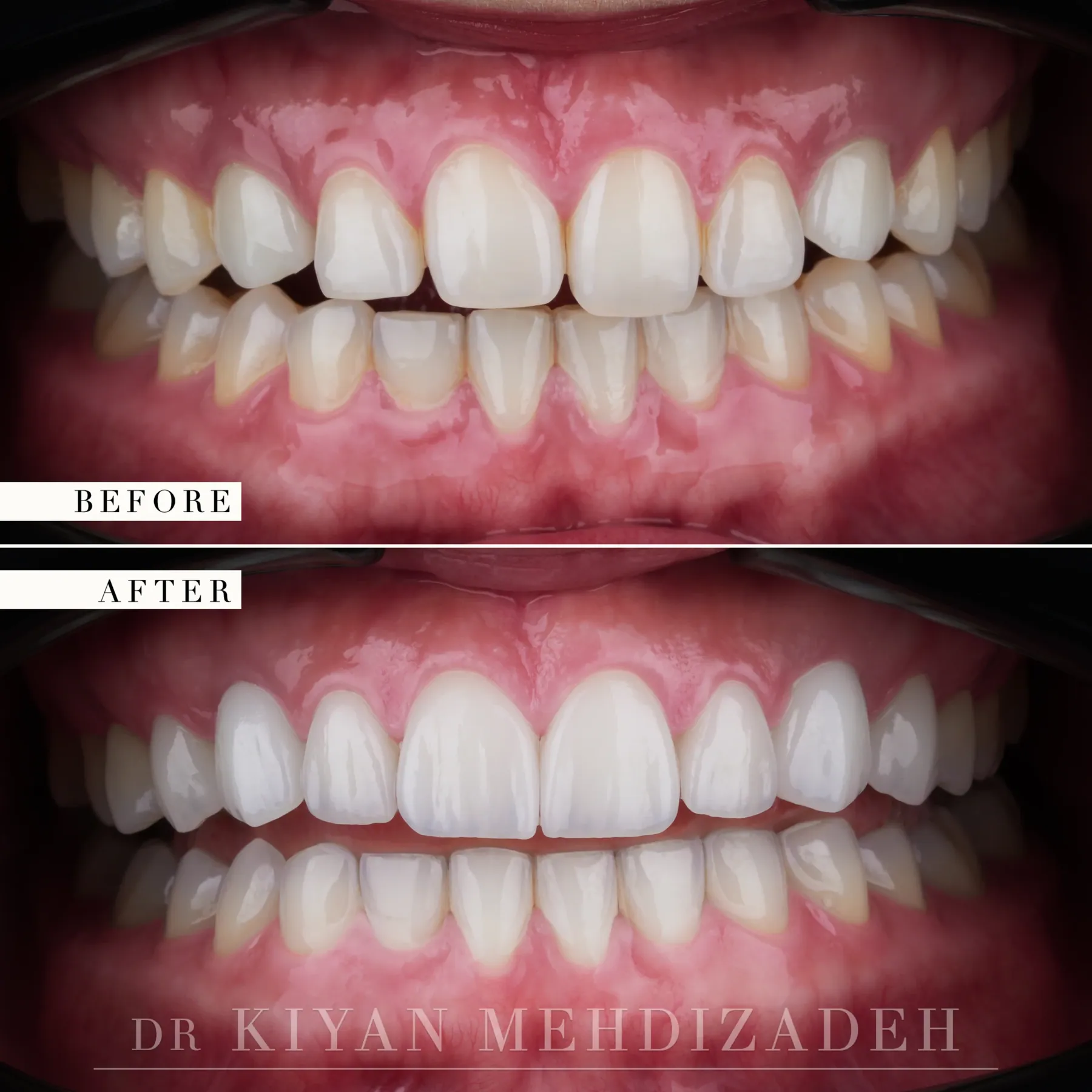
Before, and after.
Every smile on this site was made here: our patients, our laboratory, our work.
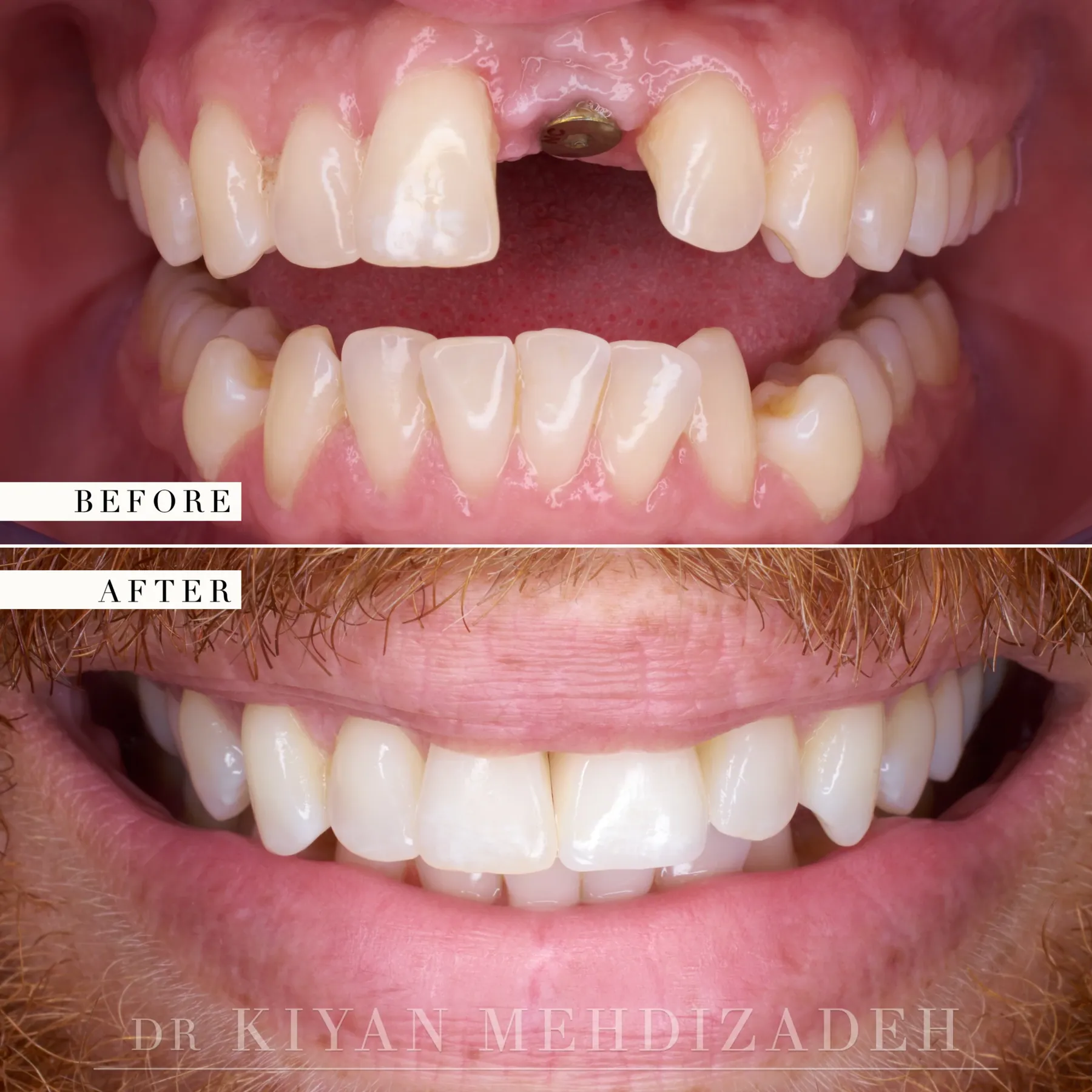
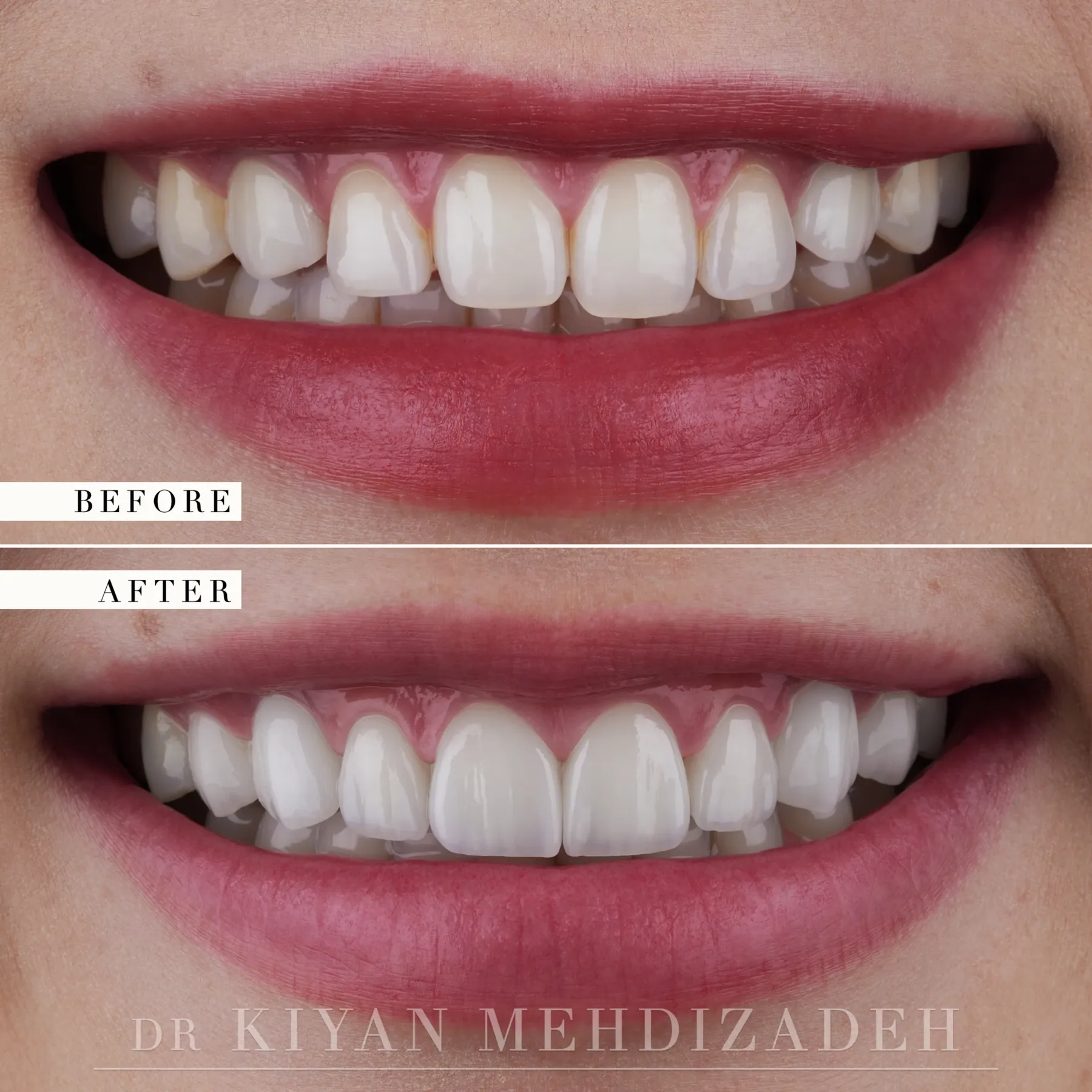
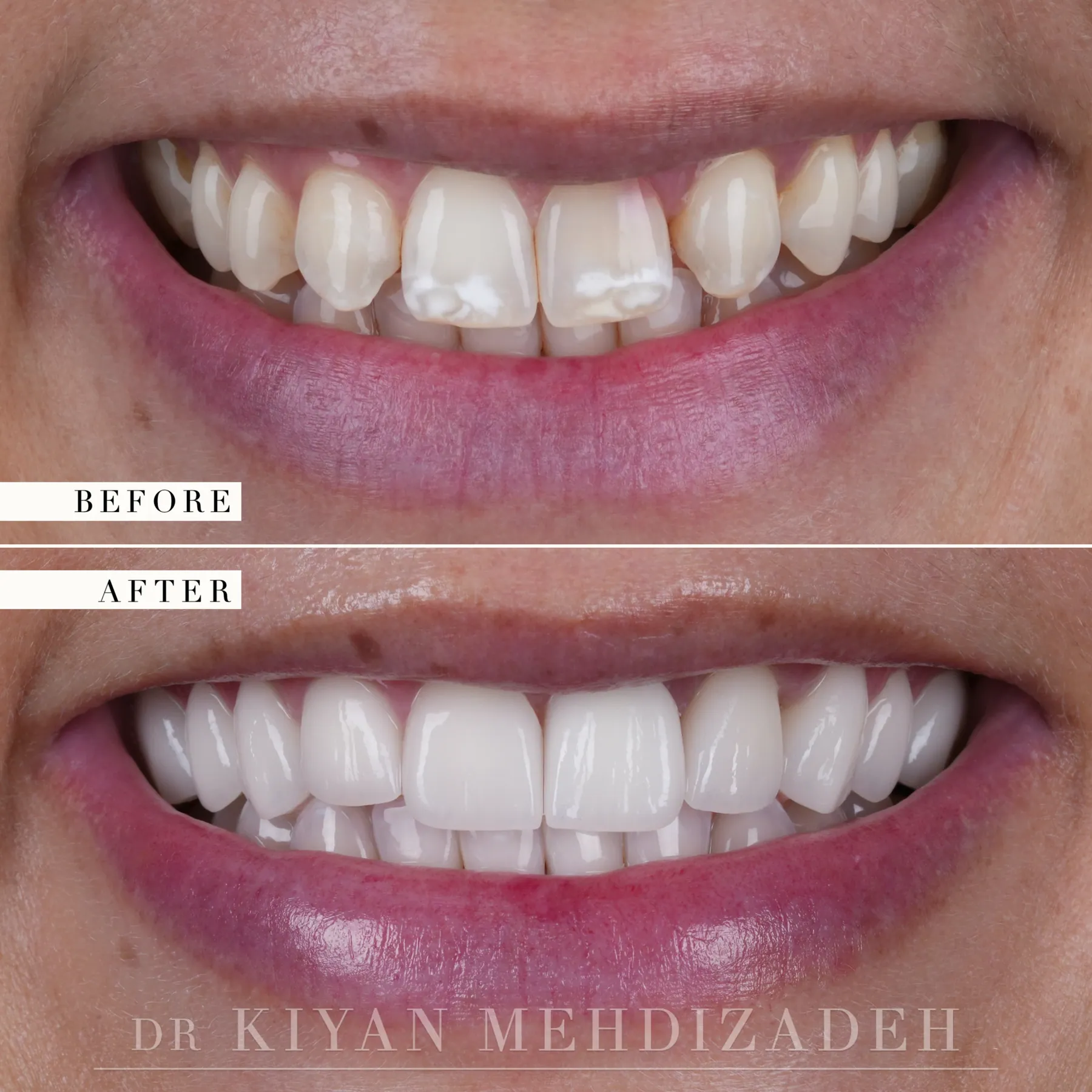
What a ceramic implant is.
This page explains what a ceramic implant is made of, how it differs from titanium, what the published evidence shows about how long each lasts, and what decides which one suits a site.
Zirconia is zirconium dioxide, a white ceramic. It is the same family of material our laboratory uses under porcelain for strong crowns and bridges, as in the crown in this case. Made into an implant, it is shaped and surfaced to be placed in the jaw the way a titanium implant is, and the bone grows against its surface and holds it, the process called osseointegration.
Most implants are titanium, the material with the longest record in dentistry. Titanium is gray, and a gray tint can show through thin gum. Zirconia, a ceramic, is the metal-free alternative, and it is white. Dr. Mehdizadeh places both.
There is one difference in design worth knowing. Most titanium implants come in two pieces: the implant in the bone, and an abutment, the connector that rises through the gum, fixed to it later. Most ceramic implants on the market, and most of those studied, are made in one piece, with the abutment part of the implant itself. Two-piece ceramic implants exist, but far fewer of them have been studied.
Why the color under the gum matters.
At an upper front tooth, the gum over an implant can be thin. Where it is, the gray of titanium can show through as a shadow at the gum line, and the crown can look darker at its neck than the natural tooth beside it.
A white implant takes that risk away at its source. It is not the only way to manage it. On a titanium implant, a custom abutment made of zirconia keeps metal away from thin gum. In this case, two implants placed years earlier were healthy and stayed where they were, and their new crowns went onto custom zirconia abutments, so no metal color shows through at the gum line.
What decides how a front-tooth implant looks is still mostly where it sits and how the gum is shaped around it: the gum line, the small triangle of gum between the teeth, and the thin bone on the lip side. Single tooth implants explains each of them.
How long ceramic implants last, compared with titanium.
Titanium has the longer record. A 2019 review in the Journal of Dentistry pooled studies that followed implants for at least ten years. About 96 percent were still in place at ten years, or about 93 percent once the patients lost to follow-up were allowed for.
For zirconia, the strongest evidence reaches five years. A review prepared for the 2023 consensus conference of the International Team for Implantology found 97 percent of zirconia implants still in place at five years, with bone levels and gum health similar to published titanium figures. It rested on 277 implants, against thousands in the titanium reviews, and on no randomized trials.
Beyond five years the picture is thinner and less consistent. A 2024 review of 25 studies in Clinical Oral Investigations estimated 95 percent survival at ten years, while cautioning that few patients had been followed that long. A study published in Clinical Oral Implants Research in 2026 followed 66 single-tooth implants of one one-piece zirconia design for ten years and found 73 percent still in place; its authors did not recommend that implant for routine use.
Earlier ceramic implants broke more often. In the 2024 review, 26 of 4,017 zirconia implants fractured, almost all of them designs no longer sold, many of them narrow. Implants whose abutment part had been ground down with a drill after placement did worse.
Read together, modern zirconia implants have performed comparably to titanium over the first five years, and titanium has the larger and longer body of evidence beyond that.
What decides which implant suits you.
Wanting no metal. Some patients want nothing metal in the mouth. True titanium allergy is rare: a study of 1,500 implant patients found it in 0.6 percent. Zirconia is the option for anyone who wants a metal-free implant, for that reason or any other.
Where the tooth is. At a front tooth with thin gum, a white implant removes the chance of a gray shadow. At a back tooth, where the gum line is not seen, the color of the implant matters far less.
The bone and the angle. A one-piece implant has its abutment built in, so the angle at which the crown will sit is set at surgery. It needs bone that lets the implant go exactly where the crown needs it, and grinding the abutment afterwards to correct the angle is linked with more failures in the published data. Where a site needs grafting, or the implant has to be angled, a two-piece design gives more room to adjust.
Healing. A one-piece implant rises through the gum from the day it is placed, so it has to be kept out of the bite while the bone grows against it.
Dr. Mehdizadeh plans every implant on the 3D X-ray (CT scan), and examines the gum at the site before he chooses the implant for it.
One price, front tooth or back.
Each case is quoted as a whole, and the price covers the treatment from start to finish.
Single implant with a custom shade-matched crown
$84/month
$7,000
144 payments at 9.99% APR, on approved credit.
Includes the extraction, any socket graft and the temporary tooth. The crown is layered by hand so its color matches the teeth beside it. Single tooth implants
The consultation, including a 3D X-ray (CT scan), is complimentary. Most PPO plans contribute toward the cost of treatment. Financing is available.

One doctor, from the implant to the crown.
Dr. Mehdizadeh places the implant, ceramic or titanium, performs any grafting it needs and designs the crown. Our laboratory, in the same building, makes the crown and matches it to your own teeth.
Find out what your implant would cost.
Tell us what is going on. Add photos if you have them; if not, we will call and talk it through.
Or call (310) 770-3335.
Ask about ceramic implants
Reviewed by our treatment coordination team. Call or text (310) 770-3335 if you would rather speak now.
Request received
A treatment coordinator will call you within two hours during office hours (Monday to Friday, 9 to 4).
To talk now, call (310) 770-3335.
Frequently Asked Questions
Are zirconia implants as reliable as titanium implants?
Over five years, published studies of modern zirconia implants report survival similar to titanium, about 97 percent. Titanium has been studied in far larger numbers and for longer, and data on zirconia beyond five years is limited and less consistent.
Are ceramic implants metal-free?
Yes. A zirconia implant is a ceramic, zirconium dioxide, and the implant itself contains no metal.
Do I need a ceramic implant if I am allergic to metal?
True titanium allergy is rare; a study of 1,500 implant patients found it in 0.6 percent. If you want no metal in your mouth, for that reason or any other, a zirconia implant is the option, and Dr. Mehdizadeh will tell you whether your site suits one.
Will a titanium implant show gray through my gum?
It can, at a front tooth where the gum is thin. A zirconia implant, or a custom zirconia abutment on a titanium implant, keeps metal away from thin gum. One of the cases on this page used custom zirconia abutments for that reason.
Can a ceramic implant break?
It can, as any implant can, but fractures have become uncommon. In a 2024 review, 26 of 4,017 zirconia implants fractured, almost all of them earlier designs no longer sold, many of them narrow.
Does Dr. Mehdizadeh place both kinds?
Yes. He places titanium and zirconia implants and chooses between them for each site, from the 3D X-ray (CT scan) and an examination of the gum.
How much does a ceramic implant cost?
A single implant with a custom shade-matched crown is $7,000, including the extraction, any socket graft and the temporary tooth. $84/month: 144 payments at 9.99% APR, on approved credit. The consultation, including a 3D X-ray (CT scan), is complimentary.
Last Updated: October 2026