Correcting a New Smile Around Old Implants
Working with imperfect implant positions to create a harmonious smile
By Dr. Kiyan Mehdizadeh, DMD · 9460 Wilshire Blvd, Suite 850, Beverly Hills, CA 90212 · (310) 770-3335
Last Updated: August 2026
Have implants that never looked right?
Implants can be placed correctly and still leave a smile that reads as dental work, because the crowns, the gumline, and the teeth around them were never designed as one thing. Send us a photo and we will tell you what could be harmonised.
- A response within one business day. Usually much sooner.
- A real cost estimate, not a range designed to get you in the door.
- No obligation. Many patients take months to decide. That is normal.
Ask about your case
Reviewed by our treatment coordination team. Call or text (310) 770-3335 if you would rather speak now.
Request received
Our treatment coordination team will review what you sent and call you
within one business day.
If you would like to hold a consultation time now, you can do that below.
Treatment Plan by Dr. Kiyan Mehdizadeh
- Comprehensive smile analysis accounting for existing implant positions at #6 and #11
- Gum lift (gingival recontouring) to create even, uniform gum architecture across all teeth
- Digital design of slender tooth proportions to replace short, wide tooth appearance
- 6 porcelain veneers on natural teeth with custom shade matching
- 2 new implant crowns on existing implants (#6 and #11) with custom zirconia abutments
What Are Congenitally Missing Canines and How Are They Treated When Implants Already Exist?
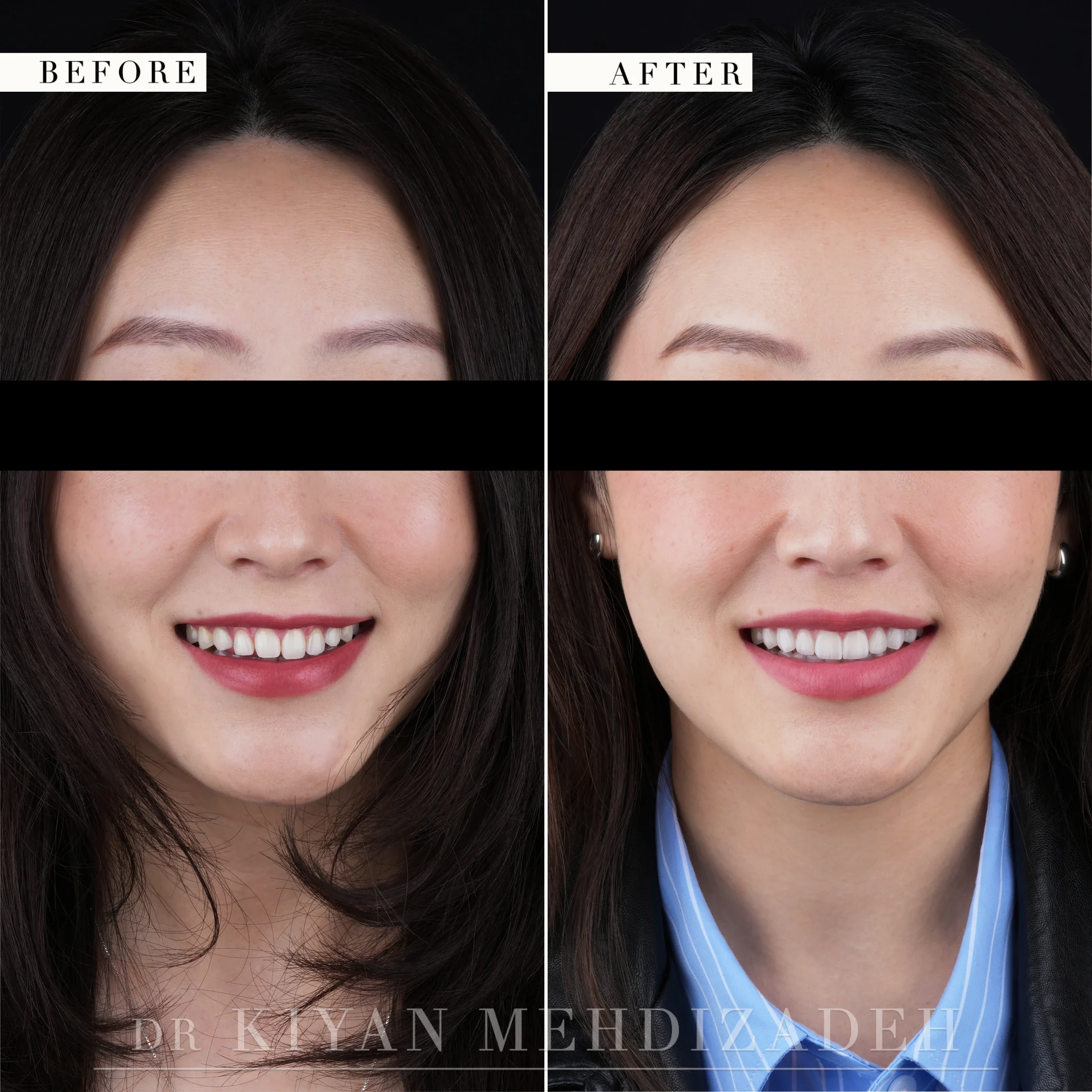
Congenitally missing teeth are permanent teeth that never develop due to genetic factors. While wisdom teeth are the most commonly absent, upper canines are among the more functionally and aesthetically significant teeth that can fail to develop. This patient was born without her upper canine teeth at positions #6 and #11. As a teenager, she had two dental implants placed to replace the missing canines. At the time, it was a reasonable solution. But the body had other plans, and a treatment strategy was needed that would work with her existing implants rather than against them.
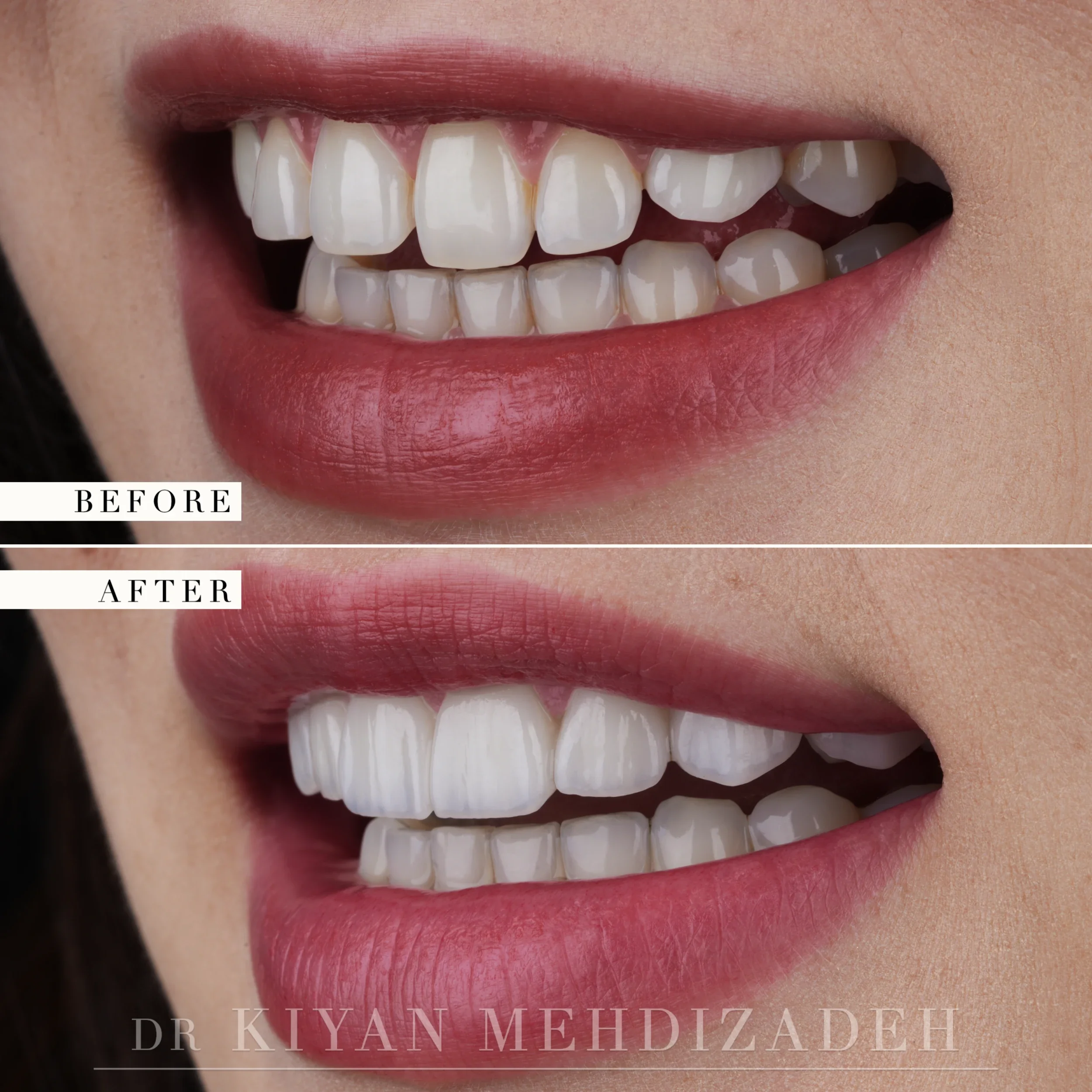
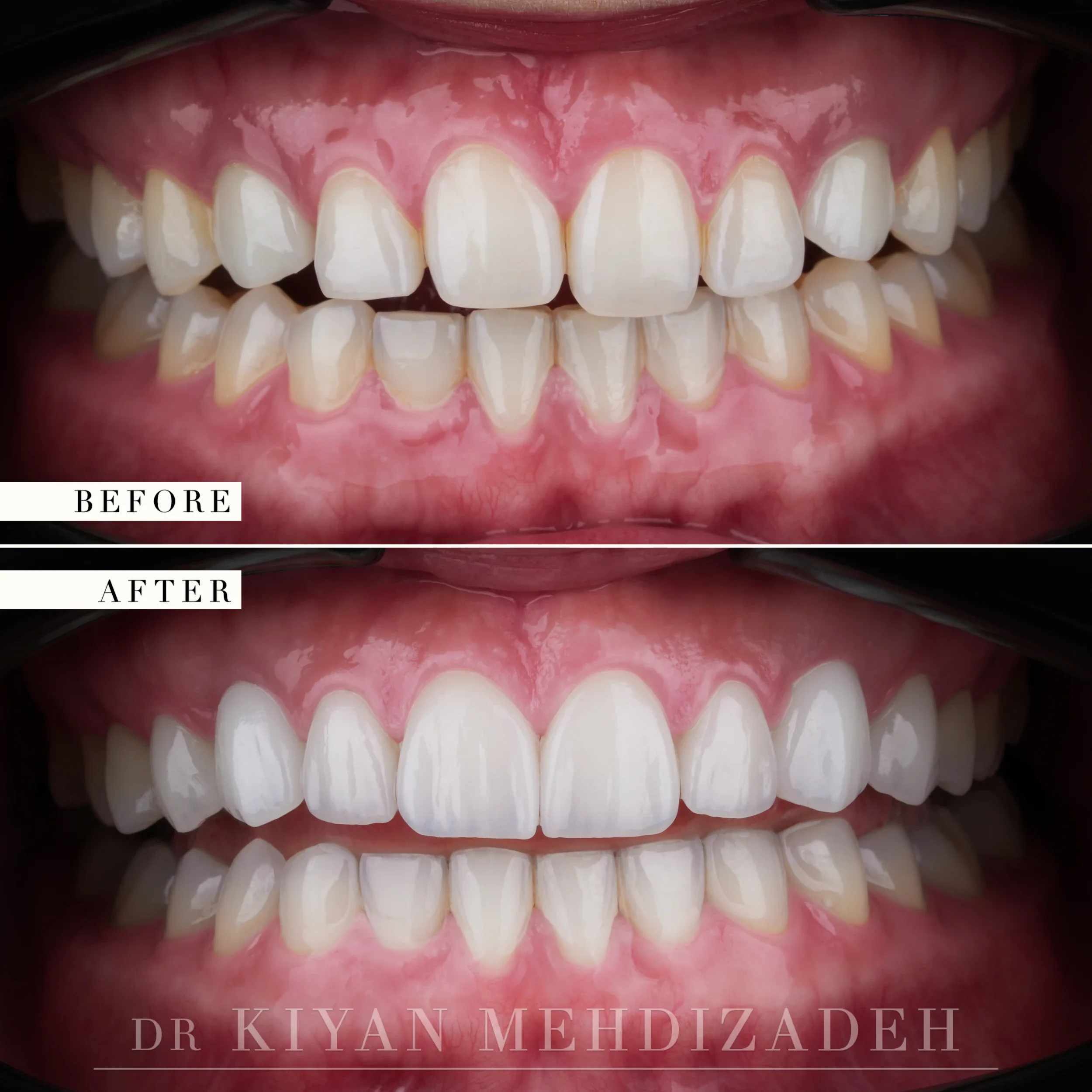
After her implants were placed during adolescence, her natural teeth continued to shift and move as her jaws developed through her late teens and early twenties. But dental implants do not move—they are anchored directly to bone through a process called osseointegration. The result: her implants were now positioned higher than her natural teeth, creating an uneven smile line that no amount of orthodontics could correct. The implant crowns also appeared short and wide relative to her natural teeth, further disrupting the visual harmony of her smile.
“The implants stayed in position while everything around them moved. We needed to bring harmony to a smile that had grown apart.”
Why Not Remove the Old Implants and Start Over?
The most direct question patients ask is why not simply remove the existing implants and place new ones in better positions. The answer lies in surgical reality. Removing osseointegrated implants is significant surgery that destroys surrounding bone, requires extensive bone grafting to rebuild the extraction site, and means starting the entire implant process over from scratch with 6–12 months of additional healing. For implants that are otherwise healthy and well-integrated into the bone, this level of intervention would be medically excessive and would subject the patient to unnecessary surgical risk. Instead, a treatment approach was designed that preserved the healthy implants while addressing every aesthetic concern through less invasive means.
The Clinical Challenge
Two healthy implants sitting higher than ideal, natural teeth that had shifted over years of growth, short and wide tooth proportions, and a desire for a harmonious smile—all without removing the existing implants.
How Did the Gum Lift Create the Foundation for Symmetry?
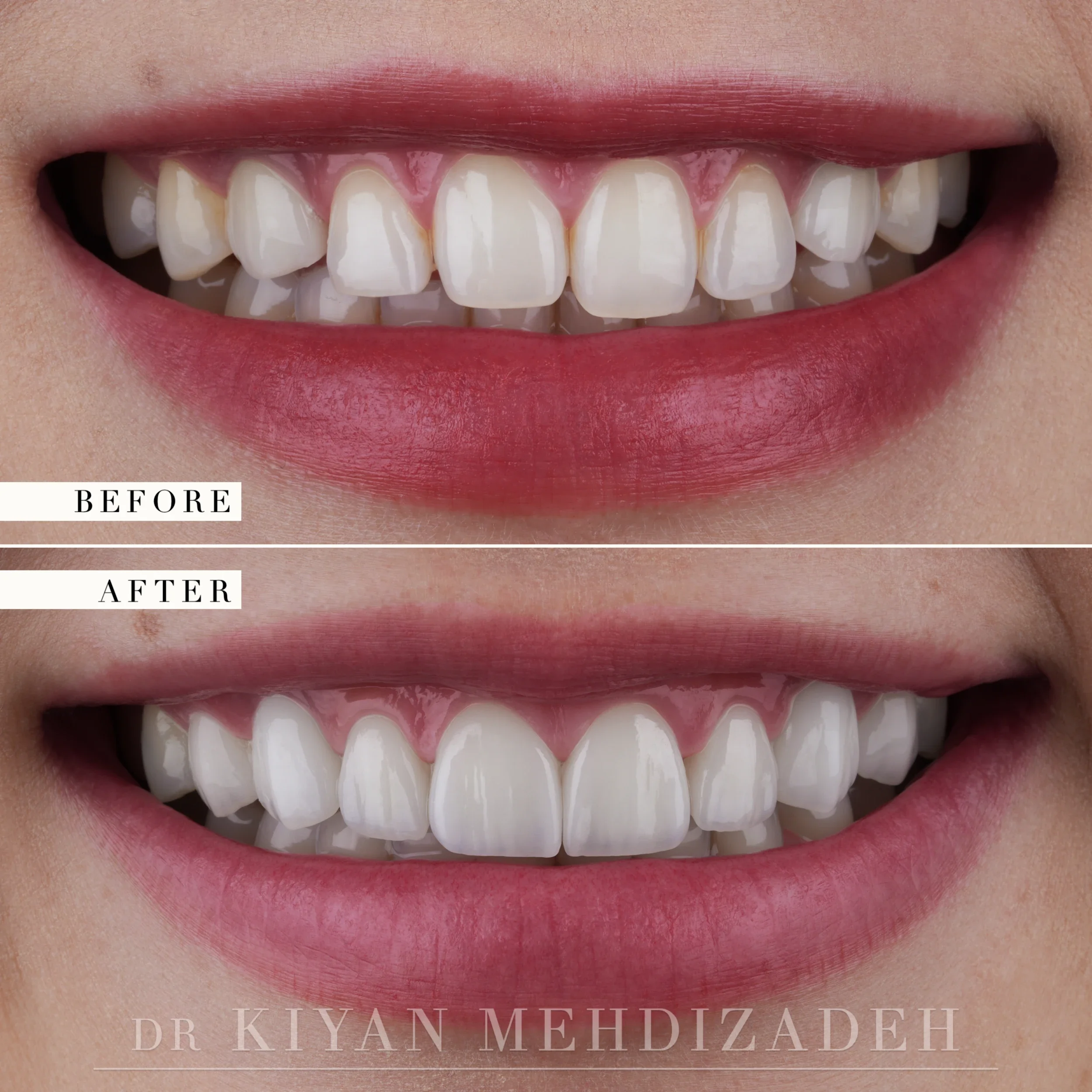
Rather than working against the implant positions, the treatment was designed around them. The first step was a gum lift—a precise reshaping of the gum tissue to create even, uniform arches across all teeth. This accomplished two critical goals: it leveled the gum line to reduce the visual impact of the higher implant positions, and it exposed more natural tooth structure that would allow for the creation of more elegant, properly proportioned teeth.
Before the gum lift, her teeth appeared short and wide because excess gum tissue covered a significant portion of the crown. By carefully recontouring the tissue using microsurgery techniques, the vertical dimension needed to design slender, naturally proportioned teeth was gained. The gum lift alone transformed the foundation upon which the entire restorative design would be built. Healing time for gum tissue stabilization was approximately 6–8 weeks before proceeding to the veneer preparation phase.
How Were Veneers and Implant Crowns Designed to Work Together?
With the gum architecture optimized, the restorative phase began. Six porcelain veneers were placed on her natural teeth, designed to complement the new gum line and create ideal proportions with slender, elegant forms rather than the previous short and wide appearance. The two existing implants at #6 and #11 received new crowns meticulously crafted to blend seamlessly with the veneers despite their slightly higher position.
Custom Zirconia Abutments: The Hidden Foundation
A critical detail in this case was manufacturing custom zirconia abutments for the implant crowns. Standard abutments are made of titanium or gray metal, which can show through translucent porcelain and create a grayish appearance at the gum line. Custom zirconia abutments are tooth-colored, supporting natural-looking gum tissue and preventing any metal color from showing through the crowns. This attention to the foundation beneath the visible restoration is what separates exceptional results from merely acceptable ones.
- 6 porcelain veneers with slender, elegant proportions replacing short, wide tooth forms
- 2 implant crowns on custom zirconia abutments designed to harmonize with veneer aesthetics
- Elegant surface texture for natural light reflection
- True symmetry achieved through careful gum and restorative planning
- Subtle translucency matching natural tooth characteristics
What Was the Final Result After 16 Weeks?
Sixteen weeks from consultation to completion. The result is flawlessly natural—a smile with proper light reflection, true symmetry, subtle translucency, and elegant texture. Most importantly, no one would ever know she has implants, let alone that they are positioned higher than ideal. The gum line appears uniform, the tooth proportions are balanced, and the overall effect is that of a naturally beautiful smile that was always meant to be there.
This case demonstrates that dental imperfections do not always require perfect solutions. Sometimes the most effective approach is designing around existing conditions rather than fighting against them. Her implants remain healthy and functional with decades of remaining service life, while her smile is now everything she wanted it to be.
“The result is flawlessly natural, harmonious. Elegant texture on the teeth. Proper light reflection. True symmetry. Subtle translucency. It has everything a natural smile needs.”
Frequently Asked Questions About Congenitally Missing Canines and Implant Harmonization
What are congenitally missing teeth?
Congenitally missing teeth are permanent teeth that never develop due to genetic factors. The condition is called hypodontia (1–5 missing teeth) or oligodontia (6 or more missing). The most commonly affected teeth are wisdom teeth, upper lateral incisors, lower second premolars, and upper canines. Approximately 2–8% of the population is missing at least one permanent tooth (excluding wisdom teeth). When permanent teeth fail to develop, options include dental implants, bridges, or orthodontic space closure depending on the specific teeth involved and the patient’s overall dental situation.
Why did the implants end up in the wrong position?
Dental implants placed during adolescence do not move as the jaw continues to grow and remodel. While natural teeth shift and adjust their positions through periodontal ligament-mediated movement over time, implants are fused directly to bone (osseointegrated) and remain fixed exactly where they were placed. This patient’s implants were placed as a teenager, and her natural teeth continued to erupt and shift during her late teens and early twenties while the implants stayed stationary. This is one reason many implant specialists recommend delaying implant placement until skeletal growth is complete, typically age 18–21 for women and 21–25 for men.
What is a gum lift and why was it needed in this case?
A gum lift (gingival recontouring or crown lengthening) is a procedure that reshapes the gum tissue to expose more tooth structure and create even, symmetrical gum architecture. In this case, the gum lift served two critical purposes: leveling the gum line to minimize the visual impact of the higher implant positions, and exposing enough natural tooth structure to allow for slender, properly proportioned veneers. Without the gum lift, the teeth would have remained short and wide regardless of how well the veneers were designed.
Can existing implant crowns be replaced without removing the implant?
Yes. The dental implant is the titanium post integrated into the jawbone—the crown is a separate component that attaches to the implant via an abutment screw. Crowns can be removed and replaced without disturbing the implant itself. In this case, both healthy implants at positions #6 and #11 were kept, and new crowns with custom zirconia abutments were designed to harmonize aesthetically with the new porcelain veneers on the adjacent natural teeth.
What are custom zirconia abutments and why do they matter?
Abutments are the connectors between the implant body in the bone and the visible crown above the gum line. Standard abutments are made of titanium or other gray metals, which can show through translucent porcelain and create a dark or grayish appearance at the gum margin—particularly problematic in the smile zone. Custom zirconia abutments are fabricated from tooth-colored ceramic material, supporting natural-looking pink gum tissue and preventing any metal shadow from showing through the crown.
How long does gum lift healing take before veneers can be placed?
Gum tissue typically heals within 2–4 weeks after a gum lift procedure. However, a waiting period of 6–8 weeks before finalizing veneer design ensures the tissue has fully matured and stabilized at its permanent position. Proceeding too early risks the gum line shifting after veneers are bonded, which would compromise the proportional design. This patience during healing is a key factor in achieving predictable, lasting results.
How much does a gum lift with veneers and implant crowns cost?
This case was $24,000, covering the gum lift, six porcelain veneers and two implant crowns. Porcelain veneers range from $1,800 to $3,500 per tooth depending on complexity. Gum lift and crown lengthening procedures range from $2,000 to $3,000. We accept PPO insurance and offer financing through Proceed Finance, PatientFi, Happen Bank, CareCredit, and Cherry.
How long does this type of combined treatment take?
This case was completed in approximately 16 weeks from initial consultation to final delivery. The timeline included gum lift surgery (week 1), gum tissue healing and maturation (weeks 2–8), veneer and implant crown preparation and laboratory fabrication (weeks 9–14), and final bonding and delivery (weeks 15–16). Cases with less extensive gum surgery may be completed in 10–12 weeks.
How long do porcelain veneers and implant crowns last?
High-quality porcelain veneers typically last 15–20 years or longer with proper care. Implant crowns have similar longevity, with many lasting 20+ years. The implants themselves are designed to last a lifetime. Maintenance includes professional cleanings every 6 months, avoiding using teeth to open packages, and wearing a night guard if grinding is present. Implant crowns may require periodic screw retightening at recall appointments.
Should implants for congenitally missing teeth be placed during adolescence?
Current evidence suggests delaying implant placement until skeletal growth is complete—typically age 18–21 for women and 21–25 for men. Implants placed before growth completion may end up in suboptimal positions as the surrounding bone and teeth continue to develop. Interim solutions such as removable retainers with prosthetic teeth or resin-bonded bridges can maintain space and aesthetics until the patient is old enough for permanent implants.
Last Updated: August 2026

Dr. Kiyan Mehdizadeh, DMD
Doctor of Dental Medicine
Most cosmetic dentists refer out for surgery. Most surgeons don't do cosmetic work. Dr. Mehdizadeh trained in both — implantology and bone grafting at Loma Linda and UCLA, fixed prosthodontics under Mauro Fradeani in Italy, periodontal microsurgery with Hürzeler and Zuhr in Munich, and IV sedation at the University of Alabama. That combination means complex cases involving surgery, grafting, implants, and restorative work are planned and executed by a single provider with full command of every phase.
Technical skill produces function. Taste is what produces beauty. The difference between dental work that looks like dental work and a result that looks entirely natural comes down to aesthetic judgment — proportion, texture, translucency, how light moves across a surface. That sensibility runs through everything here, from the way cases are designed to the office itself.
An in-house master ceramist and on-site laboratory allow restorations to be designed, fabricated, and refined with direct collaboration between doctor and technician — no outsourced lab work, no guesswork, no compromise on the final product. Dr. Mehdizadeh is one of few dentists with the refined ability to provide care across multiple specialties, resulting in cohesive and holistic outcomes.
Education & Credentials
- Doctor of Dental Medicine (DMD), cum laude — Boston University
- Bachelor of Science in Biology — Emory University
- Mastership in Implant Dentistry & Grafting — Loma Linda University / gIDE Institute
- Advanced Implant Therapy & Grafting — UCLA / gIDE Institute
- Implant Placement & Restoration — UCLA / Nobel Biocare
- Guided Bone Regeneration & Ridge Augmentation — gIDE Institute
- Sinus Elevation & Augmentation — gIDE Institute
- Soft Tissue Management & Grafting — gIDE Institute
- Minimally Invasive Augmentation & Autogenous Bone Management — IDEA, San Francisco
- Master Program in Fixed Prosthodontics — Fradeani Education, Italy
- Aesthetic Dentistry — UCLA School of Dentistry
- Advanced Occlusion & Bite Design — UCLA
- Periodontal Micro-Surgery — Hürzeler/Zuhr, Munich
- Micro-Endodontic Training — University of Pennsylvania
- IV Sedation — University of Alabama at Birmingham
- Injectable Therapy for TMJ & Facial Pain — American Academy of Facial Esthetics
Considering similar treatment?
Send Dr. Mehdizadeh a photo and ask what’s possible for your case.
Other cases like this one
Replacing a Missing Front Tooth With a Bridge and Veneers
Missing a front tooth for years?
View case →A Pink-Porcelain Bridge After a Failed Root Canal and Abscess
Lost a front tooth to infection?
View case →Masculine Veneers and an Implant, Rebuilt on a Traveler's Timeline
Want it brighter and even - but not obvious?
View case →