Tooth ResorptionInternal and external.
Tooth resorption is the body breaking down a tooth's own structure, from inside the root or from its outer surface. It is usually painless and found on an X-ray. Some teeth can be kept. When a tooth is lost, we replace it with an implant, and in the front of the mouth the gum line decides whether the result looks natural.
Single implant with crown: $7,000
$84/month 144 payments at 9.99% APR, on approved credit.
Your consultation, including a 3D X-ray (CT scan), is free.
Send your X-rays or photos if you have them. Either way, we reply with a cost. No obligation.
Ask about tooth resorption
Reviewed by our treatment coordination team. Call or text (310) 770-3335 if you would rather speak now.
Request received
A treatment coordinator will call you within two hours during office hours (Monday to Friday, 9 to 4).
To talk now, call (310) 770-3335.
- A call within two hours during office hours.
- A written cost from us, before you commit to anything.
- No obligation. Many patients take weeks to decide. That is normal.
- Free consultation and 3D X-ray (CT scan)
- Private practice since 2012
- IV sedation in our own office
- In-house dental laboratory
What tooth resorption is.
Tooth resorption is the loss of a tooth's hard tissue to the same kind of cells that remodel bone. After an injury or long inflammation, those cells can start dissolving the root. When this starts inside the root canal it is internal resorption; when it starts on the outside of the root it is external resorption. The two look alike on an ordinary X-ray, and they are treated differently.
Most patients feel nothing. Resorption is usually found on a routine X-ray, and sometimes as a pink shadow near the gum line.
A 3D X-ray shows where it is and how far it has gone.
A flat X-ray cannot always tell internal from external resorption, or show how far around the root it has spread. A 3D X-ray (CT scan) shows both, and it is the imaging the American Association of Endodontists names for this. We take it at your consultation, which is free.
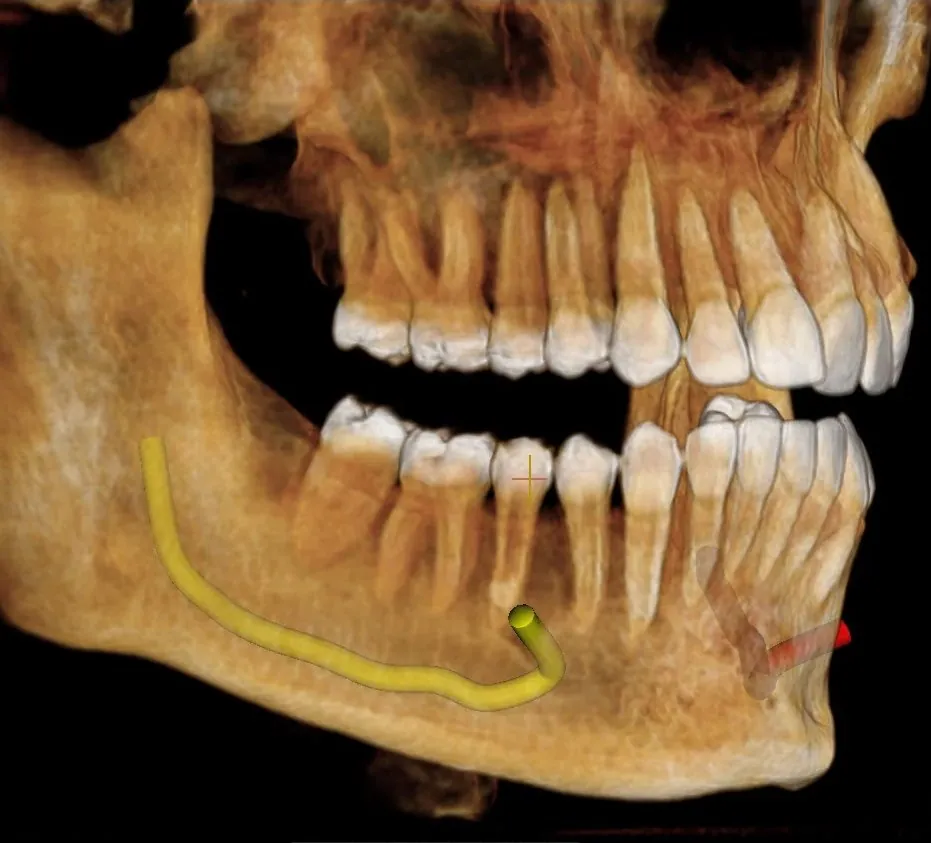
Internal resorption: often stopped with a root canal.
Internal resorption starts inside the root, usually after a blow to the tooth or long inflammation of the nerve. The living tissue inside the canal keeps it going, hollowing the root from within.
When it is found before it breaks through the side of the root, a root canal removes that tissue and the resorption stops. The tooth is kept. When the root has been hollowed through, or is too thin to hold a crown, the tooth is replaced with an implant.
External resorption: often a reason to replace the tooth.
External resorption starts on the outside of the root. It takes three main forms.
Cervical resorption begins just below the gum line. It is linked to orthodontic treatment, injury and internal bleaching, and in many patients no cause is found. A small lesion caught early can be repaired: in the longest-running follow-up of treated cases, every small lesion was repaired successfully, and only about one in eight of the most advanced. Once it has spread around the root, the tooth is usually replaced.
Inflammatory resorption follows a serious injury, when infection inside the tooth reaches the root surface.
Replacement resorption follows a tooth being knocked out or pushed into the bone. Bone slowly takes the place of the root, the tooth fuses to the jaw, and in time it is lost.
When a tooth with external resorption cannot be kept, we plan its replacement before it comes out, so the gum and bone are protected from the start.
Replacing a front tooth without losing the gum line.
In the front of the mouth the bone over the roots is thin: one millimeter or less at most front teeth, and half a millimeter or less at about half of them. When a tooth is removed, that bone shrinks, and within six months the ridge can lose a third to more than half of its width. The gum follows the bone. That is why a replacement tooth can end up longer than its neighbors, with a dark line or a missing point of gum between the teeth.
Partial extraction (socket shield). Where the outer part of the root is healthy, Dr. Mehdizadeh keeps a thin section of it against the bone and places the implant behind it. That section keeps its ligament and the bone keeps its blood supply, so the gum line stays where it is.
Gum and bone grafting. Where the root cannot be kept, the socket is grafted when the tooth comes out, and a graft of your own gum tissue thickens the gum over the implant.
Shaping the gum. The temporary tooth is shaped to mold the gum as it heals, and the final crown copies that shape. The point of gum between two teeth fills the space almost every time when the bone beneath it is within five millimeters of where the teeth touch, which is why the plan protects that bone first. More on single implants.
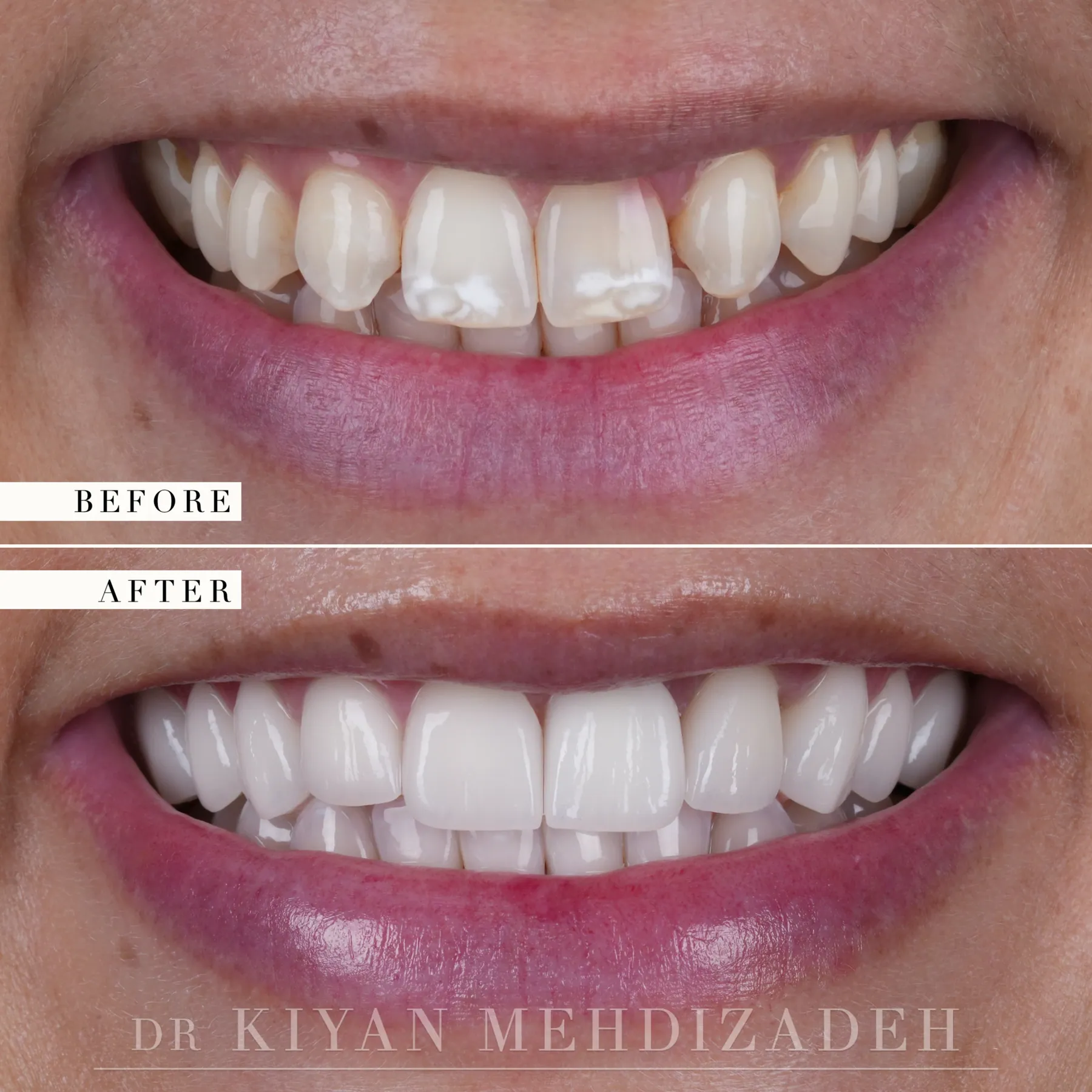
A front tooth lost to internal resorption.
Every practice says its work looks natural. We show you. Here are 52 of our own cases, each photographed before and after.
What treatment costs.
A single implant with a custom shade-matched crown is $7,000, including the extraction, any socket graft and the temporary tooth. $84/month: 144 payments at 9.99% APR, on approved credit. A bone graft or sinus lift, when one is needed, is $3,000. Your written plan lists every visit and the total before you agree to treatment. Financing is available. Most PPO plans contribute toward the cost of treatment.

One doctor, from the extraction to the final crown.
Dr. Mehdizadeh plans the extraction around the gum line, places the implant and designs the crown, and our own master ceramist makes it. He trained in periodontal microsurgery with Hürzeler and Zuhr in Munich, and in implant dentistry and grafting at Loma Linda University and UCLA.
Tell us what is going on.
Send an X-ray or photos if you have them; if not, we will call and talk it through.
Or call (310) 770-3335.
Ask about tooth resorption
Reviewed by our treatment coordination team. Call or text (310) 770-3335 if you would rather speak now.
Request received
A treatment coordinator will call you within two hours during office hours (Monday to Friday, 9 to 4).
To talk now, call (310) 770-3335.
Frequently Asked Questions
What is tooth resorption?
The loss of a tooth's hard tissue to the cells that normally remodel bone. Internal resorption starts inside the root canal; external resorption starts on the outer surface of the root.
What causes tooth resorption?
Injury to the tooth, long inflammation of the nerve, orthodontic treatment and internal bleaching are the known causes. In many cases of external resorption no cause is found.
Can tooth resorption be stopped?
Internal resorption found before it breaks through the root is stopped with a root canal. Small external lesions near the gum line can be repaired. Advanced resorption usually means replacing the tooth.
Does resorption hurt?
Usually not. Most cases are found on an X-ray.
Why does my tooth look pink near the gum?
A pink shadow near the gum line can be a sign of resorption. We check it with a 3D X-ray.
Can braces or whitening cause resorption?
Orthodontic treatment is one of the most common factors linked to external resorption near the gum line, and bleaching from inside a tooth is another.
When does a resorbing tooth need to come out?
When the root has been hollowed through, when the resorption has spread around the root, or when bone has replaced the root.
Can the implant go in the same day the tooth comes out?
Often, yes, when the bone and gum around the socket allow it. The 3D X-ray shows whether yours do.
Will my gum line look natural after an implant?
That is what the plan is built around: keeping the bone and gum at the tooth from the moment it comes out, and shaping the gum with the temporary tooth before the final crown is made.
Last Updated: October 2026