White Spots After BracesDemineralization, and what corrects it.
The chalky white marks some people find when their braces come off are enamel that has lost mineral. Early marks can improve without drilling. Deeper damage needs a new surface, and porcelain holds its color on it far longer than bonding.
Four veneers from $16,000
$192/month 144 payments at 9.99% APR, on approved credit.
Your consultation, including a 3D X-ray (CT scan), is free.
Send photos if you have them. Either way, we reply with a cost. No obligation.
Ask about white spots
Reviewed by our treatment coordination team. Call or text (310) 770-3335 if you would rather speak now.
Request received
A treatment coordinator will call you within two hours during office hours (Monday to Friday, 9 to 4).
To talk now, call (310) 770-3335.
- A call within two hours during office hours.
- A written cost from us, before you commit to anything.
- No obligation. Many patients take weeks to decide. That is normal.
- Free consultation and 3D X-ray (CT scan)
- Private practice since 2012
- IV sedation in our own office
- In-house dental laboratory
Before, and after.
Every smile on this site was made here: our patients, our laboratory, our work.
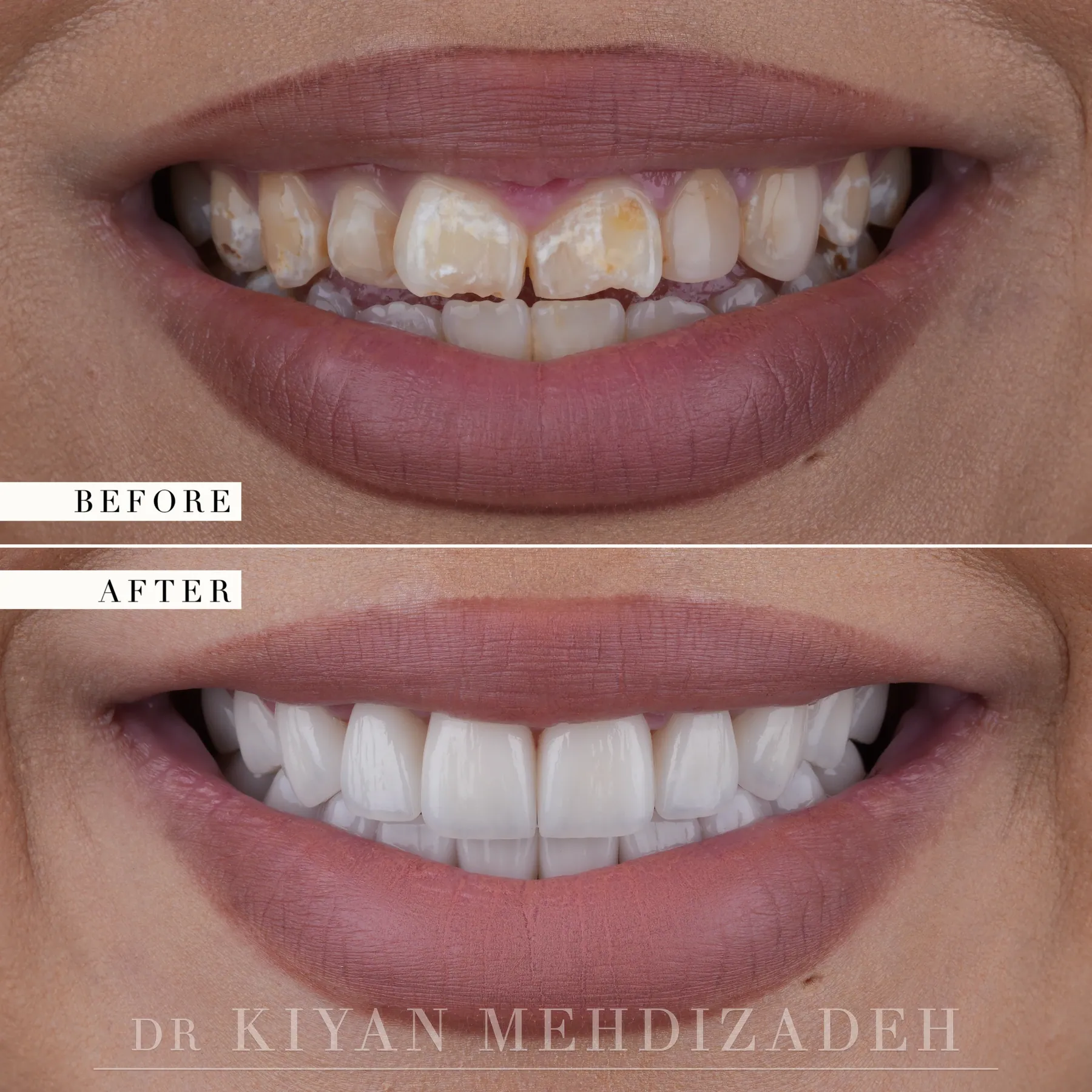
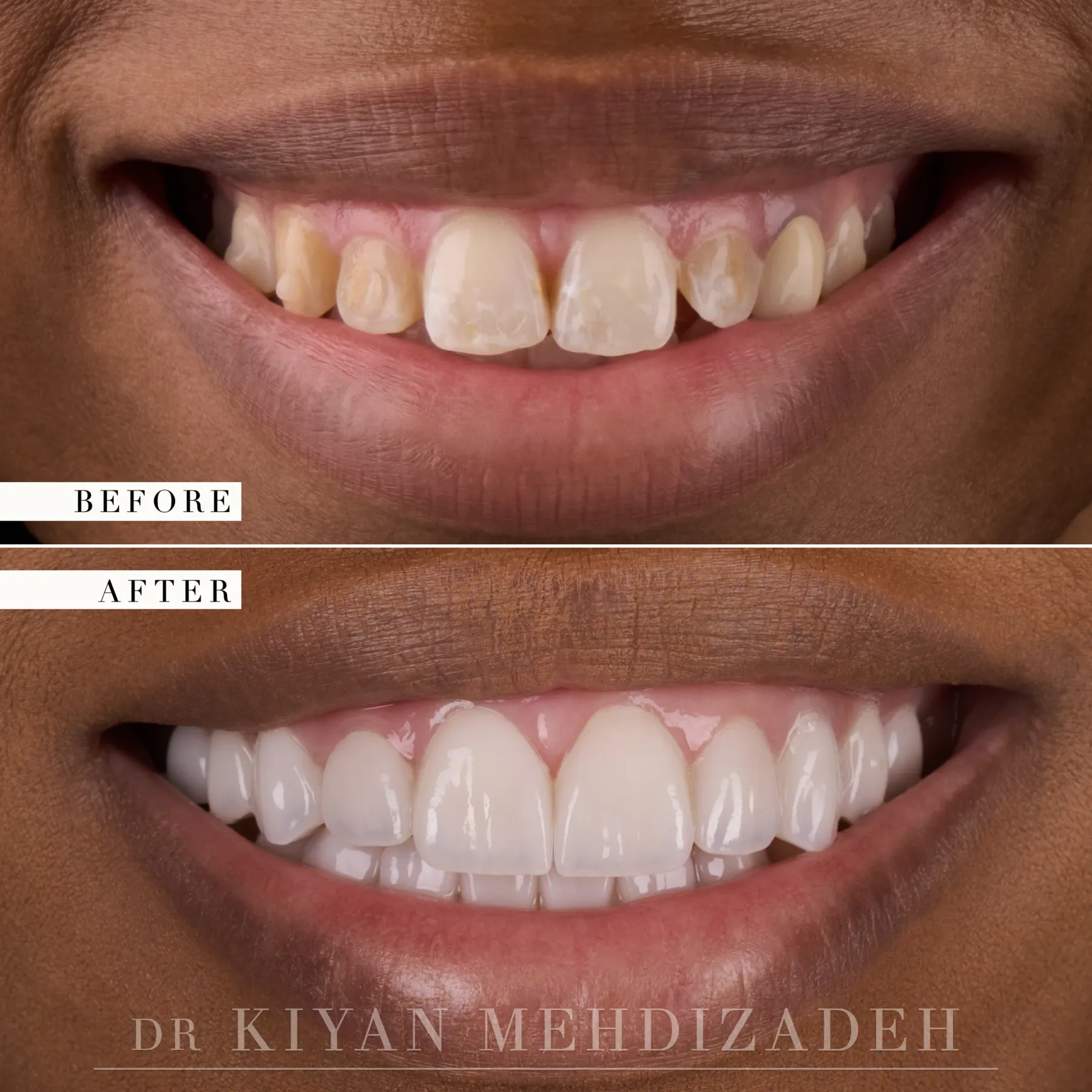
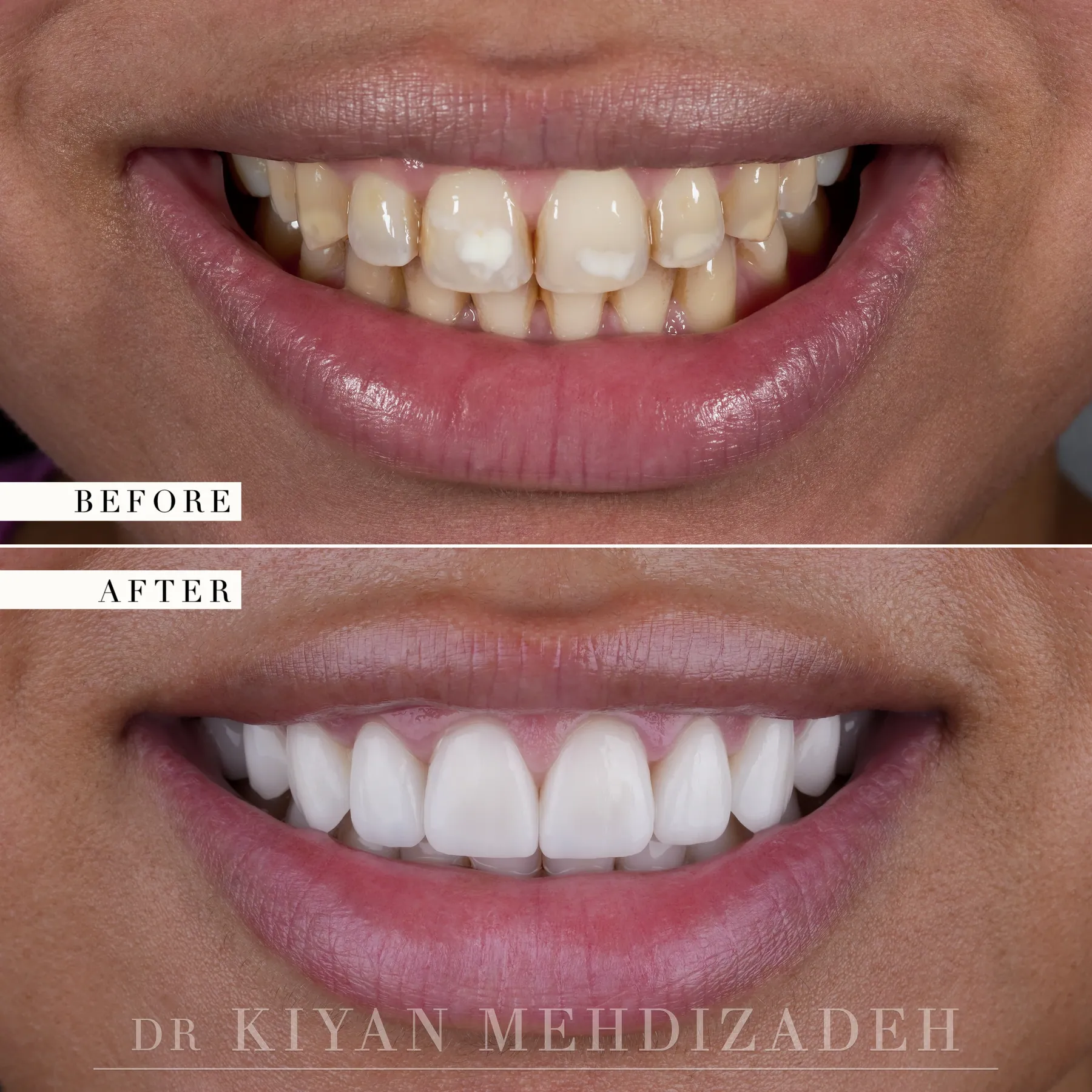
What the white spots are.
This page explains what causes white spots after braces, which treatments help at which stage, why bonding over them tends to fail sooner than bonding on sound enamel, and when veneers are the answer.
Plaque collects around brackets, where it is hardest to brush away. The bacteria in it produce acid, and the acid dissolves mineral from the enamel beneath. Enamel that has lost mineral handles light differently from the enamel around it, so it looks chalky and white. It often becomes obvious only when the brackets come off and leave the outline of each one behind.
It is common. A 2015 review of ten studies found white spots in about two in three patients treated with fixed braces, and new spots forming during treatment in nearly half.
A white spot is the first stage of decay. While its surface is intact, it can take up mineral again and harden. Left with plaque on it, the surface can break down into a cavity, and the spot can pick up stain and turn brown.
Not every white spot comes from braces. Some form with the tooth, because that patch of enamel carried less mineral from the start. Bleaching acts on such a patch and on the tooth around it unevenly, which is why whitening often leaves it just as visible, as in this case.
From the least treatment to the most.
What a white spot needs depends on how deep it goes, whether its surface has broken down, and whether anything else about the teeth needs to change.
Time and fluoride. Once the brackets are off and the teeth can be cleaned properly, the surface of a spot can take up mineral again. Fluoride toothpaste supports that. A 2016 review of twenty trials found that stronger fluoride treatments added only a small benefit over daily fluoride toothpaste, and little that could be seen.
Resin infiltration. A thin, runny resin is drawn into the porous enamel of the spot and set with light, without drilling. Filling the pores changes how the spot handles light, so it blends toward the enamel around it. A 2021 review found that it masked spots after braces better than fluoride varnish or no treatment, though most studies followed patients for a year or less. It suits spots whose surface is still intact.
Bonding. Where a spot is deep or stained, or has become a cavity, the damaged enamel is removed and the tooth is rebuilt in composite resin, the tooth-colored material used for fillings. It is quick and costs less than porcelain.
Porcelain veneers. Where the damage is spread across the front teeth, or the shape, color or length of the teeth also needs to change, veneers give the teeth a new surface in porcelain.
Why bonding over white spots fails sooner.
Composite bonding is softer, more porous and less color-stable than porcelain, and those three properties determine how it fails. It absorbs staining from ordinary diet over time, and its edges chip under biting force.
Over demineralized enamel it has a second problem. That enamel is weaker and more porous than sound enamel, which makes it a less reliable surface to bond to, and the edges of bonding over it tend to stain and chip sooner. Bonding also covers a spot without treating it: decay beneath it carries on unless it is removed first.
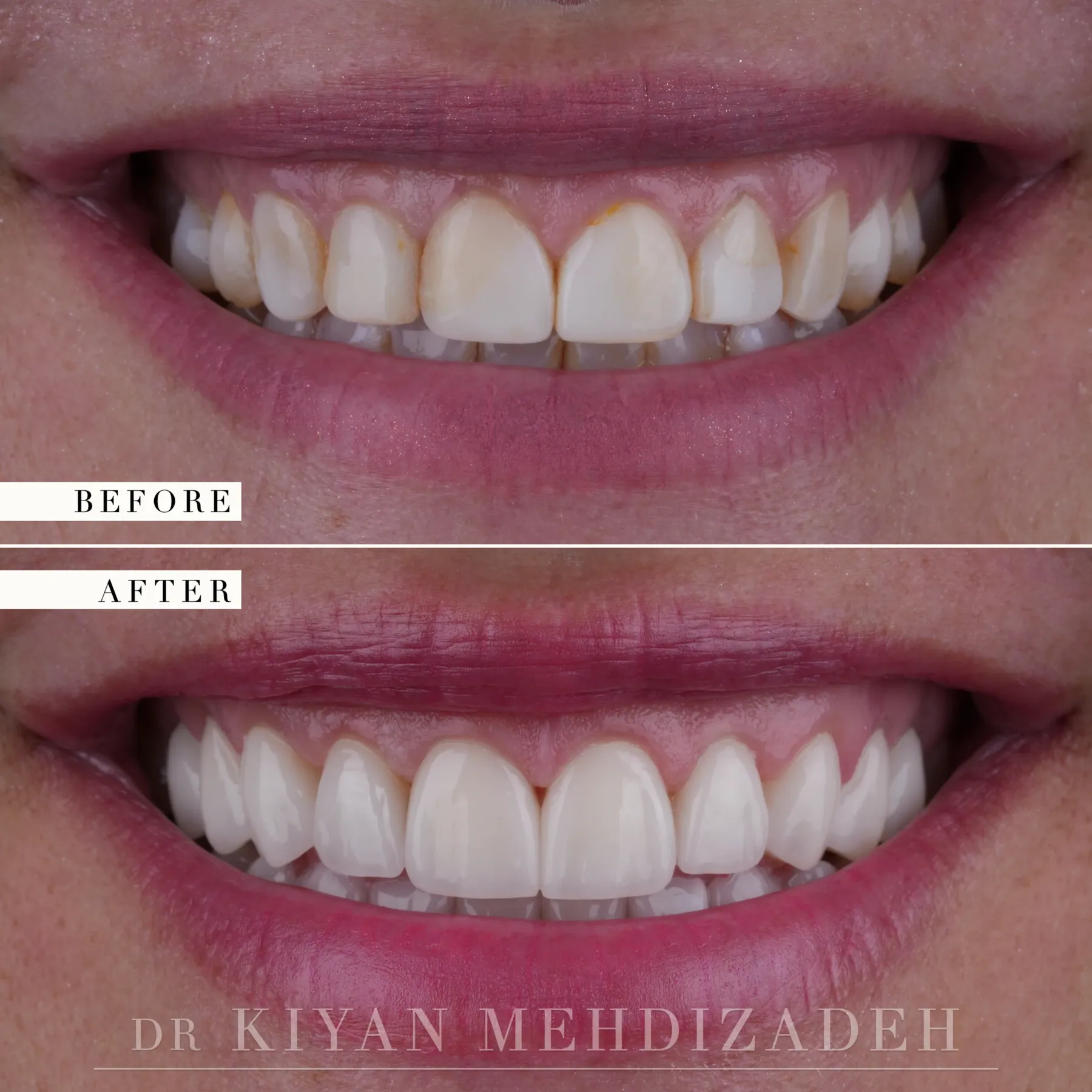
This case shows the pattern. She had white spots and brown marks from braces and had them bonded at another practice. Within two to three years the composite had turned yellow and gray where it met the tooth, and it had begun to chip and crack, so the bonding drew more attention than the marks it covered.
Bonding still has its place: where it can achieve what you want, it is the more conservative option. Where bonding over white spots has already been tried and failed, that is the normal outcome, not bad luck.
When veneers are the answer.
In this case, treatment began by removing all of the old bonding. That showed the full extent of the damage: enamel dissolved around the bracket sites, and early cavities in several teeth. Dr. Mehdizadeh removed the decay first, keeping as much healthy tooth as possible, and only then were the veneers made: ten upper and ten lower, covering every damaged surface, restoring the length the teeth had lost and evening the color. It took four weeks from consultation to final bonding.
Porcelain resists stain better than natural enamel and does not discolor from coffee, tea, red wine or tobacco. The bonding material at the edges can stain over time, and decay can still start where porcelain meets tooth if plaque is left there, so cleaning at the gum line still matters.
The number of veneers follows where the damage is and where the porcelain should end: four, eight, ten or twenty. How many veneers do you need? explains why.
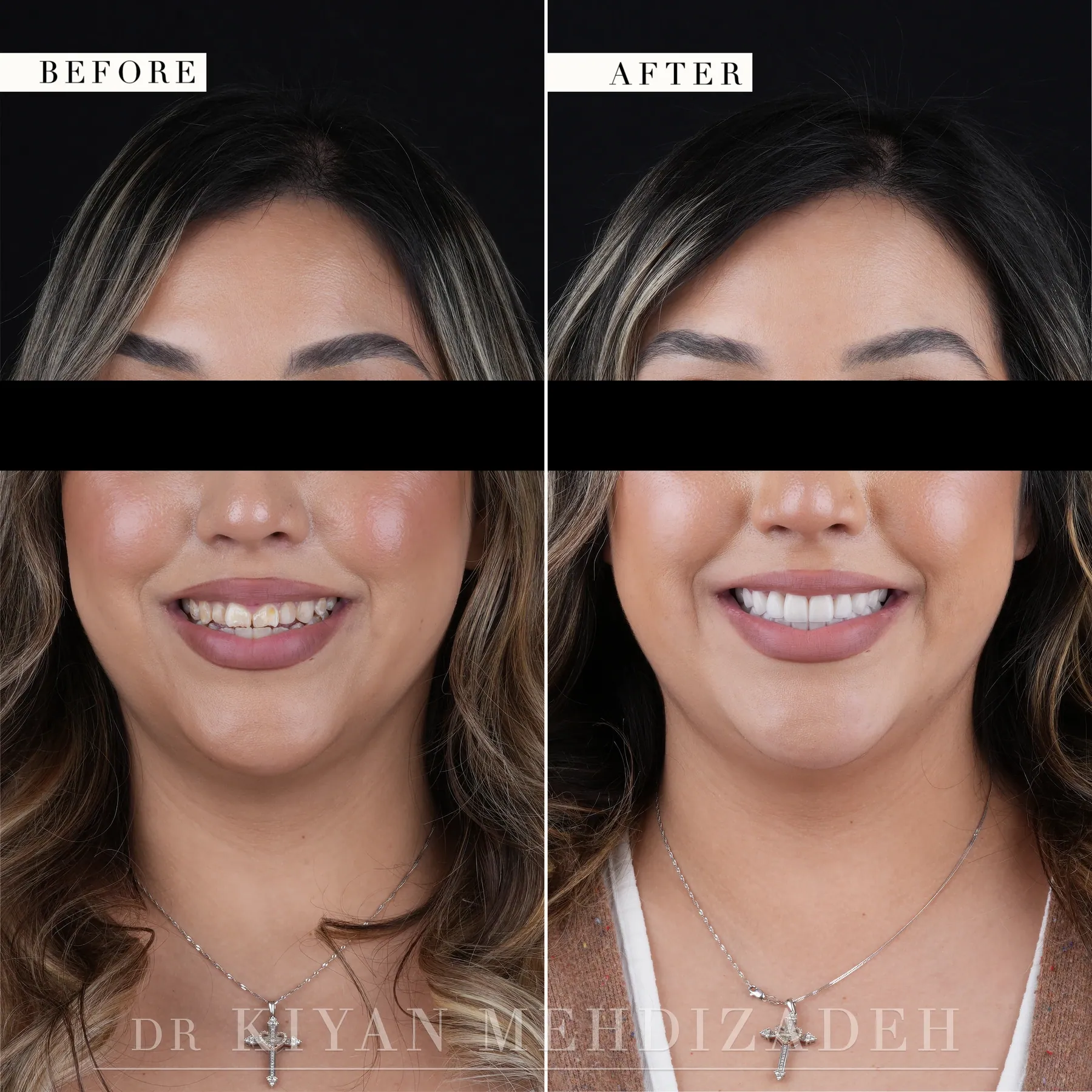
Straight is not the same as finished.
White spots are often not the only thing braces leave behind. Orthodontics changes where a tooth sits; it cannot change its shape, its width or its color.
In this case, the teeth were straight after braces but discolored and flared, with small spaces their shape had left. A gum lift lengthened the teeth, and veneers designed to fill the spaces near the gum and flatten the flare corrected all of it in one plan, worn first as temporaries and revised to her preference.
Porcelain does not respond to whitening, so natural teeth that stay are whitened first and left to settle, and the shade is chosen against them.
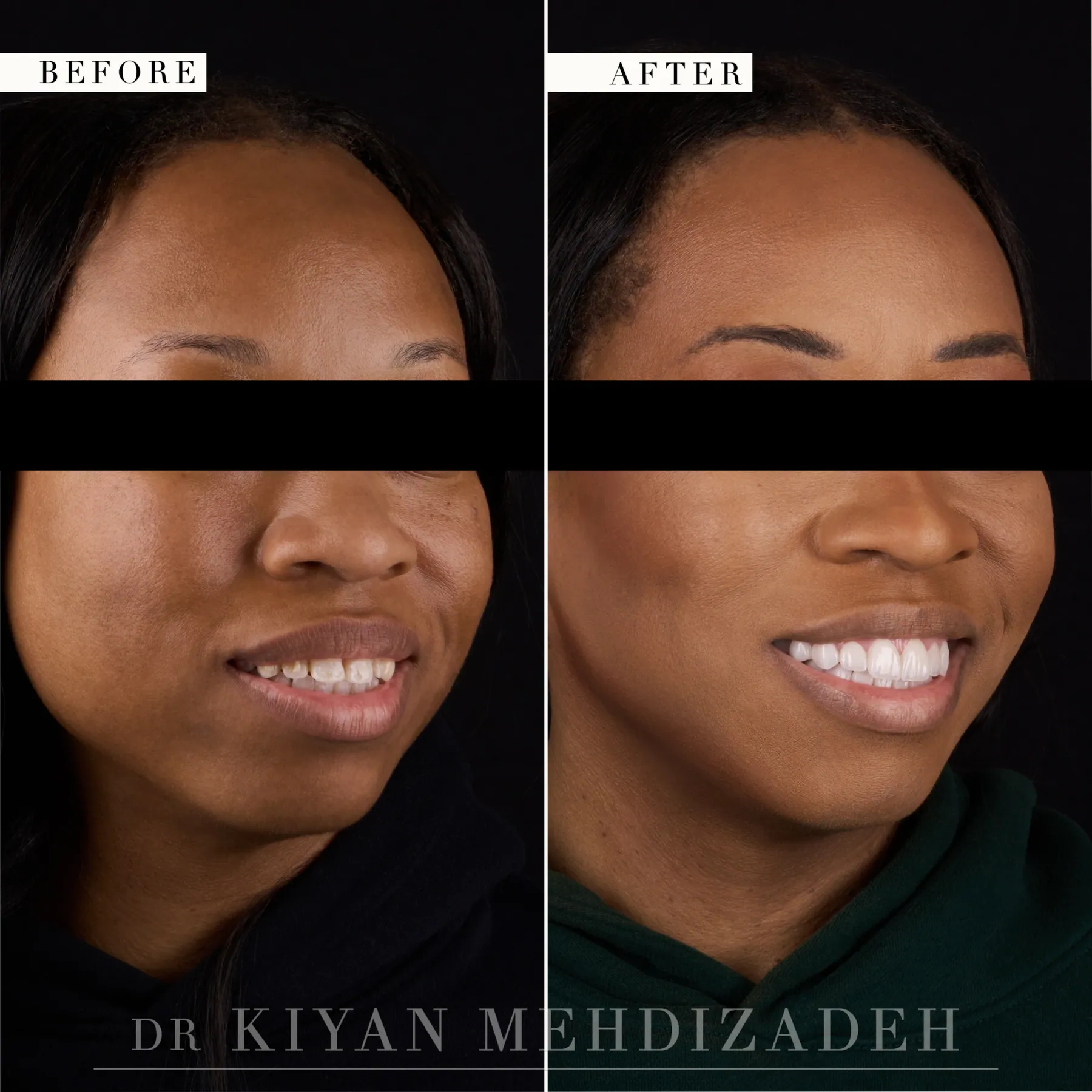
What veneers for white spots cost.
Veneers are priced by the number of veneers in the case, never per tooth. Four veneers start at $16,000. $192/month: 144 payments at 9.99% APR, on approved credit. Most cases also include a gum lift or whitening. Every number and its price is set out in the full price table.
This case, twenty veneers after braces, was $42,000.
The consultation, including a 3D X-ray (CT scan), is complimentary. Most PPO plans contribute toward the cost of treatment. Financing is available.

One doctor, from the design to the final porcelain.
Dr. Mehdizadeh designs every veneer case himself. He trained in fixed prosthodontics under Mauro Fradeani in Italy, and our laboratory, in the same building, makes the veneers.
Tell us what you would like to change.
Tell us what is going on. Add photos if you have them; if not, we will call and talk it through.
Or call (310) 770-3335.
Ask about white spots
Reviewed by our treatment coordination team. Call or text (310) 770-3335 if you would rather speak now.
Request received
A treatment coordinator will call you within two hours during office hours (Monday to Friday, 9 to 4).
To talk now, call (310) 770-3335.
Frequently Asked Questions
What causes white spots after braces?
Plaque that collects around the brackets. The bacteria in it produce acid that dissolves mineral from the enamel, and enamel that has lost mineral looks chalky and white. The spots often show the outline of each bracket once the braces come off.
Do white spots from braces go away on their own?
Some improve once the brackets are off and the teeth can be cleaned properly, as the surface takes up mineral again, but many stay visible. In published trials, stronger fluoride treatments added only a small benefit over daily fluoride toothpaste.
What is resin infiltration?
A thin resin drawn into the porous enamel of a white spot and set with light, without drilling. It changes how the spot handles light so it blends toward the enamel around it. It suits spots whose surface is still intact, and long-term studies are still few.
Why does bonding over white spots fail?
Composite is softer and more porous than porcelain, so it stains and chips. Over demineralized enamel, which is weaker and more porous than sound enamel, its edges tend to stain and chip sooner, and bonding covers a spot without treating any decay beneath it.
When are veneers the right choice for white spots?
When the damage is deep, stained or decayed, when it is spread across several front teeth, or when the shape, color or length of the teeth also needs to change. Any decay is removed first, and the veneers then give the teeth a new surface in porcelain.
Can white spots come back under veneers?
The porcelain itself does not stain, but decay can still start at the edge of a veneer, where porcelain meets tooth, if plaque is left there. Cleaning at the gum line and regular checkups still matter.
How much do veneers for white spots cost?
Veneers are priced by the number in the case, never per tooth, from $16,000 for four. $192/month: 144 payments at 9.99% APR, on approved credit. The consultation, including a 3D X-ray (CT scan), is complimentary.
Last Updated: October 2026