Correcting Dark Veneer Margins and Two Failed Implants
Dark margins from bulky veneer work, recession behind them, and two implants that had failed from bone loss and poor placement.
By Dr. Kiyan Mehdizadeh, DMD · 9460 Wilshire Blvd, Suite 850, Beverly Hills, CA 90212 · (310) 770-3335
Last Updated: October 2026
Are dark lines showing at the gum line of your veneers?
A dark line at the gum is the edge of the porcelain, uncovered by recession. It cannot be polished out and it cannot be whitened away, because the problem is at the margin rather than on the surface. What it can be is remade, with margins that finish flush with the tooth so the tissue has something healthy to sit against. Send us a photograph of your smile and we will tell you what is involved.
- A response within one business day. Usually much sooner.
- A real cost estimate, not a range designed to get you in the door.
- No obligation. Many patients take months to decide. That is normal.
Ask about your case
Reviewed by our treatment coordination team. Call or text (310) 770-3335 if you would rather speak now.
Request received
Our treatment coordination team will review what you sent and call you
within one business day.
If you would like to hold a consultation time now, you can do that below.
Treatment Plan by Dr. Kiyan Mehdizadeh
- Assessment of the existing veneers, the recession behind them and the failing implants.
- Smile and bite design establishing the shapes and the bite before any preparation.
- Gum lift across the upper teeth to set the heights the restorations would be built to.
- Removal of the two failed implants, bone grafting of both sites and placement of new implants under intravenous sedation.
- Three months of healing, with a temporary restoration carrying those teeth.
- Twenty-three units in e.max: seventeen veneers, two onlays, two inlays and two implant crowns, then the bite balanced and retainers fitted.
The Patient's Journey
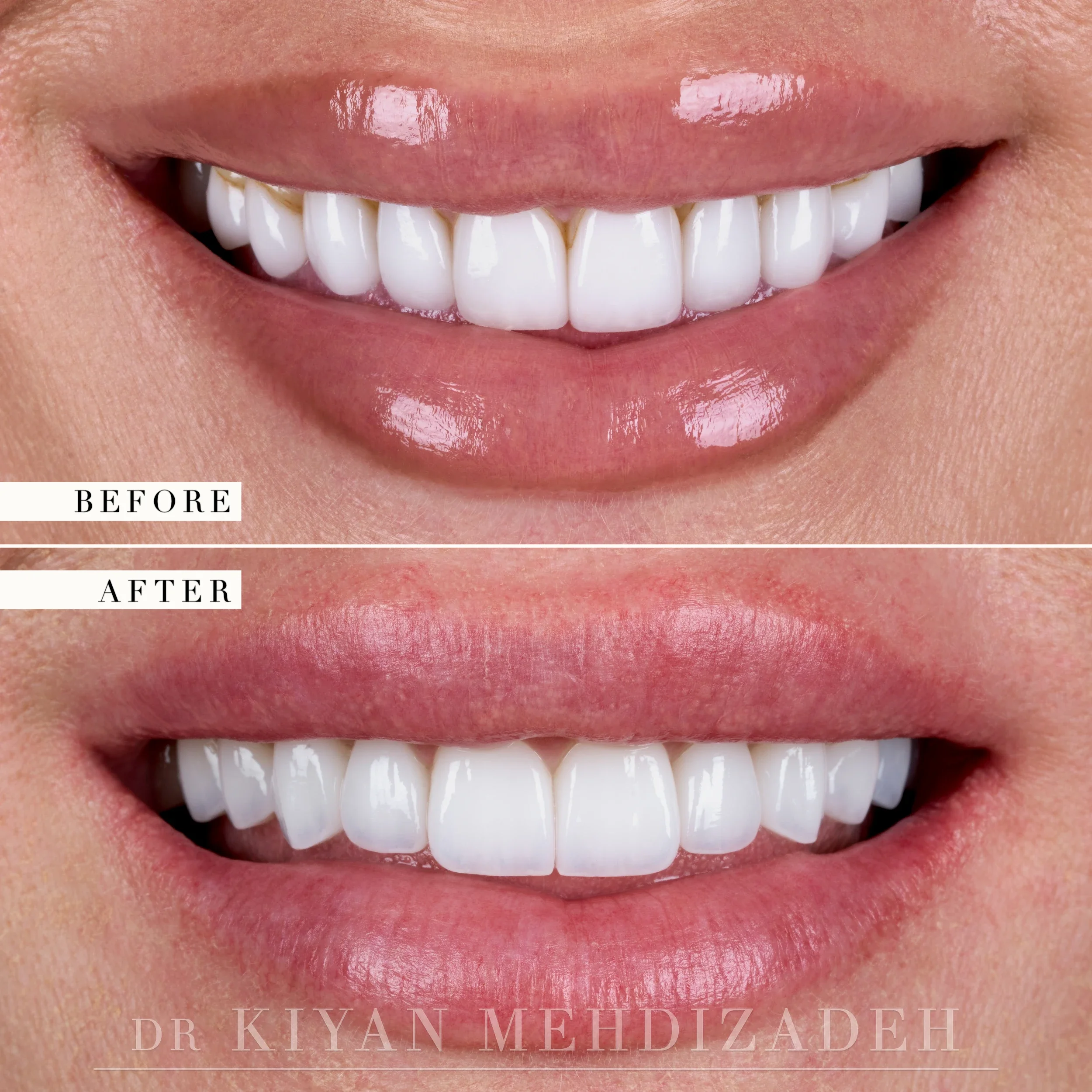
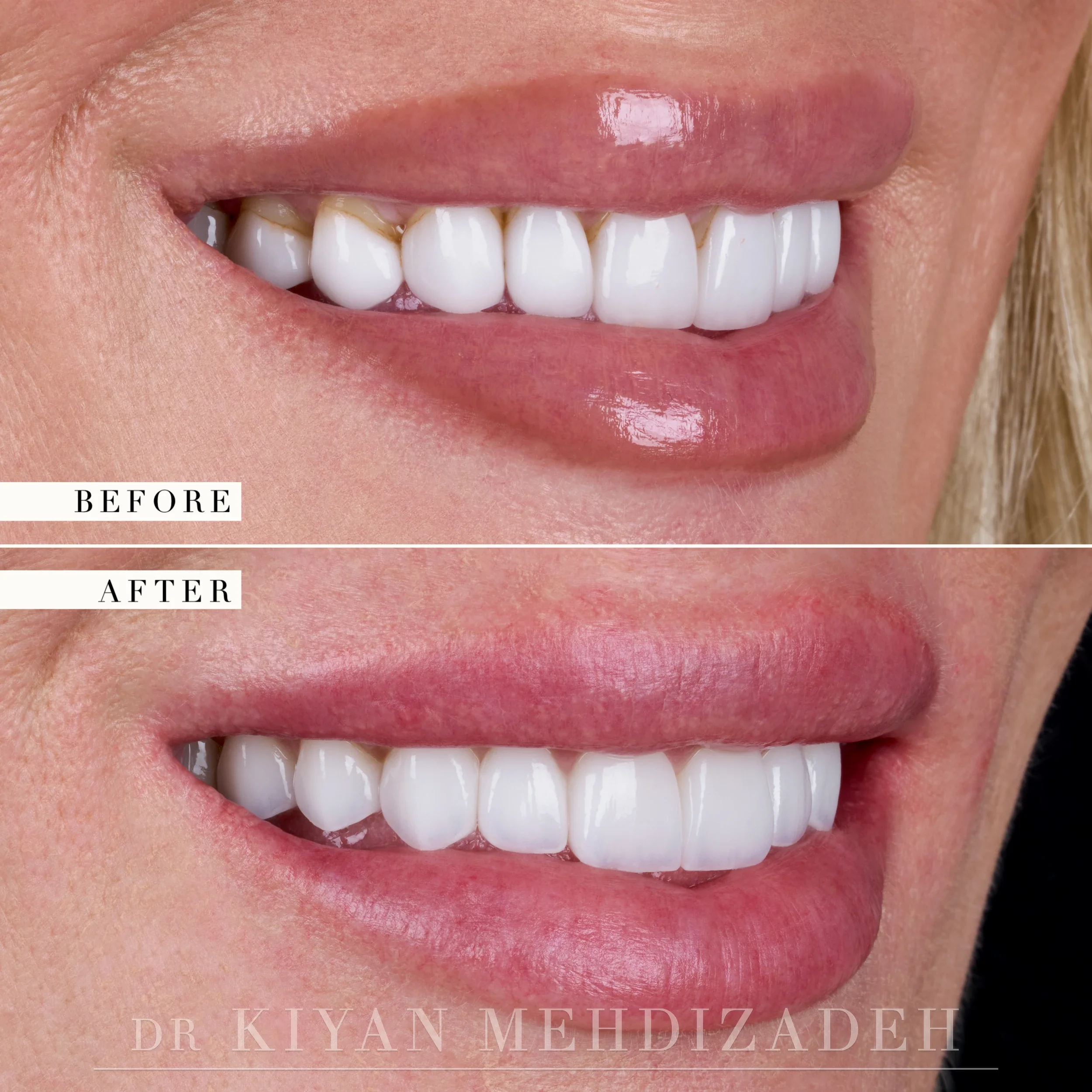
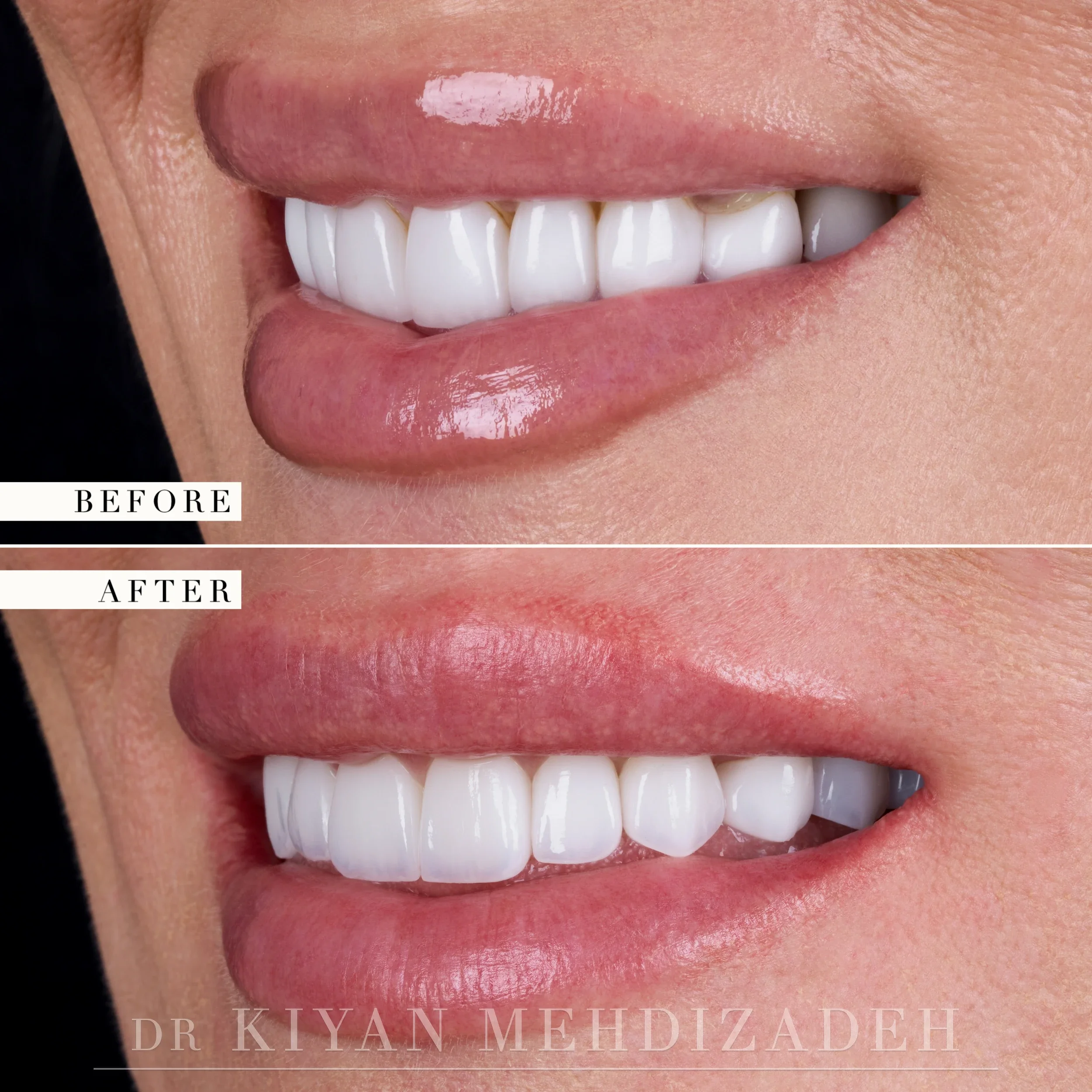
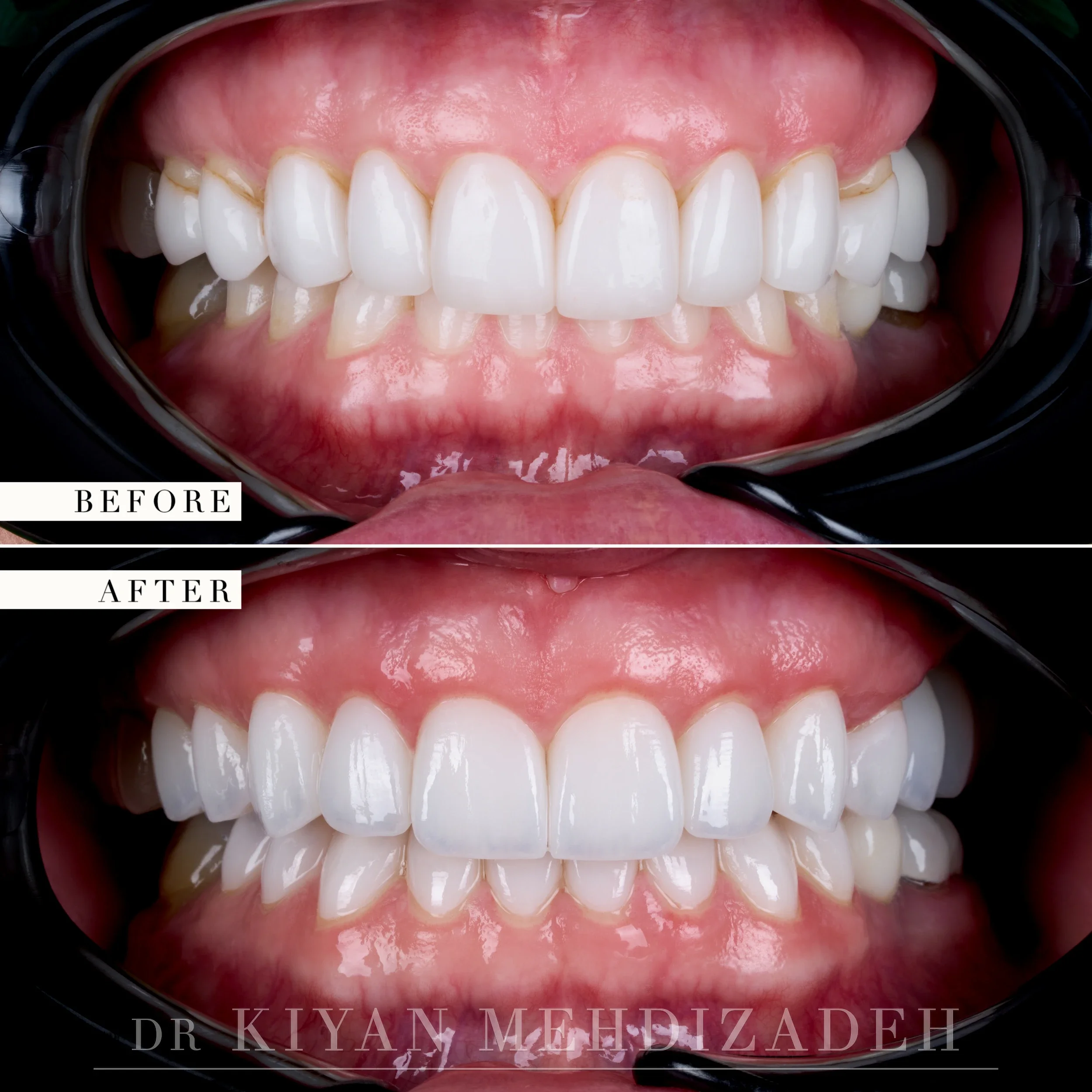
This patient came to the practice because of the dark lines along her gum line. She already had porcelain veneers, placed some years earlier, and those lines were the margins of that porcelain, uncovered where the gum had receded away from them. The appearance embarrassed her.
The recession was not incidental to the old work. The previous veneers had bulky margins, and a margin that stands proud of the tooth holds plaque against the gum. Periodontal tissue irritated for long enough recedes, and as it recedes it uncovers the junction between the porcelain and the tooth underneath. That junction is the dark line. The problem visible in the mirror was the problem sitting under the gum, which is why nothing applied to the porcelain surface would have corrected it.
Why the Implants Had Failed
Two implants in the upper arch had also failed, at a second premolar and the first molar behind it. The reasons were bone loss around both and the positions they had been placed in. Position matters because an implant transmits occlusal force directly into bone rather than through a periodontal ligament. An implant angled poorly concentrates that force where the bone is least able to carry it, and bone loaded that way is resorbed rather than maintained. Once enough has gone the implant loses stability, and remaking the restoration above it changes nothing.
Rebuilding the Sites First
Both implants were removed and both sites were grafted, because the bone that had been lost had to be replaced before a new implant could be placed into it. The replacements went in under intravenous sedation, in positions that direct occlusal force into sound bone. A provisional restoration carried her across those teeth meanwhile. Three of the five months this case took were spent on graft and implant healing.
Replace the margins that caused the recession. Rebuild the bone at both failed implant sites and place implants that can be restored. Establish the shapes and the occlusion before any preparation. Finish every margin flush with the tooth at the gum line.
How Dr. Mehdizadeh Approached Treatment
The design came first. The shapes of the teeth and the position of the bite were established before any preparation, so the ceramic was fabricated to a plan rather than to whatever the previous restorations had left behind.
The gum line was lifted across the upper teeth, from the second premolar on one side to the first premolar on the other, which established the heights the new restorations would be built to. Where the previous work had left bulky margins, the replacements finish flush with the tooth at the gum line, which is the condition periodontal tissue stays healthy against.
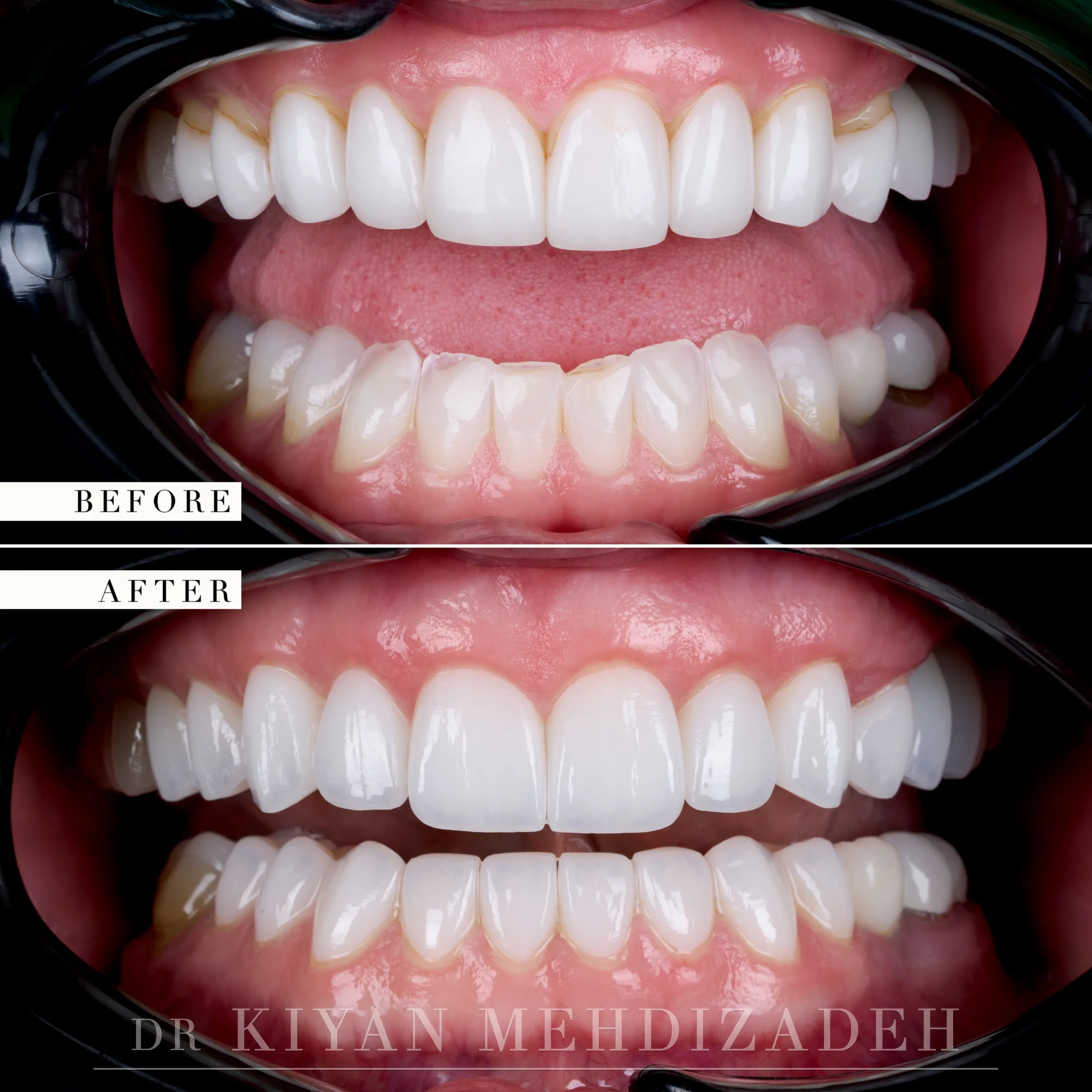
Twenty-three units were then fabricated in e.max in the practice laboratory. Seventeen are porcelain veneers, eight in the upper arch and nine in the lower. The remainder are two onlays, two inlays on the posterior teeth and two implant crowns on the replaced implants. The provisional restorations were finalized in her mouth while the definitive units were being made, so the shapes she approved were the shapes that were copied.
The occlusion was balanced once the restorations were seated, and she wears retainers.
The Result After Five Months
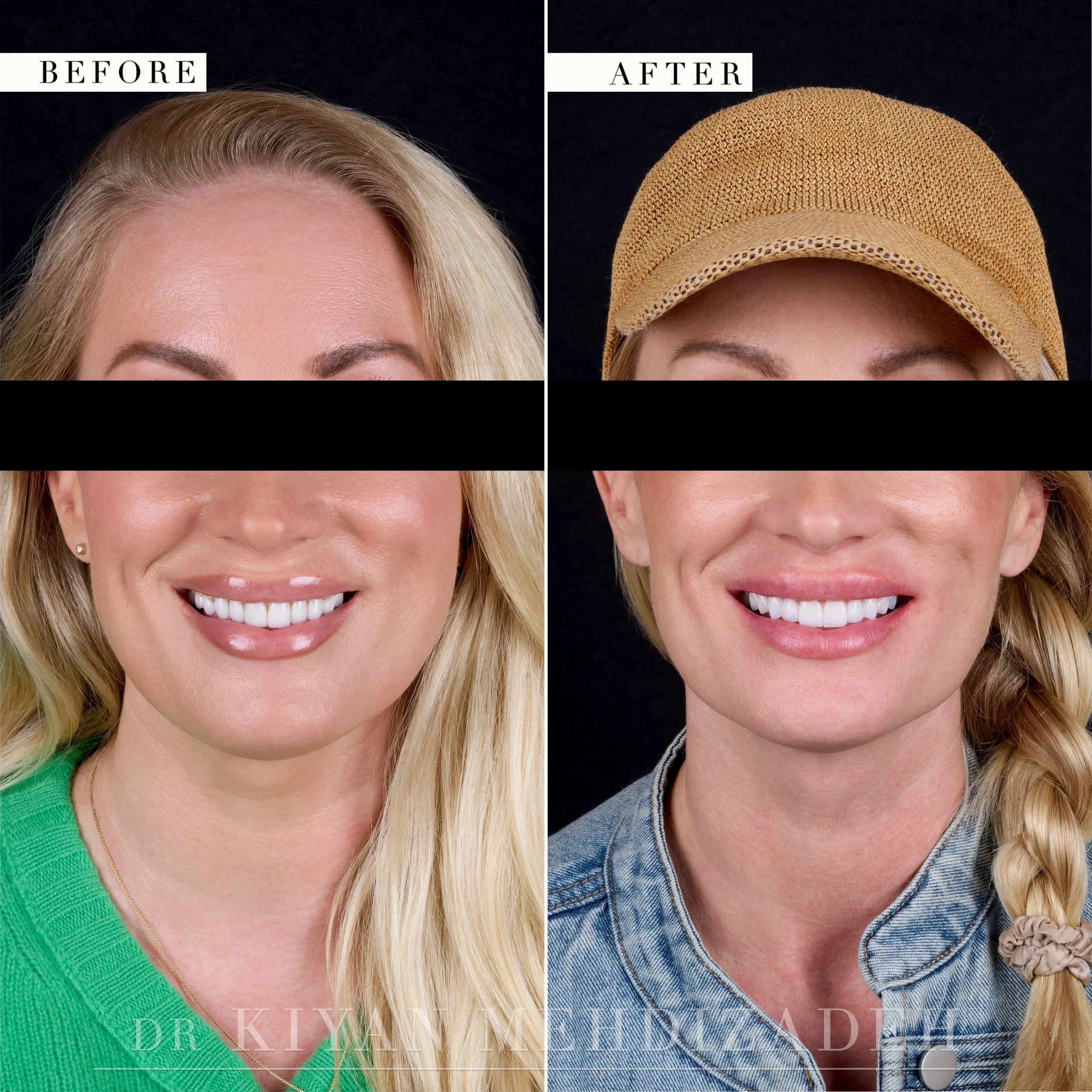
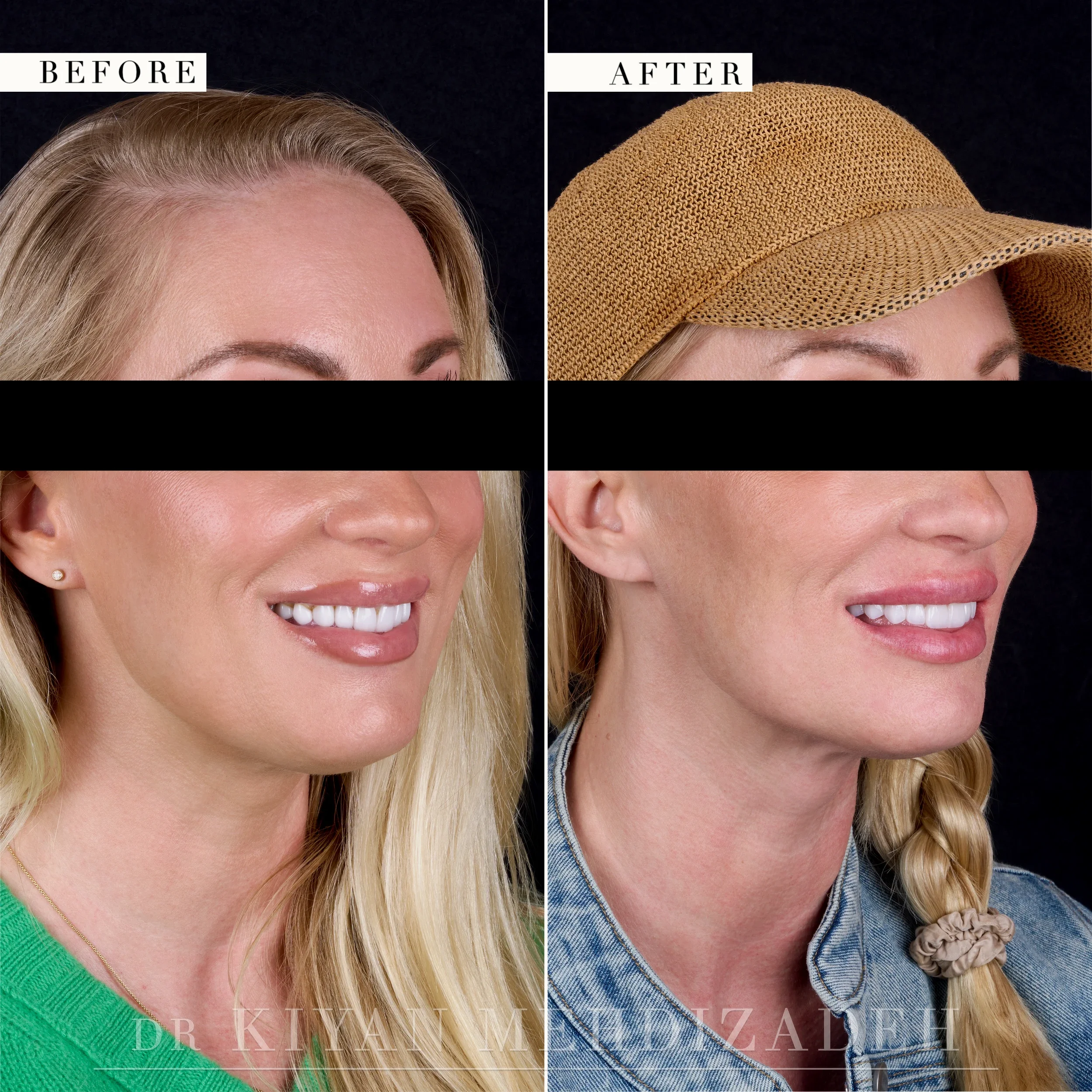
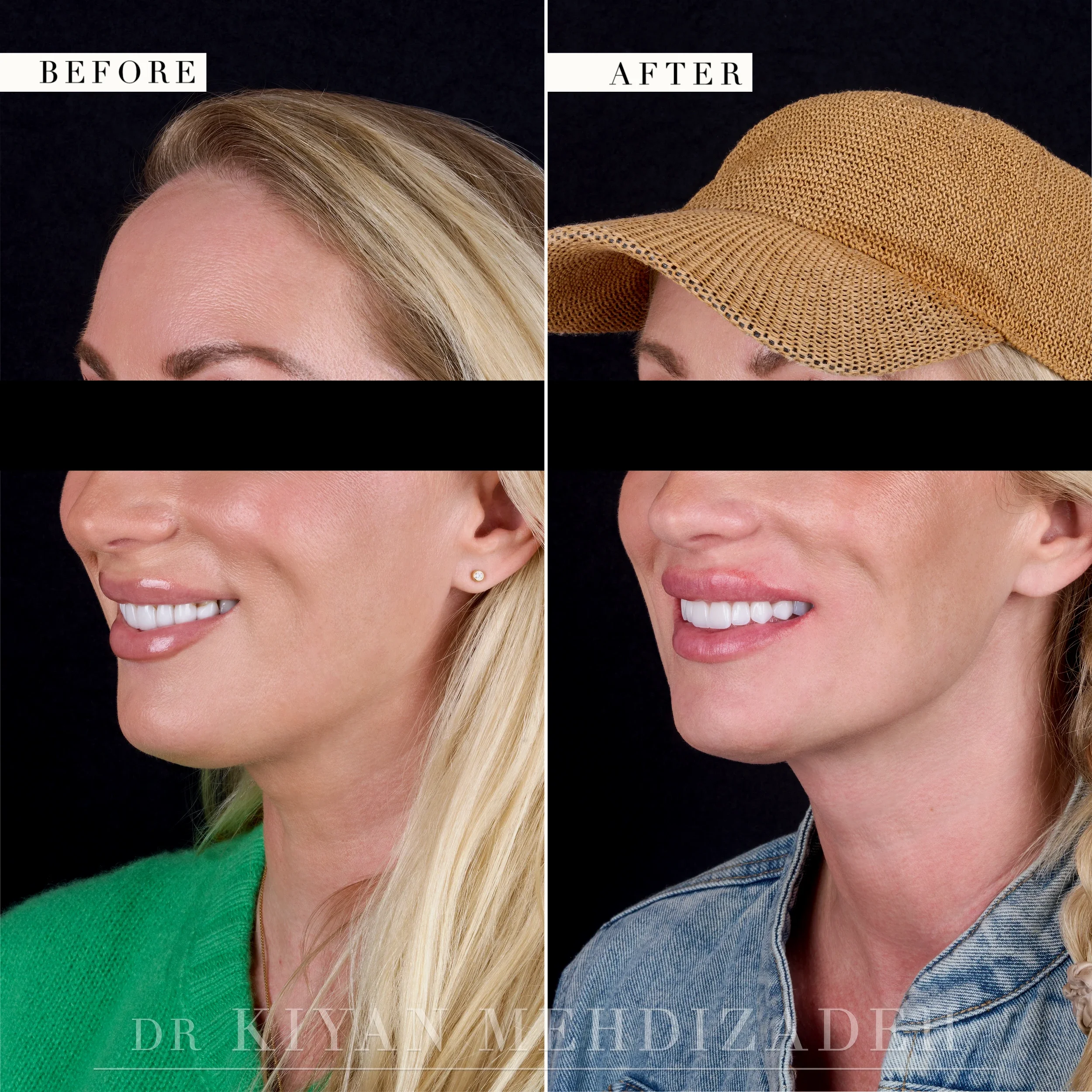
The dark lines are gone, and they are gone because the margins that produced them are gone. The new restorations meet the tooth at the gum without a ledge, and the periodontal tissue sits against them instead of receding. The shade and the surface texture were the other half of the brief: the shapes were designed to look natural rather than uniform, and the ceramic was finished with the surface character that natural enamel has rather than a uniform polish.
Maintenance, repair and recare were discussed and deliberately left outside the treatment plan, because they are continuing rather than part of a course of treatment. The restorations are ceramic. How long they last depends on the occlusion staying balanced, on the retainers being worn, and on the gum line staying healthy, which is where the previous work failed.
The Face, Not Just the Teeth
Frequently Asked Questions About Replacing Failed Veneers and Implants
Why do dark lines appear at the gum line of older veneers?
The line is the junction between the porcelain and the tooth underneath it. While the gum covers that junction nothing shows. When the gum recedes the junction is uncovered, and because the tooth under a veneer is usually darker than the porcelain over it, the exposed edge reads as a dark line.
Can dark margins be polished or whitened away?
No. Polishing acts on the surface of the porcelain and the dark line is not on the surface, it is at the edge where the porcelain stops. Whitening does not change the color of porcelain at all. The margin has to be remade.
What makes a veneer margin bulky, and why does that matter?
A margin is bulky when the porcelain stands proud of the tooth instead of finishing flush with it. The step that creates holds plaque against the gum, the tissue stays irritated, and irritated tissue recedes. The bulky margin is therefore the cause of the recession that later exposes it.
Why did the original implants fail?
Bone had been lost around both of them, and both had been placed in positions that made that likely. An implant carries the force of the bite directly into bone. One that is sited or angled poorly concentrates that force where the bone is least able to carry it, and the bone is lost rather than maintained.
Can a failed implant site be used again?
Usually, but not immediately. The implant is removed and the bone that was lost is grafted, because a new implant needs bone to hold it. Once the graft has healed, a new implant can be placed into the rebuilt site.
How long does a graft take to heal before implants can be restored?
In this case three of the five months were spent on healing, covering both the grafts and the implants placed into them. That period is not optional and it is not shortened by the restorative work being ready sooner.
Was sedation used?
Yes. The implants were removed and replaced, and the sites grafted, under intravenous sedation. IV sedation at this practice is a flat fee of $1,500 to $1,800 set by the complexity of the case rather than by the length of the appointment, added to the cost of the procedure itself.
How long did the whole case take?
Five months from the first appointment to the final cementation, of which three months were healing. The rest was the design, the provisional restorations and the fabrication of the ceramic in the practice laboratory.
What did this case cost?
This case was $47,000 for twenty-three units of e.max, two implants with bone grafting, a gum lift and the design and provisional stages. Porcelain veneers at this practice are $1,800 to $3,500 per tooth, and a case total is not that figure multiplied by a count.
What does she have to do to keep it?
She wears retainers and keeps the gum line healthy, which is what gave way under the previous work. Maintenance, repair and recare were discussed and left outside the treatment plan, because they are ongoing rather than part of a course of treatment.
Last Updated: October 2026

Dr. Kiyan Mehdizadeh, DMD
Doctor of Dental Medicine
Most cosmetic dentists refer out for surgery. Most surgeons don't do cosmetic work. Dr. Mehdizadeh trained in both — implantology and bone grafting at Loma Linda and UCLA, fixed prosthodontics under Mauro Fradeani in Italy, periodontal microsurgery with Hürzeler and Zuhr in Munich, and IV sedation at the University of Alabama. That combination means complex cases involving surgery, grafting, implants, and restorative work are planned and executed by a single provider with full command of every phase.
Technical skill produces function. Taste is what produces beauty. The difference between dental work that looks like dental work and a result that looks entirely natural comes down to aesthetic judgment — proportion, texture, translucency, how light moves across a surface. That sensibility runs through everything here, from the way cases are designed to the office itself.
An in-house master ceramist and on-site laboratory allow restorations to be designed, fabricated, and refined with direct collaboration between doctor and technician — no outsourced lab work, no guesswork, no compromise on the final product. Dr. Mehdizadeh is one of few dentists with the refined ability to provide care across multiple specialties, resulting in cohesive and holistic outcomes.
Education & Credentials
- Doctor of Dental Medicine (DMD), cum laude — Boston University
- Bachelor of Science in Biology — Emory University
- Mastership in Implant Dentistry & Grafting — Loma Linda University / gIDE Institute
- Advanced Implant Therapy & Grafting — UCLA / gIDE Institute
- Implant Placement & Restoration — UCLA / Nobel Biocare
- Guided Bone Regeneration & Ridge Augmentation — gIDE Institute
- Sinus Elevation & Augmentation — gIDE Institute
- Soft Tissue Management & Grafting — gIDE Institute
- Minimally Invasive Augmentation & Autogenous Bone Management — IDEA, San Francisco
- Master Program in Fixed Prosthodontics — Fradeani Education, Italy
- Aesthetic Dentistry — UCLA School of Dentistry
- Advanced Occlusion & Bite Design — UCLA
- Periodontal Micro-Surgery — Hürzeler/Zuhr, Munich
- Micro-Endodontic Training — University of Pennsylvania
- IV Sedation — University of Alabama at Birmingham
- Injectable Therapy for TMJ & Facial Pain — American Academy of Facial Esthetics
Considering similar treatment?
Send Dr. Mehdizadeh a photo and ask what’s possible for your case.