A Confident Smile After Years of Grinding
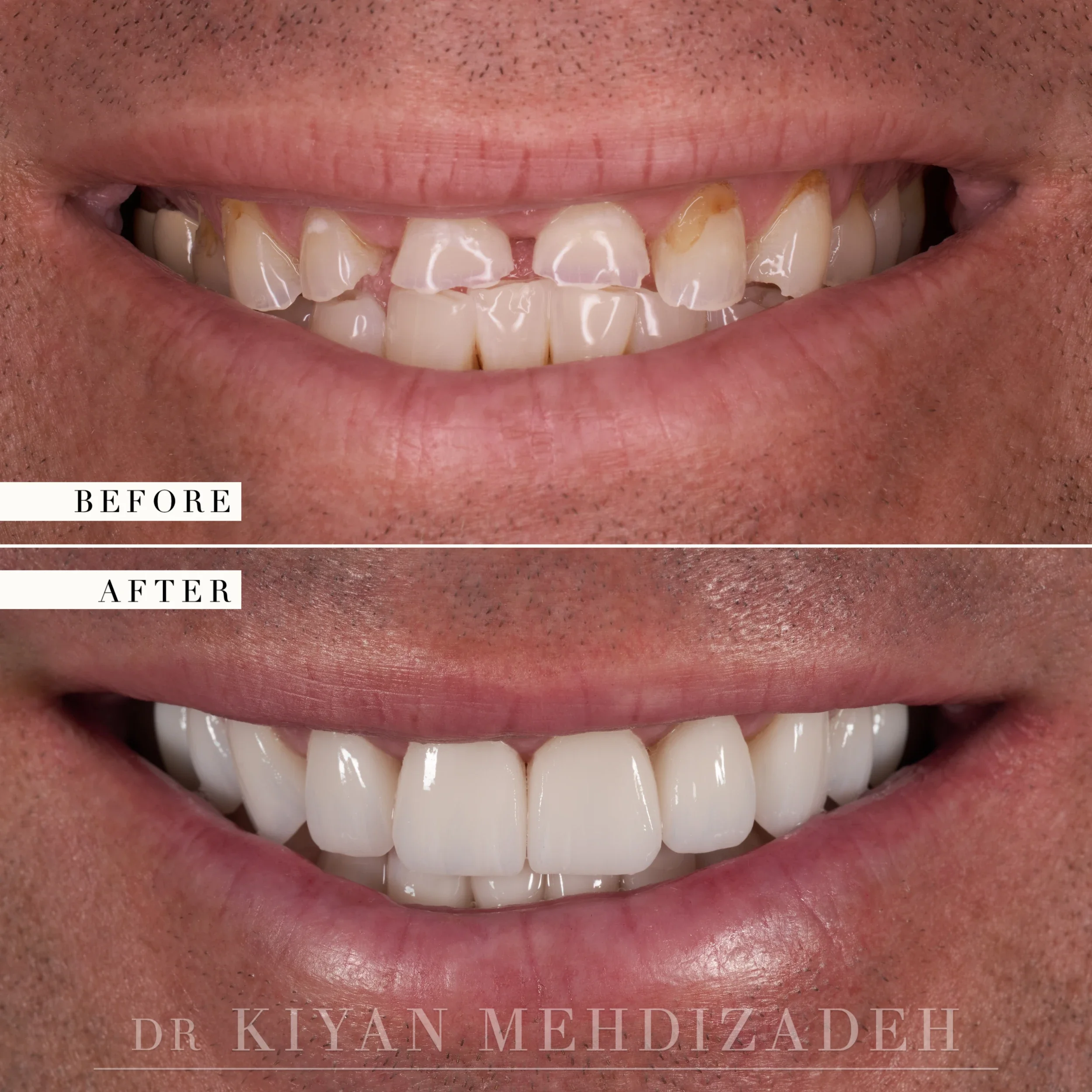
Years of grinding had shortened the teeth until some upper incisors sat almost level with the gum. Restoring the appearance was the last step, not the first.
By Dr. Kiyan Mehdizadeh, DMD · 9460 Wilshire Blvd, Suite 850, Beverly Hills, CA 90212 · (310) 770-3335
Last Updated: September 2026
Have your teeth worn shorter over the years?
Wear is a bite problem before it is a cosmetic one, and rebuilding the teeth without establishing where the bite should sit hands the same forces a new set of surfaces to destroy. Send us a photo of your teeth and we will tell you what is causing the wear, what restoring it would involve, and what it would cost.
- A response within one business day. Usually much sooner.
- A real cost estimate, not a range designed to get you in the door.
- No obligation. Many patients take months to decide. That is normal.
Ask about your case
Reviewed by our treatment coordination team. Call or text (310) 770-3335 if you would rather speak now.
Request received
Our treatment coordination team will review what you sent and call you
within one business day.
If you would like to hold a consultation time now, you can do that below.
Treatment Plan by Dr. Kiyan Mehdizadeh
- Assessment of the worn dentition and of the vertical dimension lost to attrition.
- Crown lengthening to expose sound tooth structure for the restorations to engage.
- Provisional restorations in both arches, worn long enough to test the restored bite.
- Twenty-eight individual ceramic restorations, fourteen in each arch.
The Patient's Journey
This patient had worn his teeth down through severe bruxism. Bruxism is the involuntary grinding and clenching that most people do in their sleep, and that a few do with this much force. The attrition ran across his whole dentition rather than concentrating on the front teeth. Several upper incisors had shortened until they sat almost level with the gingival margin. He was embarrassed by them. He wanted a smile he could be confident about for a career change he had already decided on.
Wear of this severity is a bite problem before it is a cosmetic one. Treating it in the other order is how these cases fail. The teeth are short because the opposing arch has been abrading them for years, and lengthening them without first establishing where the bite should sit simply hands the same destructive forces a new set of surfaces to remove.
Two separate problems had to be solved before any ceramic was made. The first was structural. A restoration needs a collar of sound tooth structure to grip, called a ferrule, and teeth worn nearly to the gingival margin do not present one. Without a ferrule a restoration is held by adhesive alone against a patient whose parafunctional forces had already destroyed his own enamel, which is a poor arrangement. There was no room to prepare these teeth, because the preparation would have consumed everything that remained.
The second problem was the vertical dimension of occlusion, meaning the height at which the jaws close when the teeth meet. Decades of attrition had lowered his. The restorations had to reopen it, and reopening it is not a matter of simply building the teeth taller: the elevator musculature and the temporomandibular joints have accommodated the collapsed position over many years, and they have to tolerate the new one comfortably before it is committed to in ceramic. A vertical dimension the patient cannot function at produces muscle pain, joint symptoms and fractured restorations, in roughly that order.
The second problem was the vertical dimension, meaning the height at which the jaws close when the teeth meet. Decades of attrition had lowered his, and the restorations had to reopen it. Reopening the vertical dimension is not simply a matter of building the teeth taller. The muscles and the temporomandibular joints have accommodated the collapsed position over years, and they have to tolerate the new one before it is committed to in ceramic.
Expose sound tooth structure for the restorations to engage. Reopen the vertical dimension lost to attrition. Prove the new bite in provisionals before committing it to ceramic. Restore twenty-eight teeth as individual units. Complete treatment within two months.
How Dr. Mehdizadeh Approached Treatment
Provisional restorations were then placed across both arches at the intended vertical dimension. This is the step patients most often want to skip. It is also the one that decides whether the case succeeds, because it converts a proposed occlusion into a tested one. He wore the provisionals and ate on them, and the restored bite was assessed in function rather than on an articulator alone. Only once his musculature and joints had accommodated the new position without complaint was the definitive work begun.
Twenty-eight individual ceramic restorations were then fabricated, fourteen in each arch, as a combination of inlays and crowns according to how much structure each tooth had retained. Individual units matter here. A splinted arch is simpler to make and simpler to fit, but it cannot be repaired one tooth at a time, and it removes the interproximal access a patient with his history will need for the rest of his life.
Twenty-eight individual ceramic restorations were then fabricated, fourteen in each arch, as a combination of inlays and crowns according to how much structure each tooth had retained. Individual units matter here. A splinted arch is simpler to make and simpler to fit, but it cannot be repaired tooth by tooth, and it removes the interproximal access that a patient with his history will need for the rest of his life.
The reconstruction restored the appearance of the dentition and the vertical dimension it had lost. He functions on the new bite. The worn edges are gone, the anterior teeth have proportions appropriate to his face rather than the stumps attrition had left, and the teeth are no longer the first thing anyone notices about him.
The parafunction itself has not been cured. Bruxism is a neuromuscular habit, not a dental one, and no restoration alters it. What changes is what absorbs the force. Ceramic is considerably harder than the enamel it replaced, and a night guard takes the load during the hours when the grinding actually occurs.
The parafunction itself has not been cured, because bruxism is a neuromuscular habit rather than a dental one, and no restoration alters it. What changes is what absorbs the force. Ceramic is considerably harder than the enamel it replaced, and a night guard protects the restorations during the hours when the grinding actually occurs.
Frequently Asked Questions About Full Mouth Reconstruction for Worn Teeth
What causes teeth to wear down this severely?
Bruxism, the involuntary grinding and clenching that occurs mostly during sleep. It is a neuromuscular habit rather than a dental one. Over years the opposing arches abrade one another, shortening the teeth and lowering the height at which the jaws close.
What is crown lengthening and why was it needed first?
Gingival tissue is removed and the underlying bone recontoured to expose more of the natural tooth. Teeth worn almost to the gingival margin present no collar of sound structure for a restoration to grip, and preparing them without lengthening first would consume what little remained.
What is vertical dimension?
The height at which the jaws close when the teeth meet. Years of attrition lower it, and a reconstruction of worn teeth has to reopen it. The muscles and the temporomandibular joints have accommodated the collapsed position, so the new one is tested before it is made permanent.
Why were provisional restorations worn before the ceramic was made?
Because a restored bite has to be proved in function rather than assumed. The provisionals hold the intended vertical dimension while the musculature and joints accommodate it. Committing twenty-eight ceramic units to a position that has not been tested is how these cases fail.
Why individual units instead of a splinted arch?
A splinted arch is easier to fabricate and to fit, but it cannot be repaired tooth by tooth and it eliminates the interproximal access needed for cleaning. Individual restorations keep both, which matters over the decades a reconstruction like this is meant to serve.
What is the difference between an inlay and a crown here?
An inlay restores the biting surface and sits within the remaining walls of the tooth. A crown covers the tooth entirely. Which one a tooth received depended on how much sound structure it had retained, so the more conservative option was used wherever the tooth allowed it.
Will the grinding damage the new restorations?
The habit is not cured by restoring the teeth. Ceramic is considerably harder than the enamel it replaced, and a night guard absorbs the force during sleep when the parafunction occurs. Wearing it is the single most useful thing a patient in this situation does.
How long does a full mouth reconstruction take?
This case ran two months from the crown lengthening to the final restorations. The interval depends on how long the provisionals need to be assessed in function and on how much healing the surgery requires before preparation can begin.
Is a full mouth reconstruction painful?
The surgical phase is carried out under local anesthetic, with intravenous sedation available in this office for patients who prefer it. Discomfort afterwards is comparable to other periodontal surgery and is managed with ordinary analgesia.
How much does a full mouth reconstruction cost?
This case was $56,000, covering crown lengthening, provisional restorations and twenty-eight individual ceramic units. Individual ceramic restorations range from $1,800 to $3,500 per tooth and crown lengthening ranges from $2,000 to $5,000, so the total depends chiefly on how many teeth need restoring. Financing options are available and a detailed breakdown is provided at the consultation.
Last Updated: September 2026

Dr. Kiyan Mehdizadeh, DMD
Doctor of Dental Medicine
Most cosmetic dentists refer out for surgery. Most surgeons don't do cosmetic work. Dr. Mehdizadeh trained in both — implantology and bone grafting at Loma Linda and UCLA, fixed prosthodontics under Mauro Fradeani in Italy, periodontal microsurgery with Hürzeler and Zuhr in Munich, and IV sedation at the University of Alabama. That combination means complex cases involving surgery, grafting, implants, and restorative work are planned and executed by a single provider with full command of every phase.
Technical skill produces function. Taste is what produces beauty. The difference between dental work that looks like dental work and a result that looks entirely natural comes down to aesthetic judgment — proportion, texture, translucency, how light moves across a surface. That sensibility runs through everything here, from the way cases are designed to the office itself.
An in-house master ceramist and on-site laboratory allow restorations to be designed, fabricated, and refined with direct collaboration between doctor and technician — no outsourced lab work, no guesswork, no compromise on the final product. Dr. Mehdizadeh is one of few dentists with the refined ability to provide care across multiple specialties, resulting in cohesive and holistic outcomes.
Education & Credentials
- Doctor of Dental Medicine (DMD), cum laude — Boston University
- Bachelor of Science in Biology — Emory University
- Mastership in Implant Dentistry & Grafting — Loma Linda University / gIDE Institute
- Advanced Implant Therapy & Grafting — UCLA / gIDE Institute
- Implant Placement & Restoration — UCLA / Nobel Biocare
- Guided Bone Regeneration & Ridge Augmentation — gIDE Institute
- Sinus Elevation & Augmentation — gIDE Institute
- Soft Tissue Management & Grafting — gIDE Institute
- Minimally Invasive Augmentation & Autogenous Bone Management — IDEA, San Francisco
- Master Program in Fixed Prosthodontics — Fradeani Education, Italy
- Aesthetic Dentistry — UCLA School of Dentistry
- Advanced Occlusion & Bite Design — UCLA
- Periodontal Micro-Surgery — Hürzeler/Zuhr, Munich
- Micro-Endodontic Training — University of Pennsylvania
- IV Sedation — University of Alabama at Birmingham
- Injectable Therapy for TMJ & Facial Pain — American Academy of Facial Esthetics
Considering similar treatment?
Send Dr. Mehdizadeh a photo and ask what’s possible for your case.
Other cases like this one
Underbite Correction: Full-Mouth Veneers
Restoring worn and flared front teeth by designing within the existing bite
View case →Smile Makeover After Braces
Gum lift, implants and twenty veneers sequenced as one comprehensive plan
View case →Veneers Replacing Old Bonding
Trading repeated composite repairs for a durable restoration, with implants to restore the bite
View case →