When One Gum Procedure Is Not Enough
A gummy smile can come from the gums, from the lip, or from both. This one came from both, which is why treating either alone would have left half the problem in place.
By Dr. Kiyan Mehdizadeh, DMD · 9460 Wilshire Blvd, Suite 850, Beverly Hills, CA 90212 · (310) 770-3335
Last Updated: August 2026
Does your smile show more gum than you would like?
A gummy smile can come from the gums, from the lip, or from the jaw, and the three do not respond to the same treatment. Working out which one you have is the whole of the diagnosis. Send us a photo of your full smile and we will tell you what is producing it, what would correct it, and what that would cost.
- A response within one business day. Usually much sooner.
- A real cost estimate, not a range designed to get you in the door.
- No obligation. Many patients take months to decide. That is normal.
Ask about your case
Reviewed by our treatment coordination team. Call or text (310) 770-3335 if you would rather speak now.
Request received
Our treatment coordination team will review what you sent and call you
within one business day.
If you would like to hold a consultation time now, you can do that below.
Treatment Plan by Dr. Kiyan Mehdizadeh
- Smile design, establishing the intended gum height, tooth length and a level smile line.
- Guided crown lengthening and lip repositioning surgery, carried out in one stage.
- Six weeks of healing.
- Temporary veneers to test the restored length and the corrected smile line before finalizing.
- Ten upper porcelain veneers.
The Patient's Journey
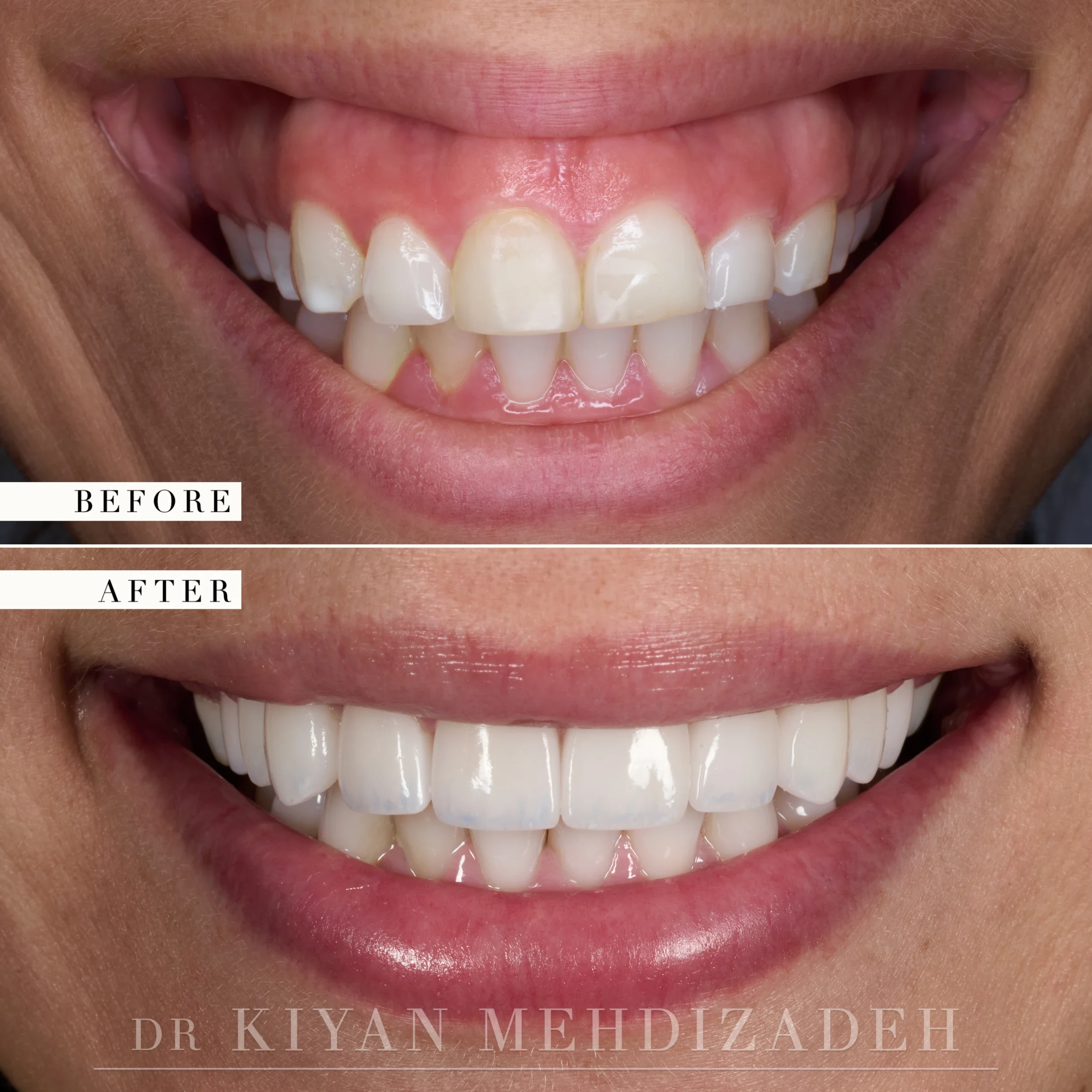
This patient presented with three problems that had developed together over a number of years. Grinding had worn the edges of her upper teeth unevenly, which had tilted the line her smile followed. The two central incisors carried composite bonding placed to repair that wear, and the bonding had discolored against the natural teeth around it. Her smile also displayed a considerable amount of gingival tissue on full animation.
The gingival display was the finding that determined the sequence of the plan. Excessive gingival display has several possible causes, and they are not interchangeable, so the first task was measurement rather than treatment. The gums may sit low over teeth of normal size, the upper lip may rise further than average when smiling, or the upper jaw may be vertically long. Each of these produces an identical complaint from the patient, and each responds to a different procedure.
Understanding the Challenge
Assessment demonstrated that two of these causes were operating simultaneously. Her gingival margins sat low over teeth that had also been shortened by wear, and her upper lip was hyperactive, rising further on smiling than a normal lip does. A normal upper lip elevates roughly six to eight millimeters; a hyperactive lip rises approximately one and a half times that distance, exposing gum tissue that is otherwise in an ordinary position.
Crown lengthening removes excess gingival tissue and recontours the alveolar bone beneath it, which addresses the gum-and-tooth half of the problem. That procedure has a defined limit. Bone can only be recontoured so far before the support the teeth depend on is compromised, and her gum display exceeded what that procedure could safely correct on its own. Pushing a single procedure past its safe range in order to avoid adding a second one is how teeth end up with less support than they need.
Treatment Goals
Reduce gingival display to a normal range without compromising bone support. Address both causes rather than the more convenient one. Restore the tooth structure lost to grinding wear. Level the canted smile line. Replace the discolored bonding with a color-stable material. Complete treatment within ten weeks.
How Dr. Mehdizadeh Approached Treatment
Lip repositioning surgery addresses the second cause directly. A horizontal strip of mucosa is removed from inside the upper lip and the vestibular sulcus is shortened with sutures. This limits how far the elevator muscles can draw the lip during a smile. Published reductions in gingival display following this procedure average approximately three and a half millimeters. The procedure does not touch the teeth or the gum line; it changes how much of them the lip reveals.
Both procedures were carried out in a single surgical stage. Staging them separately would have meant two surgical episodes, two healing periods, and an intermediate state in which neither the gum line nor the lip position was final. The veneer design depends on knowing how much tooth will be visible at full smile. That figure is the product of both variables together rather than either one alone.
Six weeks of healing followed, which allowed the gingival margins to settle and the lip to establish its new range of movement. Temporary veneers were then placed so the restored length and the corrected smile line could be assessed before anything was finalized. Ten upper porcelain veneers were delivered once those positions were agreed.
The Result After Ten Weeks
The gingival display is within a normal range, and it was brought there by two procedures each doing the part it is suited to rather than one doing more than it safely should. The upper lip is fuller at rest, which is a common and expected consequence of the repositioning procedure.
The worn incisal edges have been restored in porcelain. This allowed the smile line to be leveled at the same time, and the discolored bonding has been replaced with a material that holds its color. The wear itself was caused by grinding, so the restorations are protected by a night guard and the bite is monitored at recall.
One limitation of the lip procedure should be stated explicitly. The published follow-up on lip repositioning is inconsistent: one 2021 study reported a stable result at three and a half years, another found the change had substantially reversed by six months, and a 2023 series of two hundred patients using a different suturing method reported no recurrence at one year. Case selection and technique appear to matter a great deal. That uncertainty is one reason the gum-side correction was performed as well rather than relying on the lip alone.
Frequently Asked Questions About Gummy Smiles and Lip Repositioning
What is a gummy smile?
It is a smile that shows more gum tissue than is usual. It can come from the gums sitting low over the teeth, from an upper lip that rises further than average, from a vertically long upper jaw, or from a combination.
What is lip repositioning surgery?
A strip of tissue is removed from inside the upper lip and the space between lip and gum is shortened with sutures, so the muscles that lift the lip cannot draw it as high. Published reductions in gum display average around three and a half millimeters.
Why were two procedures needed instead of one?
The excess display exceeded what crown lengthening could safely correct alone, and part of the cause was the lip rather than the gums. Each procedure addresses a different cause. Treating only one would have left the other in place.
How is lip repositioning different from crown lengthening?
Crown lengthening exposes more tooth by removing gum and reshaping the bone beneath it. Lip repositioning does not touch the teeth or gums at all: it limits how far the lip travels. Different causes, different procedures.
Does lip repositioning change how the lip looks at rest?
The upper lip commonly appears slightly fuller at rest afterwards, which was the case here. The procedure is done from inside the mouth.
Why the six-week wait before the veneers?
Gum margins settle for several weeks after surgery, and the lip needs time to establish its new movement. The veneer design depends on knowing how much tooth is visible at full smile, and that figure is not reliable until both have stabilized.
Why replace the bonding rather than repair it again?
Composite bonding is softer and more porous than porcelain. It stains and chips over time and needs redoing. Where the damage keeps recurring, porcelain holds its shape and color considerably longer.
How long did treatment take?
About ten weeks, the bulk of it healing between the surgery and the final veneers.
What does treatment like this cost?
This case was $32,000, covering guided crown lengthening, lip repositioning, temporaries and ten porcelain veneers. Porcelain veneers range from $1,800 to $3,500 per tooth depending on complexity. We accept PPO insurance and offer financing through Proceed Finance, PatientFi, Happen Bank, CareCredit, and Cherry.
Does lip repositioning last?
This is the honest limitation of the procedure and it deserves a direct answer. The published follow-up is inconsistent: one 2021 study reported a stable result at three and a half years, another found the change had substantially reversed by six months, and a 2023 series of two hundred patients using a different suturing method reported no recurrence at one year. What the literature agrees on is that case selection and technique matter a great deal. It is discussed openly before treatment, and it is one reason the gum-side correction was done as well rather than relying on the lip alone.
Last Updated: August 2026

Dr. Kiyan Mehdizadeh, DMD
Doctor of Dental Medicine
Most cosmetic dentists refer out for surgery. Most surgeons don't do cosmetic work. Dr. Mehdizadeh trained in both — implantology and bone grafting at Loma Linda and UCLA, fixed prosthodontics under Mauro Fradeani in Italy, periodontal microsurgery with Hürzeler and Zuhr in Munich, and IV sedation at the University of Alabama. That combination means complex cases involving surgery, grafting, implants, and restorative work are planned and executed by a single provider with full command of every phase.
Technical skill produces function. Taste is what produces beauty. The difference between dental work that looks like dental work and a result that looks entirely natural comes down to aesthetic judgment — proportion, texture, translucency, how light moves across a surface. That sensibility runs through everything here, from the way cases are designed to the office itself.
An in-house master ceramist and on-site laboratory allow restorations to be designed, fabricated, and refined with direct collaboration between doctor and technician — no outsourced lab work, no guesswork, no compromise on the final product. Dr. Mehdizadeh is one of few dentists with the refined ability to provide care across multiple specialties, resulting in cohesive and holistic outcomes.
Education & Credentials
- Doctor of Dental Medicine (DMD), cum laude — Boston University
- Bachelor of Science in Biology — Emory University
- Mastership in Implant Dentistry & Grafting — Loma Linda University / gIDE Institute
- Advanced Implant Therapy & Grafting — UCLA / gIDE Institute
- Implant Placement & Restoration — UCLA / Nobel Biocare
- Guided Bone Regeneration & Ridge Augmentation — gIDE Institute
- Sinus Elevation & Augmentation — gIDE Institute
- Soft Tissue Management & Grafting — gIDE Institute
- Minimally Invasive Augmentation & Autogenous Bone Management — IDEA, San Francisco
- Master Program in Fixed Prosthodontics — Fradeani Education, Italy
- Aesthetic Dentistry — UCLA School of Dentistry
- Advanced Occlusion & Bite Design — UCLA
- Periodontal Micro-Surgery — Hürzeler/Zuhr, Munich
- Micro-Endodontic Training — University of Pennsylvania
- IV Sedation — University of Alabama at Birmingham
- Injectable Therapy for TMJ & Facial Pain — American Academy of Facial Esthetics
Considering similar treatment?
Send Dr. Mehdizadeh a photo and ask what’s possible for your case.