Fluorosis Treatment With Porcelain Veneers
Correcting fluoride staining, flared teeth, and a missing tooth with 20 veneers and a dental implant
By Dr. Kiyan Mehdizadeh, DMD · 9460 Wilshire Blvd, Suite 850, Beverly Hills, CA 90212 · (310) 770-3335
Last Updated: August 2026
Mottled or streaked enamel that will not whiten?
Fluorosis is a defect in how the enamel formed. Whitening changes the shade around it and often makes the mottling more obvious, not less. Send us a photo and we will tell you what would actually resolve it.
- A response within one business day. Usually much sooner.
- A real cost estimate, not a range designed to get you in the door.
- No obligation. Many patients take months to decide. That is normal.
Ask about your case
Reviewed by our treatment coordination team. Call or text (310) 770-3335 if you would rather speak now.
Request received
Our treatment coordination team will review what you sent and call you
within one business day.
If you would like to hold a consultation time now, you can do that below.
Treatment Plan by Dr. Kiyan Mehdizadeh
- Dental implant placement for missing posterior tooth to restore bite stability
- Correction of upper anterior flare to establish proper alignment
- 10 upper porcelain veneers to eliminate fluorosis staining and reshape teeth
- 10 lower porcelain veneers for full smile harmonization
- Bite correction and occlusal stabilization across both arches
When Fluoride Leaves Its Mark
Fluorosis is a condition that develops during childhood when a person is exposed to excessive amounts of fluoride while the permanent teeth are still forming beneath the gums. This typically occurs between birth and age eight, during the critical years of enamel development. The most common source is fluoridated drinking water at concentrations above recommended levels, though swallowing fluoride toothpaste, taking fluoride supplements, or consuming naturally high-fluoride well water can also contribute. The result is a disruption in the normal mineralization process of enamel, leaving behind characteristic white spots, brown stains, or mottled patches across the teeth.
A common misconception is that fluorosis stains can be whitened or bleached away. They cannot. Because the discoloration is embedded within the enamel structure itself—not deposited on the surface—professional whitening treatments have little to no effect on fluorosis. In mild cases, the white spots may appear more prominent after bleaching because the surrounding enamel whitens while the fluorotic areas remain unchanged. For patients with moderate to severe fluorosis, the compromised enamel can actually deteriorate over time: the chalky, porous spots may begin to flake or chip away, exposing the underlying tooth structure to decay. What starts as a cosmetic concern can become a structural one years later.
“Fluorosis staining is within the enamel itself—no amount of bleaching will remove it.”
Why Veneers Are the Best Solution for Fluorosis
The most predictable and durable solution for fluorosis is porcelain veneers or crowns. Veneers cover the compromised enamel entirely, providing a uniform surface that eliminates the visual irregularity while also protecting weakened areas from further breakdown. Unlike bonding or microabrasion, which offer temporary or partial results, well-fabricated porcelain veneers create a permanent new surface that is stronger and more stain-resistant than the original enamel.
Initial Findings
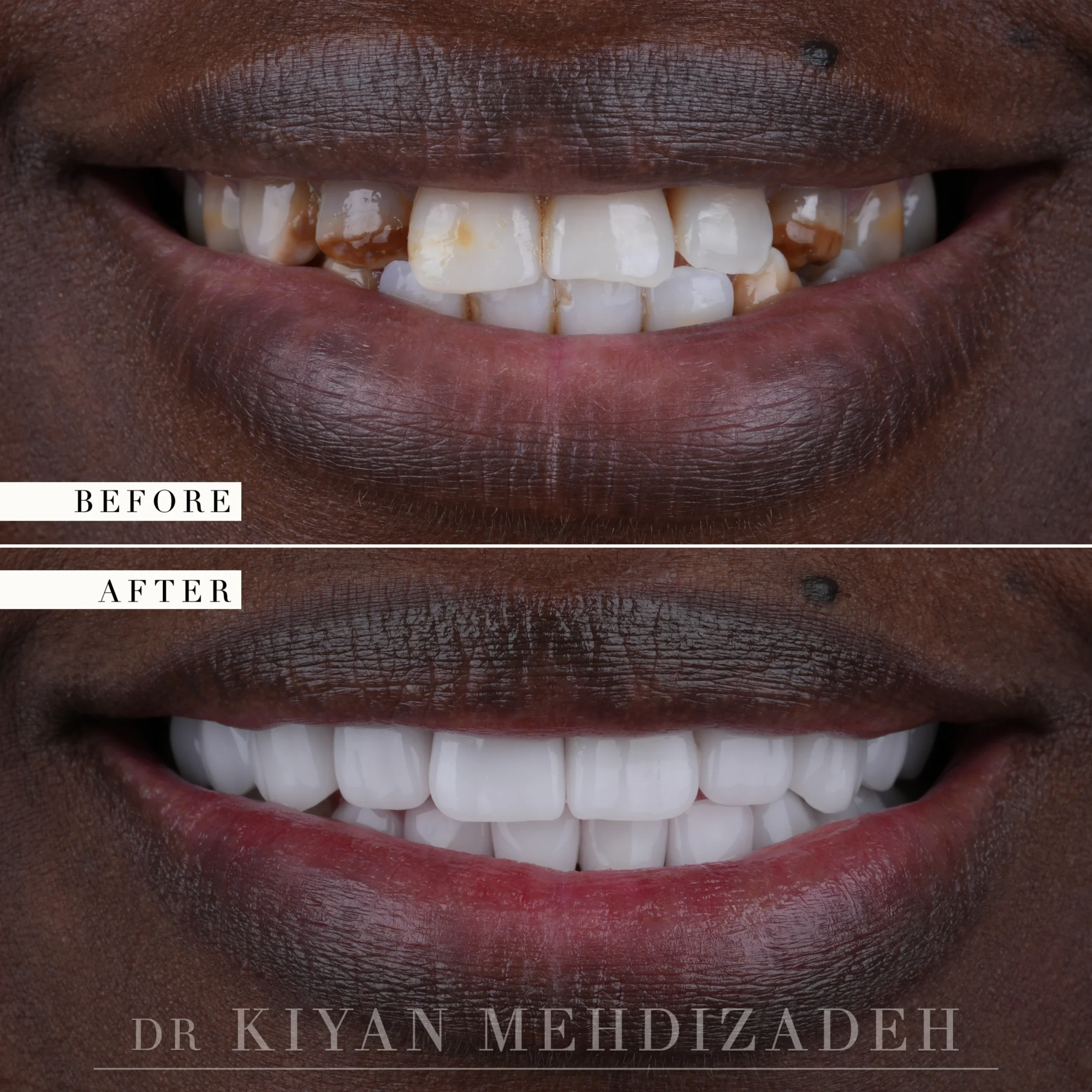
Moderate fluorosis with white and brown mottling across upper and lower teeth. Flared upper anterior teeth with compromised bite stability. Missing posterior tooth contributing to bite imbalance and shifting.
Restoring the Foundation First
Before addressing the cosmetic concerns, a dental implant was placed to replace a missing back tooth. This step is critical and often overlooked by providers who focus solely on the front teeth. The posterior teeth are the foundation of the bite—when a back tooth is missing, the remaining teeth shift, the bite collapses, and the front teeth bear forces they were never designed to handle. This is precisely what caused the flare in this patient’s upper front teeth. Restoring posterior support with an implant creates a stable platform that protects the veneer work for years to come.
The Veneer Work
With the implant integrated and the bite stabilized, 20 porcelain veneers were placed across the upper and lower arches. The treatment corrected the flare in the upper teeth, established a stable and balanced bite, and completely eliminated the fluorosis discoloration. This patient wanted very white teeth with minimal translucency—a look not typically recommended because natural teeth have some degree of translucency at the edges. However, shade preference is ultimately a personal choice, and the veneers were designed to achieve her desired brightness while maintaining proper proportions and natural tooth anatomy.
The Result
The final result is a beautiful, uniform smile that complements her features rather than distracting from them. The fluorosis staining is completely concealed, the flare is corrected, the bite is stable with full posterior support, and the shape and color of every tooth work together as a cohesive whole. Completing this case in six weeks required precise coordination between implant placement, bite correction, and veneer fabrication, but the comprehensive approach is what produces results that last.
“We always correct the posterior bite first—stability is the foundation of every lasting smile.”
Frequently Asked Questions About Fluorosis Treatment
What is fluorosis and what causes it?
Fluorosis is a cosmetic and structural condition caused by excessive fluoride exposure during early childhood, typically from fluoridated drinking water, swallowed toothpaste, or fluoride supplements. It disrupts normal enamel formation, resulting in white spots, brown stains, or mottled, porous patches on the permanent teeth. The severity depends on the amount and duration of fluoride exposure during the first eight years of life.
Can fluorosis stains be whitened or bleached away?
No. Fluorosis staining is embedded within the enamel structure, not on the tooth surface. Professional whitening treatments cannot remove it. In fact, bleaching can make fluorosis spots more noticeable because surrounding enamel whitens while the fluorotic areas remain unchanged. The only effective treatments are porcelain veneers, crowns, or in very mild cases, microabrasion combined with bonding.
Can fluorosis lead to tooth decay?
Yes. In moderate to severe cases, the fluorotic enamel is porous and structurally weak. Over time, these compromised areas can flake or chip away, exposing the underlying tooth to bacteria and decay. What begins as a cosmetic issue can progress into cavities and tooth breakdown if left untreated for years.
Why was a dental implant placed before the veneers?
A missing back tooth destabilizes the entire bite. Without posterior support, the remaining teeth shift and the front teeth absorb excessive force, leading to flaring and wear. Placing the implant first restores bite stability, which protects the veneer investment and ensures the cosmetic results are built on a solid functional foundation.
Why treat 20 teeth instead of just the ones with visible fluorosis?
Fluorosis typically affects all teeth that were developing during the period of fluoride exposure, not just a few. Treating only the most visible teeth would create obvious color and texture mismatches. Comprehensive treatment with 20 veneers ensures uniform color, proportions, and a fully harmonized smile from canine to canine on both arches.
Is it okay to choose very white veneers with minimal translucency?
It is a personal preference. Natural teeth have some translucency at the incisal edges, and incorporating this characteristic generally produces the most lifelike result. However, some patients prefer a brighter, more opaque look. The key is that the shade is chosen intentionally, the proportions remain natural, and the overall result complements the patient’s features rather than overpowering them.
How long does fluorosis veneer treatment take?
This case was completed in approximately six weeks, which included implant placement, bite correction, and fabrication and placement of 20 porcelain veneers. Timeline can vary depending on whether implants require additional healing time or bone grafting is needed. All phases of treatment are coordinated within a single practice.
How long do porcelain veneers last on fluorosis teeth?
High-quality porcelain veneers typically last 15–20 years or longer with proper care. On fluorosis-affected teeth, the bonding protocol is adjusted to account for enamel variations. Longevity depends on material quality, precision of placement, proper bite alignment, and patient maintenance including regular dental visits every 6 months.
How does fluorosis affect the bonding of porcelain veneers?
Fluorotic enamel has a different mineral composition and surface structure than normal enamel, which can affect how bonding adhesives interact with the tooth. The preparation and bonding protocol must be adjusted to account for these variations—including modified etching times and bonding agent selection. When properly managed, veneer bonding to fluorotic enamel achieves comparable long-term results to bonding on normal enamel.
How much does fluorosis treatment with veneers cost?
This case was $48,000, covering twenty porcelain veneers and a dental implant. Porcelain veneers range from $1,800 to $3,500 per tooth depending on complexity. Single implants range from $4,000 to $7,000. We accept PPO insurance and offer financing through Proceed Finance, PatientFi, Happen Bank, CareCredit, and Cherry.
Last Updated: August 2026

Dr. Kiyan Mehdizadeh, DMD
Doctor of Dental Medicine
Most cosmetic dentists refer out for surgery. Most surgeons don't do cosmetic work. Dr. Mehdizadeh trained in both — implantology and bone grafting at Loma Linda and UCLA, fixed prosthodontics under Mauro Fradeani in Italy, periodontal microsurgery with Hürzeler and Zuhr in Munich, and IV sedation at the University of Alabama. That combination means complex cases involving surgery, grafting, implants, and restorative work are planned and executed by a single provider with full command of every phase.
Technical skill produces function. Taste is what produces beauty. The difference between dental work that looks like dental work and a result that looks entirely natural comes down to aesthetic judgment — proportion, texture, translucency, how light moves across a surface. That sensibility runs through everything here, from the way cases are designed to the office itself.
An in-house master ceramist and on-site laboratory allow restorations to be designed, fabricated, and refined with direct collaboration between doctor and technician — no outsourced lab work, no guesswork, no compromise on the final product. Dr. Mehdizadeh is one of few dentists with the refined ability to provide care across multiple specialties, resulting in cohesive and holistic outcomes.
Education & Credentials
- Doctor of Dental Medicine (DMD), cum laude — Boston University
- Bachelor of Science in Biology — Emory University
- Mastership in Implant Dentistry & Grafting — Loma Linda University / gIDE Institute
- Advanced Implant Therapy & Grafting — UCLA / gIDE Institute
- Implant Placement & Restoration — UCLA / Nobel Biocare
- Guided Bone Regeneration & Ridge Augmentation — gIDE Institute
- Sinus Elevation & Augmentation — gIDE Institute
- Soft Tissue Management & Grafting — gIDE Institute
- Minimally Invasive Augmentation & Autogenous Bone Management — IDEA, San Francisco
- Master Program in Fixed Prosthodontics — Fradeani Education, Italy
- Aesthetic Dentistry — UCLA School of Dentistry
- Advanced Occlusion & Bite Design — UCLA
- Periodontal Micro-Surgery — Hürzeler/Zuhr, Munich
- Micro-Endodontic Training — University of Pennsylvania
- IV Sedation — University of Alabama at Birmingham
- Injectable Therapy for TMJ & Facial Pain — American Academy of Facial Esthetics
Considering similar treatment?
Send Dr. Mehdizadeh a photo and ask what’s possible for your case.
Other cases like this one
Fixing One Dark Tooth Without Veneers - Internal Bleaching
One dark tooth - but you don't want veneers?
View case →Tetracycline Staining Correction with Porcelain Veneers: When Bleaching Cannot Help
Whitening never worked on your teeth?
View case →Rebuilding a Front Tooth Without Losing the Gum Line
Were you born without your lateral incisors?
View case →