Complete Smile Redesign: Correcting Bulky, Unnatural Veneers from Abroad
Gum lift, 20 porcelain veneers, and implant crown for natural beauty
By Dr. Kiyan Mehdizadeh, DMD · 9460 Wilshire Blvd, Suite 850, Beverly Hills, CA 90212 · (310) 770-3335
Last Updated: August 2026
Veneers done abroad that do not look like you?
Bulky, opaque, uniform veneers are the predictable result of prepping teeth aggressively and designing to a template. Correcting them is harder than doing it right the first time, and it is doable. Send us a photo and we will be honest about what is involved.
- A response within one business day. Usually much sooner.
- A real cost estimate, not a range designed to get you in the door.
- No obligation. Many patients take months to decide. That is normal.
Ask about your case
Reviewed by our treatment coordination team. Call or text (310) 770-3335 if you would rather speak now.
Request received
Our treatment coordination team will review what you sent and call you
within one business day.
If you would like to hold a consultation time now, you can do that below.
Treatment Plan by Dr. Kiyan Mehdizadeh
- Removal and assessment of existing bulky, fake-looking veneers placed abroad
- Comprehensive smile design with symmetry mapping and facial proportion analysis
- Gum lift surgery (crown lengthening) to create symmetrical gum architecture
- Dental implant placement for missing posterior tooth
- 20 upper and lower porcelain veneers with natural characterization, texture, and translucency
- Single implant crown to complete posterior restoration
Why Do Veneers Done Abroad Often Look Fake, and How Are They Corrected?
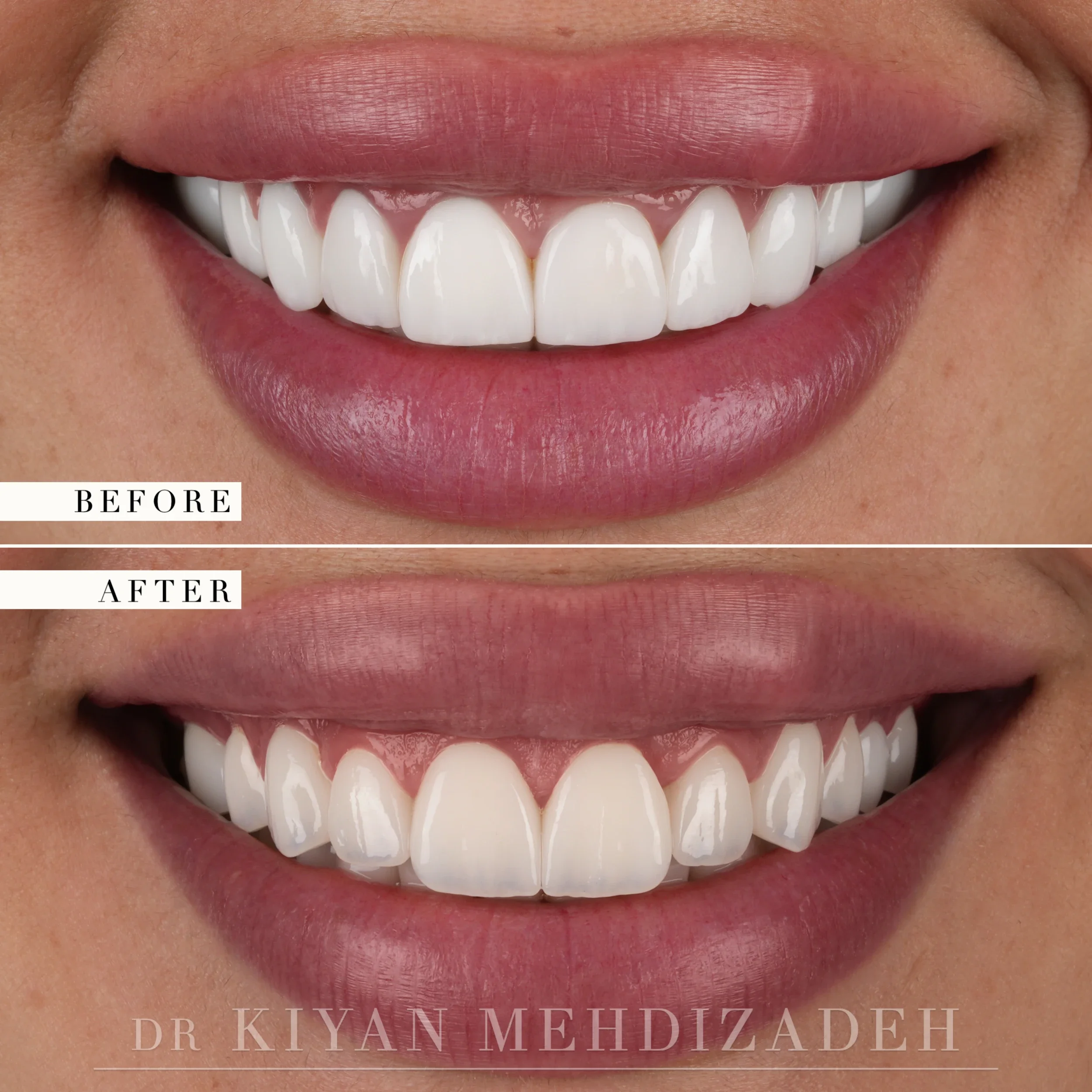
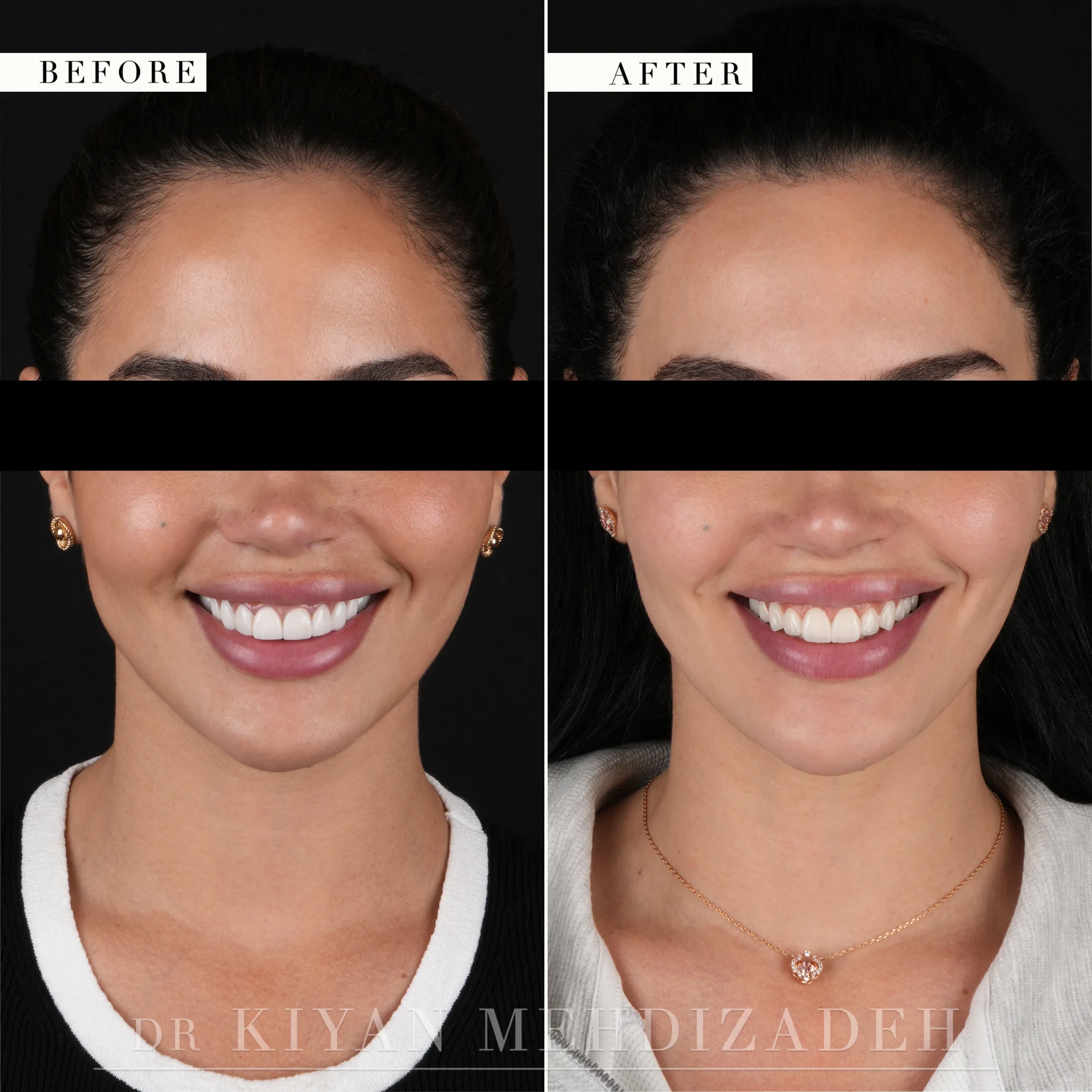
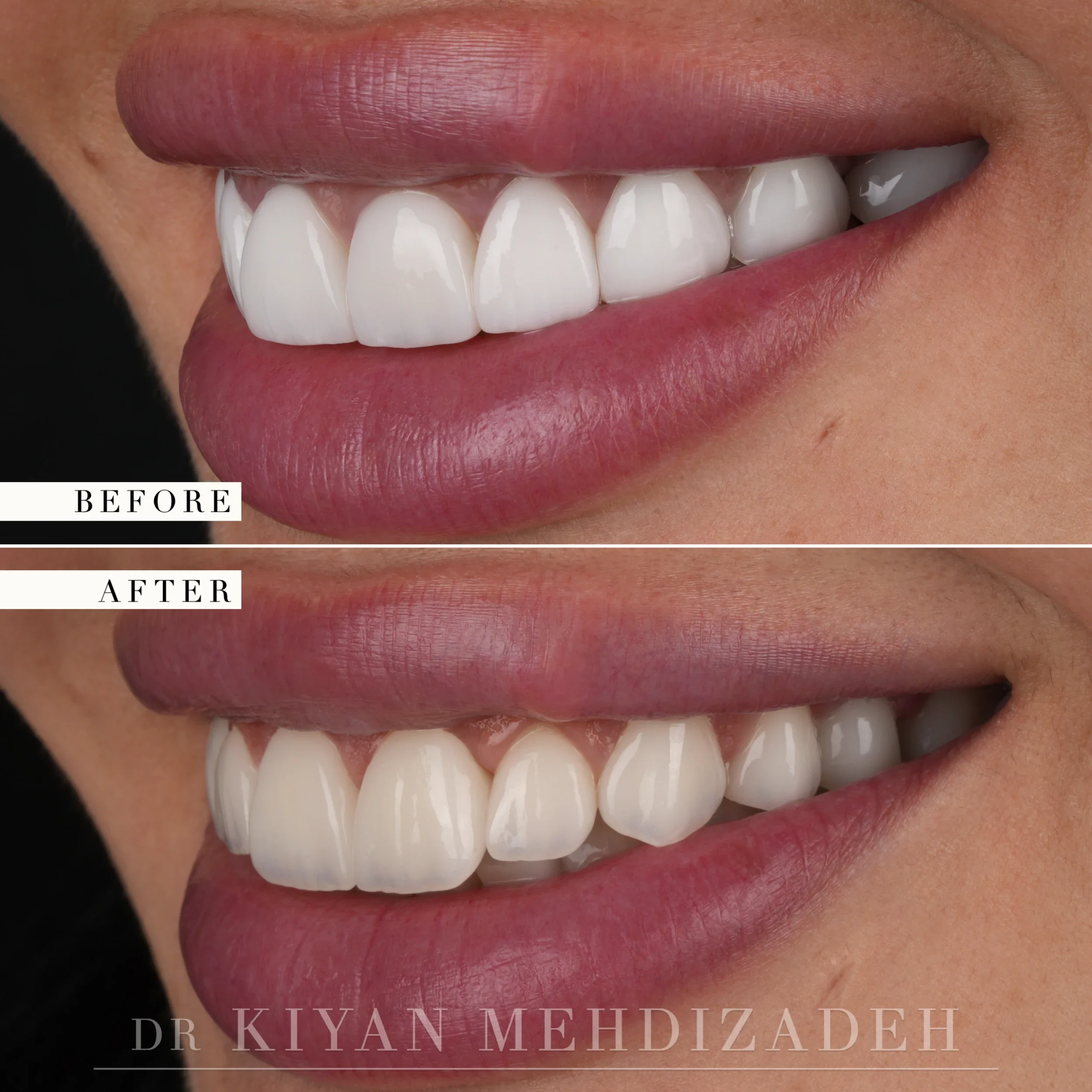
She arrived carrying photographs of her smile from several years earlier—before the veneers she had done in Colombia. At the time, she thought the color was acceptable. But something fundamental was wrong. The teeth were too bulky. They looked unmistakably fake. The shape lacked any natural variation or softness. Friends noticed. She noticed. Every photograph reminded her that her smile looked artificial rather than beautiful. The specific failures were identified and a comprehensive plan was developed to address each one.
The original work had been completed without temporaries, without a try-in stage, without the iterative refinement process that distinguishes quality cosmetic dentistry from assembly-line work. She had no opportunity to evaluate the design before permanent placement. The result was a cosmetic failure from day one—not because the materials were necessarily poor, but because the process that ensures beautiful outcomes had been skipped entirely. This is the fundamental problem with dental tourism for cosmetic cases: compressing what should be a multi-appointment design process into a single visit eliminates the very steps that produce natural results.
“Cosmetic success is determined before the porcelain is even made—in the design process, not the laboratory.”
What Was Wrong with the Gum Architecture Beneath the Veneers?
Looking closely at her existing veneers revealed a problem that no amount of veneer replacement alone could solve. Her gum line was asymmetrical—the gum tissue sat at different heights on corresponding teeth, making perfect symmetry impossible regardless of how well new veneers were designed. This is something the original provider either did not recognize or chose to ignore.
Asymmetrical gum architecture is surprisingly common and often goes unaddressed in cosmetic cases. Dentists focus on the teeth—their color, shape, and alignment—while overlooking that teeth are framed by gum tissue. When that frame is uneven, the teeth will appear uneven no matter how perfectly crafted they may be. Addressing gum architecture as the first step in every comprehensive cosmetic case ensures the foundation determines the outcome.
Patient Goals
Eliminate the bulky, fake appearance of existing veneers. Create symmetry where none existed before. Achieve soft, natural tooth shapes with proper light reflection and texture. Replace missing posterior tooth with implant. Complete treatment within 8 weeks.
How Did the Gum Lift Create a Foundation for Natural Results?
Before beautiful veneers could be created, a beautiful canvas was needed. Gum lift surgery, technically called crown lengthening or gingivectomy, involves precisely reshaping the gum tissue to establish symmetrical arches. Using microsurgery techniques, the tissue was reshaped to create even gum levels across all teeth. The procedure is performed with local anesthesia and heals within 1–2 weeks.
For this patient, the gum lift was essential. It allowed the creation of teeth that were genuinely symmetrical—not teeth that appeared uneven because they emerged from uneven gum tissue. This foundational step is what separates comprehensive smile design from superficial cosmetic work.
Why Was an Implant Placed at the Same Time as the Gum Lift?
Beyond the veneer failure, this patient was also missing a back tooth. While not visible when smiling, missing teeth create functional problems: remaining teeth shift over time, bite forces distribute unevenly, and opposing teeth can over-erupt into the empty space. A dental implant was placed at the same appointment as the gum lift surgery, maximizing efficiency by combining procedures that both require healing periods. This strategic approach—addressing multiple issues in coordinated stages—minimized overall treatment time while ensuring each element received proper attention.
How Were 20 Veneers Designed to Look Natural Instead of Fake?
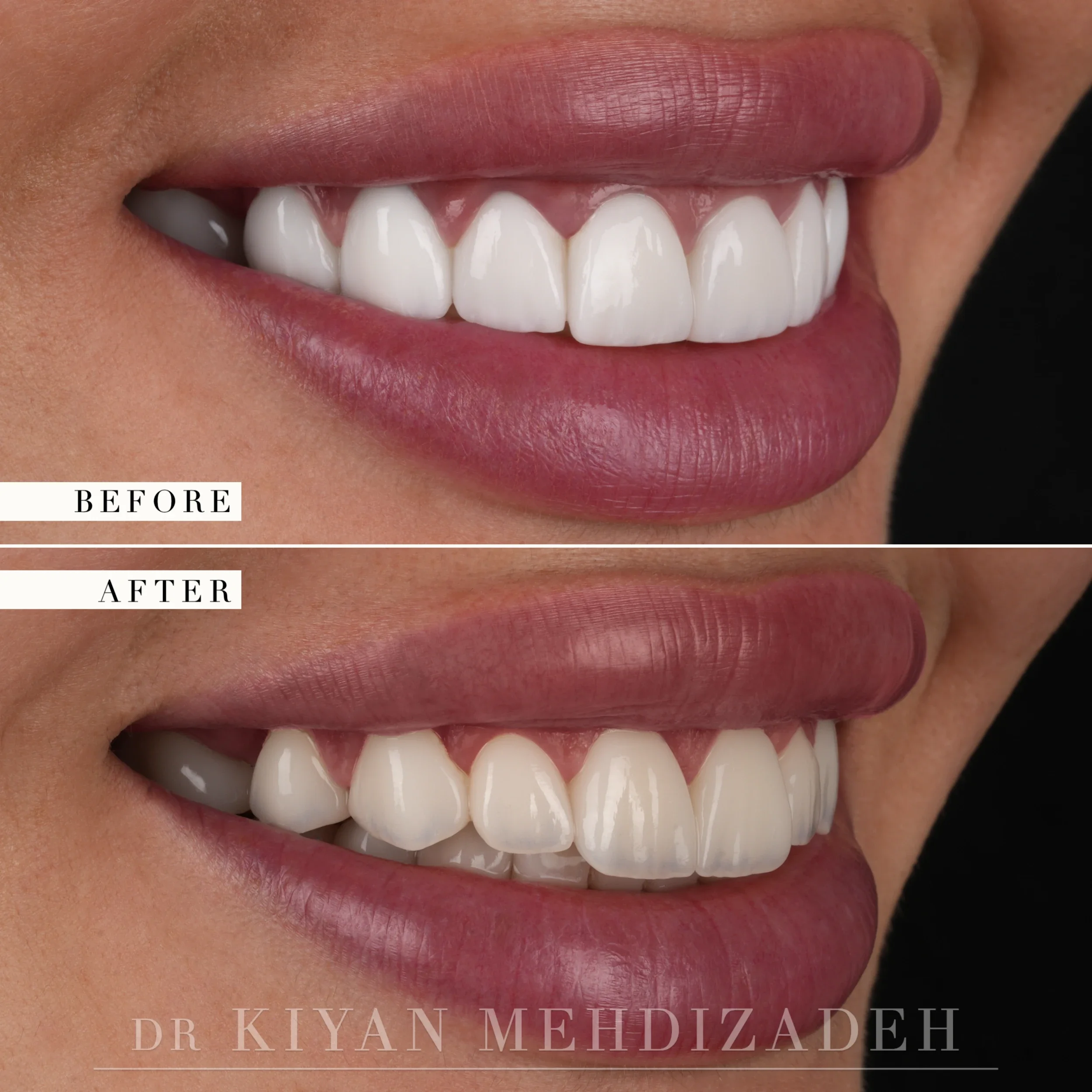
With the gum architecture corrected and the implant healing, the restorative phase began. Twenty veneers—ten upper and ten lower—would replace the failed work from abroad. But more importantly, they would be designed from scratch using principles the original dentist had ignored: softer, more natural tooth shapes replacing the blocky profiles; proper surface contours calibrated for natural light reflection; subtle texture replicating natural enamel characteristics; natural variation at the incisal edges avoiding the artificial uniformity that immediately identifies dental work; reduced bulk for harmonious facial proportions; and color with translucency that matches how natural teeth interact with light.
- Softer, more natural tooth shapes replacing blocky profiles from original work
- Proper surface contours calibrated for natural light reflection
- Subtle texture replicating natural enamel surface characteristics
- Natural variation at incisal edges avoiding artificial uniformity
- Reduced bulk for harmonious proportions relative to lips and facial structure
- Color and translucency matching natural tooth optical properties
What Was the 8-Week Timeline from Consultation to Final Result?
From initial consultation to final placement, treatment required 8 weeks—remarkably efficient for a case involving gum surgery, implant placement, and 21 restorations. The timeline worked because procedures were strategically sequenced, with healing periods utilized for design refinement and laboratory fabrication.
Unlike her original experience abroad, this patient saw and approved her new smile design before any permanent work was done. She wore provisional veneers that previewed the final result. Adjustments were made based on her feedback over multiple try-in appointments. When the permanent restorations were placed, she received exactly what she had already approved—no surprises, no disappointments, no regrets. This iterative design process is what dental tourism eliminates to save cost, and it is precisely what produces natural, personalized results.
“The difference between dental tourism and comprehensive care is the process—not just the final product.”
What Does the Final Result Look Like?
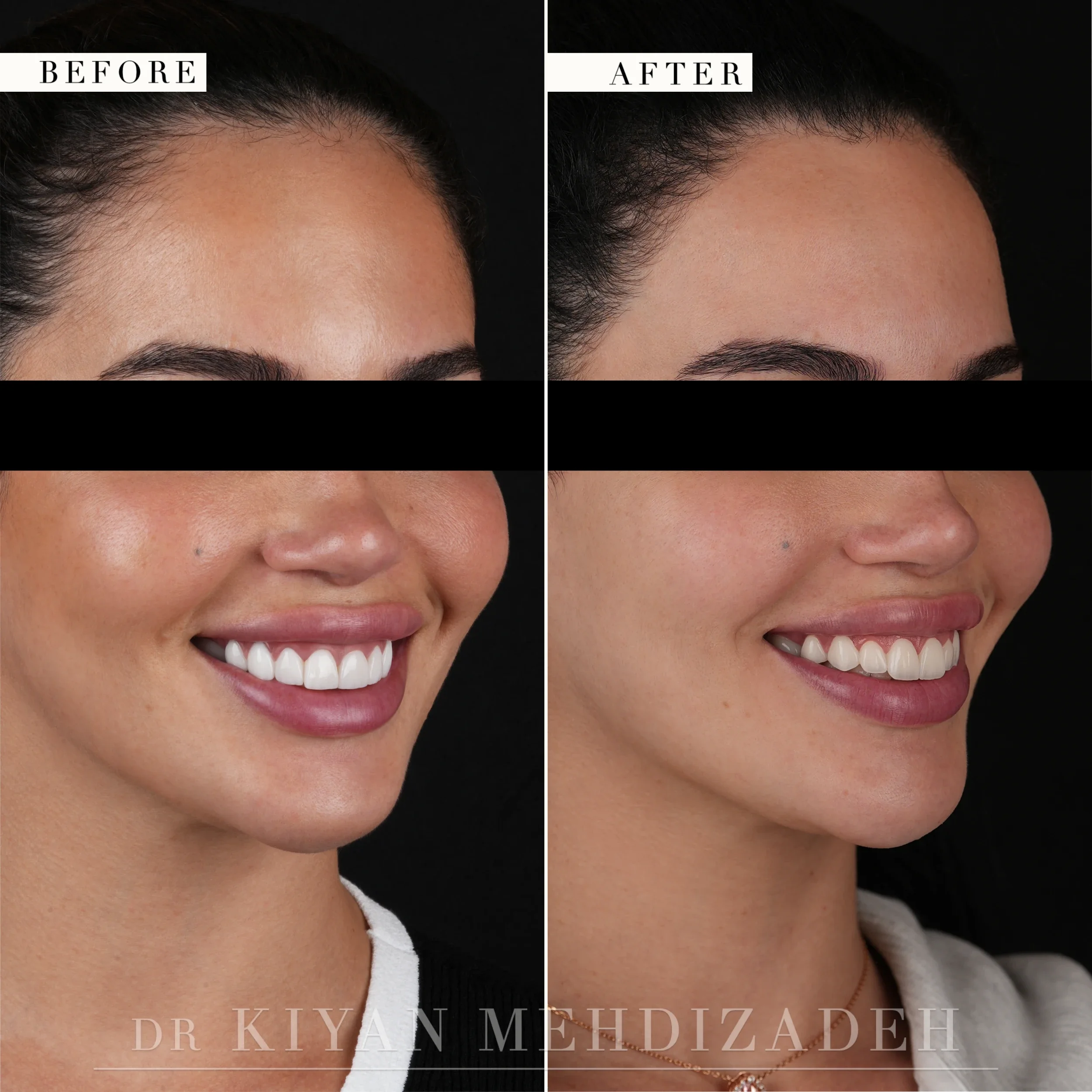
The transformation is evident in every photograph. Where there was bulk, there is now refined proportion. Where there was artificial uniformity, there is now natural variation. Where there was asymmetry, there is now balance. The teeth no longer announce themselves as dental work—they simply appear as beautiful teeth. This is what proper cosmetic dentistry achieves: not the obvious white blocks that immediately identify dental work, but teeth that look like they could have developed naturally.
Frequently Asked Questions About Veneer Redo and Smile Redesign
Why do veneers from abroad often look fake?
Dental tourism typically compresses what should be a multi-appointment design process into a single visit. Without temporaries, try-in appointments, and iterative refinement, there is no opportunity to evaluate and adjust the result before permanent placement. Quality cosmetic dentistry requires multiple appointments specifically for previewing and modifying the design—evaluating proportions, testing lip dynamics, and refining surface characteristics. When these steps are eliminated to reduce cost or travel time, the result often appears artificial because it was never properly customized to the individual patient’s facial features and aesthetic goals.
What is a gum lift and why is it needed before veneer replacement?
A gum lift (crown lengthening or gingivectomy) is a minor surgical procedure that reshapes gum tissue to create symmetrical gum architecture. When gum tissue sits at different heights on corresponding teeth—which is surprisingly common—even perfectly shaped veneers will appear asymmetrical because the frame around the teeth is uneven. By harmonizing the gum line first, a symmetrical canvas is created on which to design symmetrical teeth. The procedure uses local anesthesia and typically heals within 1–2 weeks.
Can failed veneers always be redone?
Most failed veneers can be replaced, though the approach depends on what exists beneath them. If the original preparations were conservative and healthy tooth structure remains, new veneers can be placed with excellent results. If prior work removed excessive tooth structure, created pulp damage, or introduced decay, additional restorative treatment such as core buildups, root canals, or crowns may be needed before new veneers can be placed. The condition of each tooth beneath the existing veneers is evaluated before finalizing the treatment plan.
Why were 20 veneers needed instead of just replacing the problem teeth?
Replacing individual veneers while leaving others unchanged creates visible inconsistencies in color, shape, surface texture, and light reflection between old and new work. When comprehensive redesign is the goal—correcting proportions, establishing symmetry, and creating natural variation across the entire smile—all visible teeth must be treated together. This ensures cohesive aesthetics where every tooth relates properly to its neighbors rather than mismatched elements that reveal piecemeal treatment.
How long does a veneer redo take?
This case was completed in 8 weeks, which included gum lift surgery, implant placement, design refinement with provisional veneers, laboratory fabrication, and final bonding of 20 veneers plus 1 implant crown. Veneer redo cases without additional surgical procedures can be completed in 4–6 weeks. The timeline depends on the number of teeth involved, whether gum surgery or implants are needed, and the complexity of the design changes required.
How long do redone porcelain veneers last?
High-quality porcelain veneers typically last 15–20 years or longer with proper care, whether they are initial veneers or replacement work. Longevity depends on material quality, precision of bonding, and patient maintenance. Regular dental visits every 6 months, along with avoiding habits like ice chewing or nail biting, help maximize veneer lifespan. Wearing a night guard is recommended for patients who grind or clench their teeth.
How much does it cost to redo veneers?
This case was $54,000, covering the gum lift, an implant and twenty porcelain veneers replacing the previous work. Porcelain veneers range from $1,800 to $3,500 per tooth depending on complexity. Gum lift and crown lengthening procedures range from $2,000 to $3,000. We accept PPO insurance and offer financing through Proceed Finance, PatientFi, Happen Bank, CareCredit, and Cherry.
What is the difference between dental tourism veneers and comprehensive cosmetic dentistry?
The fundamental difference is the design process, not necessarily the materials. Comprehensive cosmetic dentistry involves diagnostic photographs and measurements, digital or wax-up smile design, provisional veneers that the patient wears and evaluates before final fabrication, multiple try-in appointments for adjustments, and direct collaboration between the dentist and master ceramist. Dental tourism compresses or eliminates these steps to accommodate travel schedules, resulting in one-size-fits-all designs that often look artificial.
Are there alternatives to replacing all veneers at once?
In some cases, selective replacement of the most problematic veneers combined with recontouring of others can improve the overall appearance without a full redo. However, this approach has limitations: color matching between old and new porcelain is difficult, and design inconsistencies between original and replacement veneers may still be visible. For patients whose primary concern is the overall fake appearance of their smile, comprehensive replacement produces the most predictable and cohesive result.
What should patients look for when choosing a provider for veneer correction?
Correcting failed cosmetic work is more complex than initial veneer placement because the provider must assess damage from prior preparations, address any gum asymmetry or tissue changes, and design restorations that account for altered tooth structure. Patients should look for a provider who uses provisional veneers and try-in appointments as part of the design process, who addresses gum architecture before placing veneers, and who can handle any surgical components (gum lifts, implants) within the same practice rather than requiring separate specialist referrals.
Last Updated: August 2026

Dr. Kiyan Mehdizadeh, DMD
Doctor of Dental Medicine
Most cosmetic dentists refer out for surgery. Most surgeons don't do cosmetic work. Dr. Mehdizadeh trained in both — implantology and bone grafting at Loma Linda and UCLA, fixed prosthodontics under Mauro Fradeani in Italy, periodontal microsurgery with Hürzeler and Zuhr in Munich, and IV sedation at the University of Alabama. That combination means complex cases involving surgery, grafting, implants, and restorative work are planned and executed by a single provider with full command of every phase.
Technical skill produces function. Taste is what produces beauty. The difference between dental work that looks like dental work and a result that looks entirely natural comes down to aesthetic judgment — proportion, texture, translucency, how light moves across a surface. That sensibility runs through everything here, from the way cases are designed to the office itself.
An in-house master ceramist and on-site laboratory allow restorations to be designed, fabricated, and refined with direct collaboration between doctor and technician — no outsourced lab work, no guesswork, no compromise on the final product. Dr. Mehdizadeh is one of few dentists with the refined ability to provide care across multiple specialties, resulting in cohesive and holistic outcomes.
Education & Credentials
- Doctor of Dental Medicine (DMD), cum laude — Boston University
- Bachelor of Science in Biology — Emory University
- Mastership in Implant Dentistry & Grafting — Loma Linda University / gIDE Institute
- Advanced Implant Therapy & Grafting — UCLA / gIDE Institute
- Implant Placement & Restoration — UCLA / Nobel Biocare
- Guided Bone Regeneration & Ridge Augmentation — gIDE Institute
- Sinus Elevation & Augmentation — gIDE Institute
- Soft Tissue Management & Grafting — gIDE Institute
- Minimally Invasive Augmentation & Autogenous Bone Management — IDEA, San Francisco
- Master Program in Fixed Prosthodontics — Fradeani Education, Italy
- Aesthetic Dentistry — UCLA School of Dentistry
- Advanced Occlusion & Bite Design — UCLA
- Periodontal Micro-Surgery — Hürzeler/Zuhr, Munich
- Micro-Endodontic Training — University of Pennsylvania
- IV Sedation — University of Alabama at Birmingham
- Injectable Therapy for TMJ & Facial Pain — American Academy of Facial Esthetics
Considering similar treatment?
Send Dr. Mehdizadeh a photo and ask what’s possible for your case.