The Power of Conservative Dentistry
Internal bleaching and 4 veneers for a truly harmonious smile
By Dr. Kiyan Mehdizadeh, DMD · 9460 Wilshire Blvd, Suite 850, Beverly Hills, CA 90212 · (310) 770-3335
Last Updated: July 2026
Have one dark tooth?
A single veneer on a discoloured tooth will never truly match the teeth beside it, and the mismatch gets worse as the natural teeth age. There is a more conservative way to do this. Send us a photo and we will tell you what it would take.
- A response within one business day. Usually much sooner.
- A real cost estimate, not a range designed to get you in the door.
- No obligation. Many patients take months to decide. That is normal.
Ask about your case
Reviewed by our treatment coordination team. Call or text (310) 770-3335 if you would rather speak now.
Request received
Our treatment coordination team will review what you sent and call you
within one business day.
If you would like to hold a consultation time now, you can do that below.
Treatment Plan by Dr. Kiyan Mehdizadeh
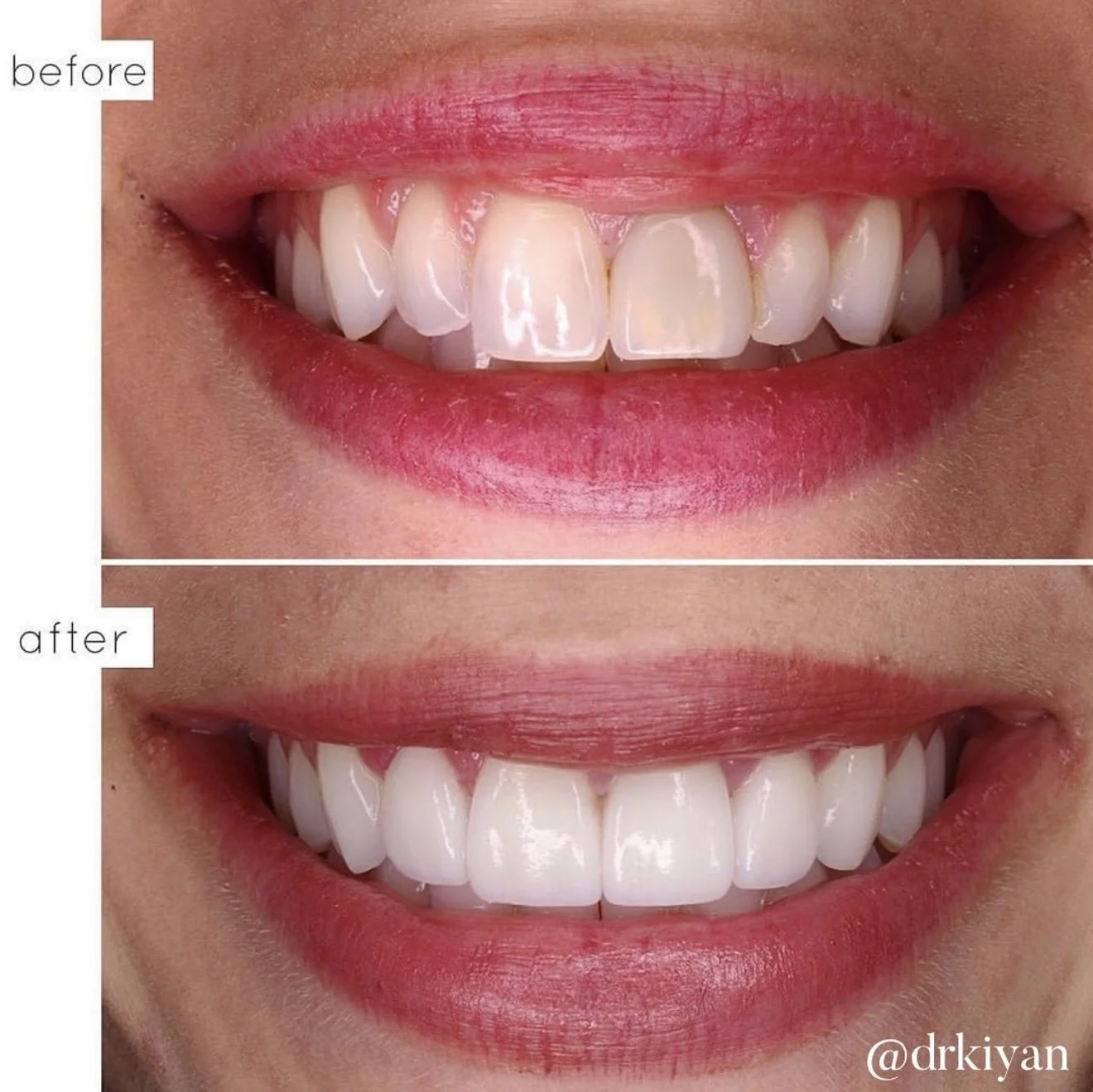
- Internal bleaching of discolored root canal tooth
- External bleaching of all teeth for even baseline color
- Four porcelain veneers on upper front teeth
- Color matching to harmonize with natural adjacent teeth
When Less Is More
This young patient presented with a specific concern: a single discolored tooth from an old root canal. She wanted improvement but didn't want extensive work. Her instinct was to simply veneer the dark tooth and be done with it. Many dentists would have agreed and placed a single veneer—a quick fix that would look fine initially but create problems down the road.
Dr. Mehdizadeh explained a different approach. A single veneer placed on a discolored tooth will never truly match the adjacent natural teeth. Over time, as natural teeth change color from food, beverages, and normal aging, the mismatch becomes increasingly obvious. What seems like the conservative choice often becomes the foundation for more extensive work later.
"Conservative dentistry isn't about doing less—it's about doing what's right."
Why Does a Root Canal Tooth Turn Dark?
When a tooth requires root canal treatment, blood breakdown products can remain trapped in the pulp chamber. Over time, these hemoglobin byproducts—iron compounds and other pigments—gradually penetrate the dentin and discolor the tooth from within. The darkening typically appears as a gray, brown, or yellowish discoloration that worsens over years. Standard external whitening treatments cannot reach this internal staining because the bleaching agents only penetrate the outer enamel layer.
How Internal Bleaching Works
Internal bleaching treats discoloration at its source. A bleaching agent—typically sodium perborate mixed with hydrogen peroxide—is placed directly inside the pulp chamber of the root canal-treated tooth. The access is sealed temporarily, and the agent works from the inside out over several days. This process is repeated across 2–3 appointments until the tooth reaches the desired shade. It's a precise, targeted approach that addresses the actual cause of discoloration rather than masking it.
Why Internal Bleaching Before Veneers?
Root canal teeth darken from blood breakdown products trapped in the pulp chamber. External bleaching cannot reach this internal staining. Internal bleaching treats the problem at its source, creating an even color foundation. Combined with external bleaching of all teeth, this establishes a uniform baseline that allows the ceramist to achieve seamless veneer-to-tooth color matching.
Creating the Even Color Baseline
After the internal bleaching brought the dark tooth back to a matching shade, external bleaching of all teeth was performed. This accomplished two goals: it brightened the smile overall, and more importantly, it created an even, consistent color across all teeth. This even baseline is essential for ceramic matching—without it, even the most skilled ceramist cannot guarantee veneers that blend invisibly with adjacent natural teeth.
The Conservative Veneer Approach
With all teeth now the same bright, even color, just four veneers were placed on the upper front teeth. Because the underlying tooth color was uniform, the ceramist could create veneers that perfectly match the natural teeth in both color and translucency. The result is seamless—you cannot tell where the veneers end and natural teeth begin.
- Internal bleaching to address root canal discoloration from the inside
- External bleaching of all teeth for a uniform color baseline
- Four veneers that perfectly blend with adjacent natural teeth
- Natural tooth shape preserved and subtly enhanced
- Total treatment completed in approximately 4 weeks
Why This Approach Matters
The transformation demonstrates what conservative cosmetic dentistry can achieve when the sequence is right. By addressing the discoloration first, creating an even baseline, then carefully matching the ceramics, the result looks completely natural. Four veneers that harmonize perfectly with natural teeth, giving the patient the bright smile she wanted without unnecessary treatment.
This case illustrates an important principle: conservative and limited cosmetic dentistry can have enormous impact when executed in the right order. The goal isn't to do as little as possible—it's to do exactly what's needed for results that will look natural for 15–20 years.
"Conservative and limited cosmetic dentistry can have a huge impact."
Frequently Asked Questions About Internal Bleaching and Conservative Veneers
What causes a root canal tooth to become discolored?
When a tooth requires root canal treatment, blood breakdown products—primarily iron compounds from hemoglobin—can remain trapped in the pulp chamber. These pigments gradually penetrate the dentin and discolor the tooth from within, typically appearing as gray, brown, or yellowish darkening that worsens over years. Standard external whitening cannot reach this internal staining.
What is internal bleaching and how does it work?
Internal bleaching places a bleaching agent (sodium perborate with hydrogen peroxide) directly inside the pulp chamber of a root canal-treated tooth. The access is sealed temporarily and the agent lightens the tooth from the inside out over several days. The process is repeated across 2–3 appointments until the desired shade is reached. It's a precise, targeted treatment that addresses discoloration at its source.
Why not just place a single veneer on the dark tooth?
A single veneer on a discolored tooth creates an inherent color matching problem. Natural teeth change shade over time from food, beverages, and aging, but veneers do not. A single veneer will eventually stand out as surrounding teeth shift in color. Addressing the underlying discoloration first creates a stable foundation that avoids this problem entirely.
How much does internal bleaching with veneers cost in Beverly Hills?
Internal bleaching typically costs $300–$600 per tooth. Porcelain veneers in Beverly Hills range from $2,000–$4,000 per tooth. A conservative case with internal bleaching, external bleaching, and 4 veneers may total $10,000–$20,000. A consultation provides a personalized treatment plan and accurate quote based on your specific needs.
How long does conservative veneer treatment take?
This case was completed in approximately 4 weeks. The internal bleaching phase requires 2–3 appointments spaced several days apart. External bleaching follows. Veneer preparation and fabrication take an additional 2–3 weeks. The entire process is structured so that each step builds on the previous one for optimal results.
Why bleach all teeth before placing veneers?
Creating an even baseline color across all teeth allows the ceramist to achieve a perfect match. When all teeth share the same shade, veneers can be crafted to blend seamlessly with natural teeth, making the cosmetic work invisible. Without this uniform baseline, even the most skilled ceramist cannot guarantee veneers that look identical to adjacent natural teeth.
How long do porcelain veneers last on bleached teeth?
High-quality porcelain veneers typically last 15–20 years or longer with proper care. The internal bleaching result is stable because the treated tooth no longer has vital pulp tissue that could cause re-darkening. The veneers themselves are non-porous porcelain that resists staining. Combined, these treatments provide long-lasting aesthetic results.
Are there alternatives to veneers for a discolored root canal tooth?
Alternatives include internal bleaching alone (if the discoloration is the only concern), a porcelain crown (if the tooth structure is significantly compromised), or dental bonding (a less expensive but less durable option). The most conservative effective treatment depends on the degree of discoloration, the structural integrity of the tooth, and the patient's aesthetic goals.
Is internal bleaching safe for a root canal tooth?
Yes, internal bleaching is a well-established and safe procedure when performed by an experienced dentist. The bleaching agent is placed only in the pulp chamber, above the root canal filling. A proper cervical seal prevents the bleaching agent from reaching the root, which is the primary safety consideration in this procedure.
Can internal bleaching be repeated if the tooth darkens again?
In most cases, the results of internal bleaching are stable long-term because the source of the discoloration has been addressed. However, if gradual re-darkening occurs over many years, the procedure can be safely repeated. The root canal filling is not disturbed during internal bleaching, so multiple treatments do not compromise the tooth's structural integrity.
Last Updated: July 2026

Dr. Kiyan Mehdizadeh, DMD
Doctor of Dental Medicine
Most cosmetic dentists refer out for surgery. Most surgeons don't do cosmetic work. Dr. Mehdizadeh trained in both — implantology and bone grafting at Loma Linda and UCLA, fixed prosthodontics under Mauro Fradeani in Italy, periodontal microsurgery with Hürzeler and Zuhr in Munich, and IV sedation at the University of Alabama. That combination means complex cases involving surgery, grafting, implants, and restorative work are planned and executed by a single provider with full command of every phase.
Technical skill produces function. Taste is what produces beauty. The difference between dental work that looks like dental work and a result that looks entirely natural comes down to aesthetic judgment — proportion, texture, translucency, how light moves across a surface. That sensibility runs through everything here, from the way cases are designed to the office itself.
An in-house master ceramist and on-site laboratory allow restorations to be designed, fabricated, and refined with direct collaboration between doctor and technician — no outsourced lab work, no guesswork, no compromise on the final product. Dr. Mehdizadeh is one of few dentists with the refined ability to provide care across multiple specialties, resulting in cohesive and holistic outcomes.
Education & Credentials
- Doctor of Dental Medicine (DMD), cum laude — Boston University
- Bachelor of Science in Biology — Emory University
- Mastership in Implant Dentistry & Grafting — Loma Linda University / gIDE Institute
- Advanced Implant Therapy & Grafting — UCLA / gIDE Institute
- Implant Placement & Restoration — UCLA / Nobel Biocare
- Guided Bone Regeneration & Ridge Augmentation — gIDE Institute
- Sinus Elevation & Augmentation — gIDE Institute
- Soft Tissue Management & Grafting — gIDE Institute
- Minimally Invasive Augmentation & Autogenous Bone Management — IDEA, San Francisco
- Master Program in Fixed Prosthodontics — Fradeani Education, Italy
- Aesthetic Dentistry — UCLA School of Dentistry
- Advanced Occlusion & Bite Design — UCLA
- Periodontal Micro-Surgery — Hürzeler/Zuhr, Munich
- Micro-Endodontic Training — University of Pennsylvania
- IV Sedation — University of Alabama at Birmingham
- Injectable Therapy for TMJ & Facial Pain — American Academy of Facial Esthetics
Considering similar treatment?
Send Dr. Mehdizadeh a photo and ask what’s possible for your case.