Teeth that stay in.
Not a denture that comes out.
All-on-4 full-arch implants in Beverly Hills.
From $360 a month on approved credit.
You leave your consultation with a written plan — every visit, every procedure, and your total cost. Before you agree to anything.
- Kiyan Mehdizadeh, DMD
- Beverly Hills
- Private practice since 2012
- IV sedation in our own office
- In-house dental laboratory
What it costs
Most patients finance it.
On approved credit, through Proceed Finance, PatientFi, Happen Bank, CareCredit or Cherry. Terms and rates vary by lender and by applicant. PPO plans frequently contribute toward treatment.
All-on-4 · one arch
$360/mo
$29,000 total · four implants, surgery, fixed bridge
Both arches
$695/mo
$56,000 total · upper and lower, planned as one case
Corporate implant centres such as ClearChoice routinely quote $50,000 and up for comparable treatment. Patients arrive here holding those plans.
The questions everybody asks
Will I be without teeth?
No. In many cases a fixed set of teeth goes in the same day as surgery. Whether that is right for you depends on your bone, and your scan tells us before we begin — so it is answered in your written plan, not discovered afterwards.
Will I be awake for it?
Not unless you want to be. IV sedation is available in this office, administered by Dr. Mehdizadeh, who trained in intravenous sedation at the University of Alabama at Birmingham. You are not sent out to a surgical centre.
How long until the final teeth?
Twelve to twenty weeks from surgery to the final restoration. You are not without teeth during that time. The variation is healing — bone integrates at its own pace — and your plan tells you which end of that range your case sits at.
Will they look like dentures?
No. For most patients this ends up being the best their smile has ever looked. The arch is designed as one piece and shaped to your face, and it is made in our own laboratory with the technician and Dr. Mehdizadeh working on it together — not posted out to a lab that never sees you. More on that below.
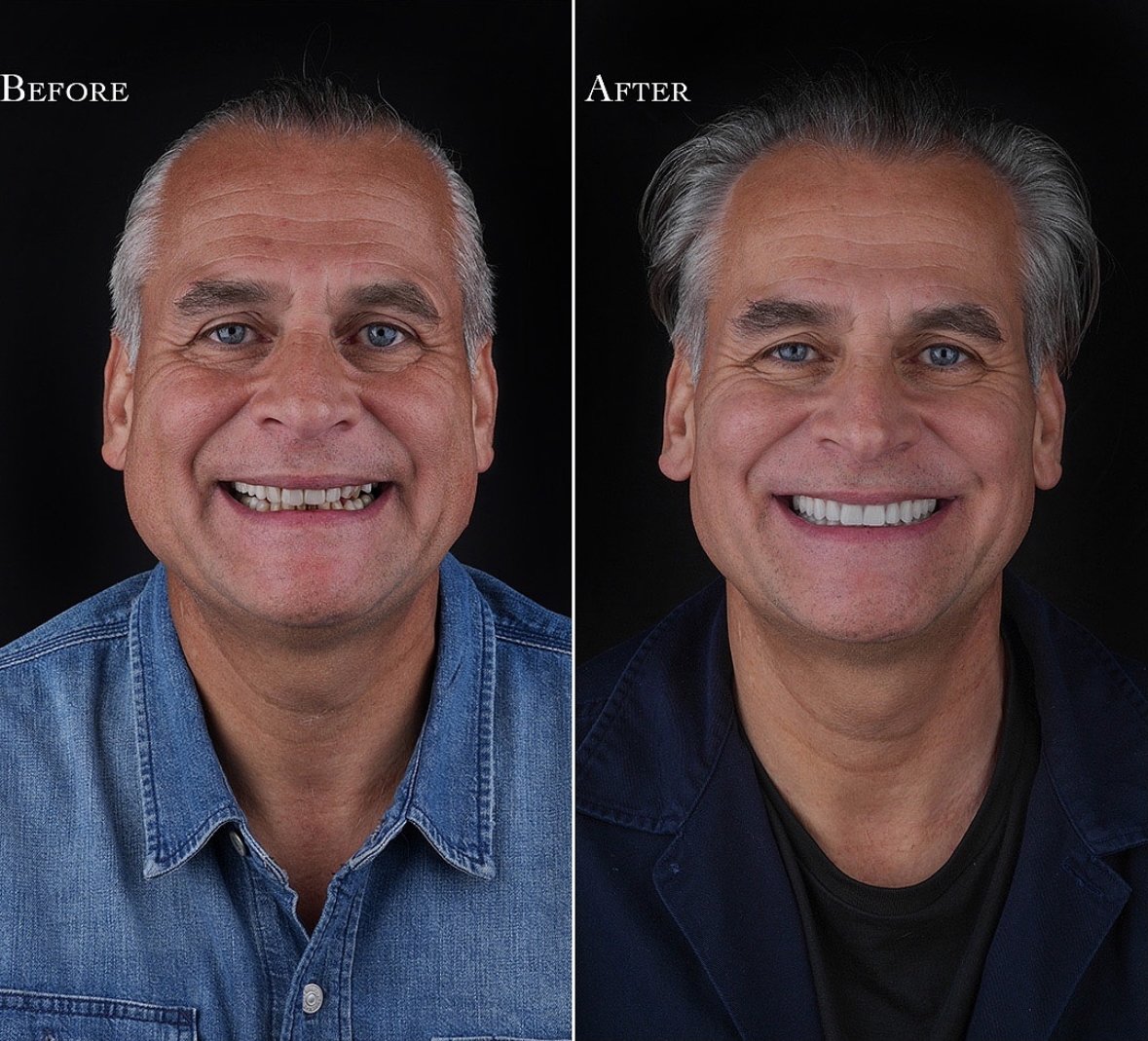
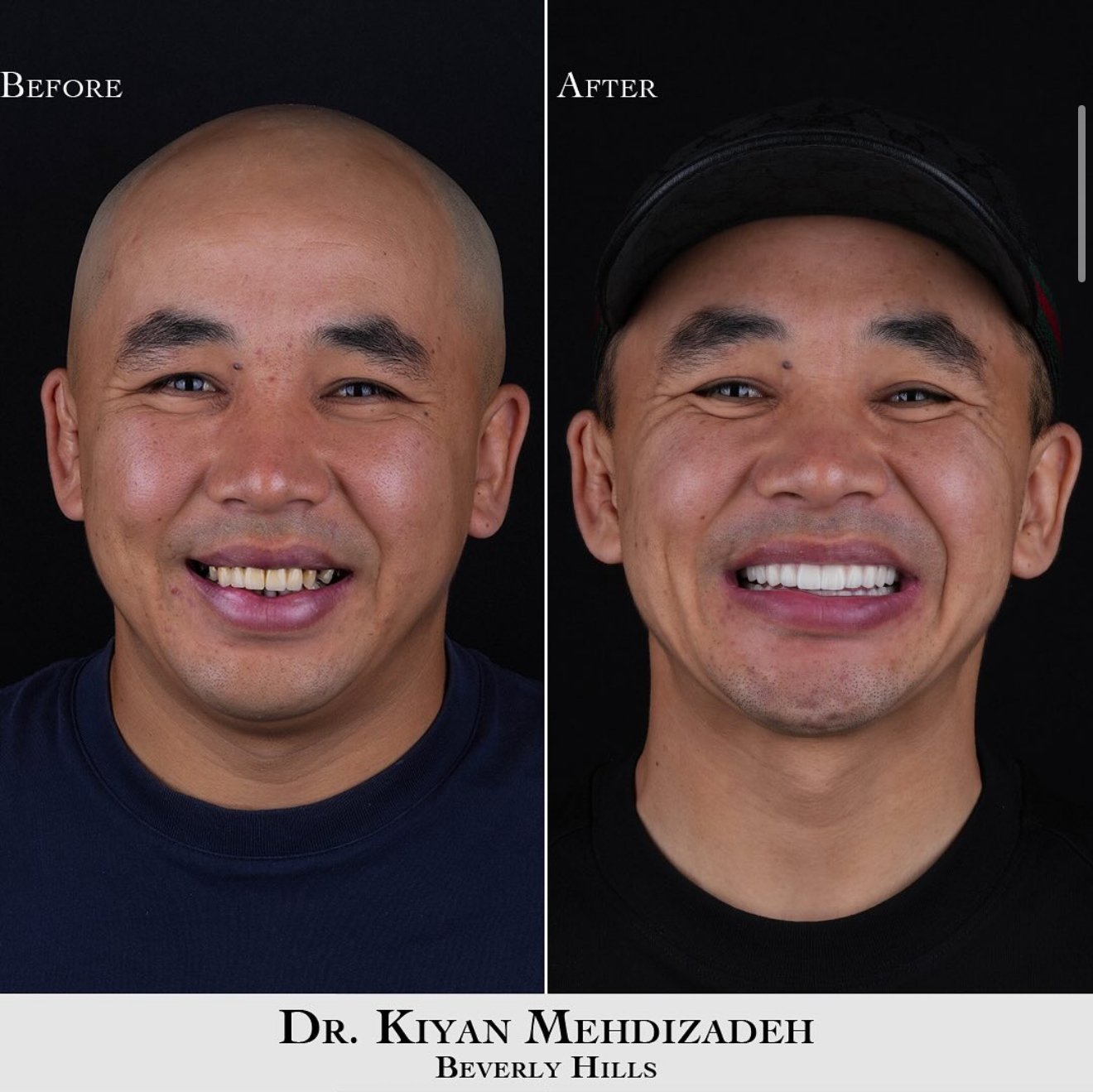
Patients of Dr. Mehdizadeh
Before, and after.
Every case below is a full-arch reconstruction performed in this office.




Apply for a consultation
Tell us where you are.
Reviewed by our treatment coordination team. Call or text (310) 770-3335 if you would rather speak now.
Request received
Our treatment coordination team will review what you sent and call you
within one business day.
If you would like to hold a consultation time now, you can do that below.
Why this is not a denture on implants
A full arch is designed from nothing.
With a single tooth, the ceramic has a neighbour to match. With a full arch there is nothing left to match. The shape of every tooth, the gum line, the way the whole thing sits under your lip — all of it is designed from scratch. It either looks like teeth, or it looks like a plate.
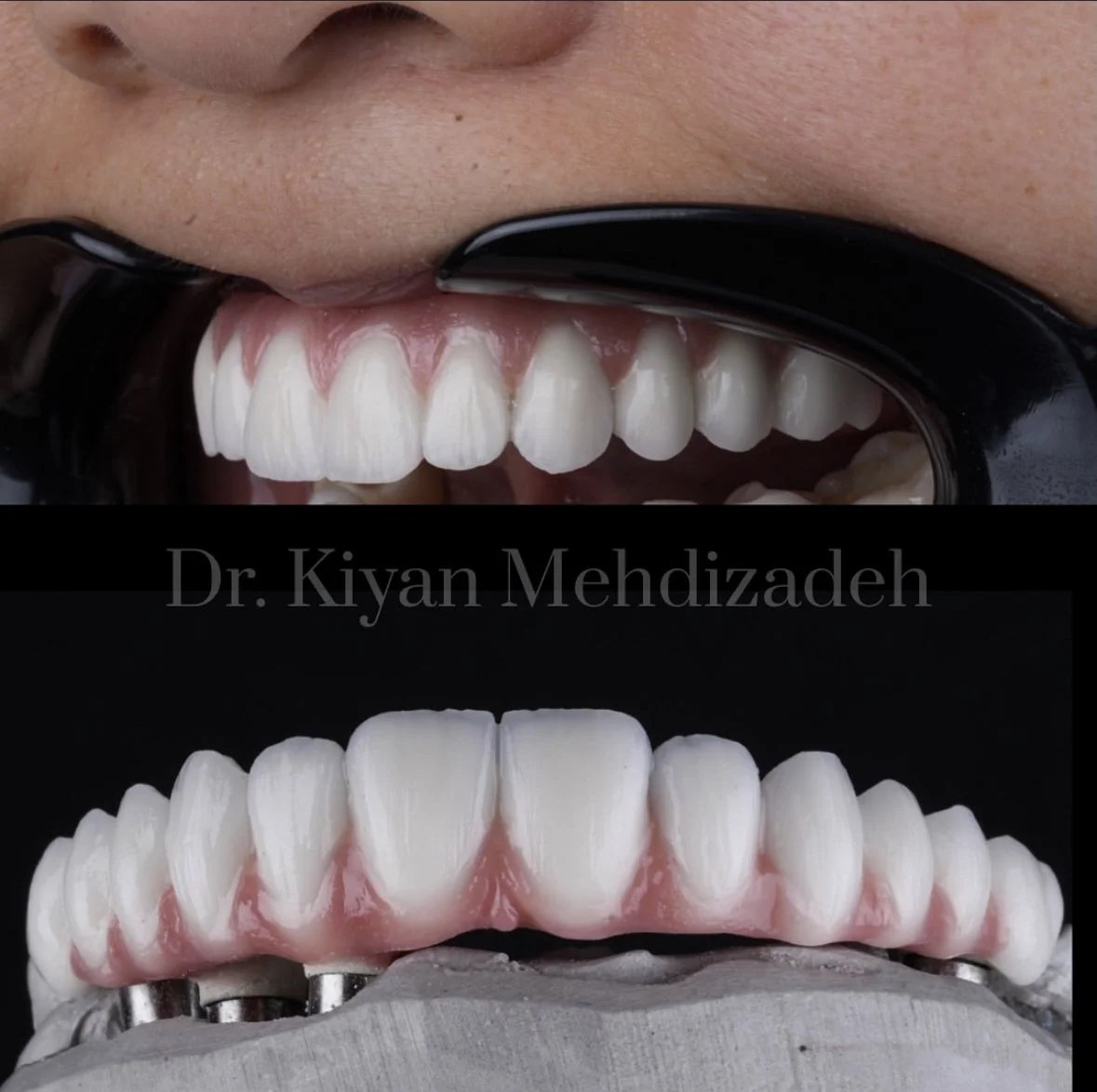
That work happens in this building.
The restoration is designed and refined through direct collaboration between the doctor and the technician, in our own laboratory, rather than shipped out and hoped for. Most practices in Beverly Hills send this work away and wait.
What you get back
Steak. Corn on the cob. An apple.
Foods that denture wearers give up. Nothing to take out at night, no adhesive, and nothing that moves when you laugh.
Find out what your case actually needs.
A full examination, a 3D scan, and a written plan with your total cost. In person with Dr. Mehdizadeh — or remotely if you are travelling, confirmed at your first visit.
Who would be treating you

Kiyan Mehdizadeh, DMD
Most cosmetic dentists refer out for surgery. Most surgeons do not do cosmetic work. Dr. Mehdizadeh trained in both — and that combination is the whole point of this practice.
He earned his Doctor of Dental Medicine, cum laude, from Boston University, after a Bachelor of Science in Biology from Emory. What followed was years of post-doctoral training across disciplines that usually live in separate offices: implant dentistry and bone grafting at Loma Linda and UCLA, fixed prosthodontics under Mauro Fradeani in Italy, periodontal microsurgery with Hürzeler and Zuhr in Munich, and advanced occlusion and bite design.
When gum surgery, bone grafting, implant placement, sedation and the final restoration are all planned and performed by one provider, treatment stays continuous — diagnosed, sequenced and executed by a single person accountable for the whole result. The practice has operated in private practice since 2012.
- Doctor of Dental Medicine, cum laudeBoston University
- Bachelor of Science in BiologyEmory University
- Mastership in Implant Dentistry & GraftingLoma Linda University / gIDE Institute
- Advanced Implant Therapy & GraftingUCLA / gIDE Institute
- Implant Placement & RestorationUCLA / Nobel Biocare
- Guided Bone Regeneration & Ridge AugmentationgIDE Institute
- Sinus Elevation & AugmentationgIDE Institute
- Soft Tissue Management & GraftinggIDE Institute
- Minimally Invasive Augmentation & Autogenous Bone ManagementIDEA, San Francisco
- Master Program in Fixed ProsthodonticsFradeani Education, Italy
- Aesthetic DentistryUCLA School of Dentistry
- Advanced Occlusion & Bite DesignUCLA
- Periodontal Micro-SurgeryHürzeler/Zuhr, Munich
- Micro-Endodontic TrainingUniversity of Pennsylvania
- IV SedationUniversity of Alabama at Birmingham
- Injectable Therapy for TMJ & Facial PainAmerican Academy of Facial Esthetics
Before you call
Will they look like real teeth, or will people be able to tell?
They will look like teeth. For most patients this is the best their smile has ever looked — better than the teeth they had before things started failing, because nothing is being patched or matched to damage. The whole arch is designed as one piece, shaped to your face, your lip line and your old photographs.
The reason we can promise that is the laboratory. It is in this building, and the technician and Dr. Mehdizadeh work on your case together rather than posting it back and forth with a lab that never meets you. You wear a provisional set first and approve the shape, shade and length before the final teeth are made. Nothing is a surprise at the fit appointment, and nothing leaves this office looking like a denture.
How much does it hurt, and how long before I feel normal?
The surgery itself is done under IV sedation in this office, and most patients remember very little of it. Afterwards, swelling and bruising build for about two days, peak around the third, and settle over the following week. Most people take two or three days away from work and manage on ordinary pain relief.
You eat soft food while the implants integrate with the bone. That is the part that takes time and cannot be rushed — it is biology, not scheduling.
How long will they last?
Two different answers, because they are two different things. The implants are titanium posts that fuse to your jaw; long-term studies report survival above ninety per cent at ten years, and they are intended to be permanent.
The bridge on top is a wearing part. You chew with it every day, and over ten to fifteen years it may need repair, refinishing or eventual replacement — which is straightforward, because it unscrews from the implants underneath. Regular cleaning appointments matter more here than they do with natural teeth, because the tissue around implants needs maintaining.
I have been told I do not have enough bone for implants.
That is one of the most common reasons people give up on this, and it is usually wrong — or rather, it is usually true at the time and solvable anyway. Bone shrinks once teeth are gone, and it shrinks faster under a denture. But it can be rebuilt: ridge augmentation, guided bone regeneration, and sinus elevation where the upper back jaw has lost height.
Where this matters is who does it. A practice that refers grafting out has a reason to call your case too difficult. Dr. Mehdizadeh performs the grafting himself, here, as part of the same plan and often the same sedated appointment. If you have been turned away, a second scan is worth the visit before you accept that answer. Call (310) 770-3335.
Am I too old? What if I smoke, or have diabetes, or take blood thinners?
Age on its own is not a limiting factor — bone volume and general health are. Most full-arch patients here are between fifty-five and seventy-five.
Smoking does measurably lower implant success, and we will talk about it honestly rather than pretend otherwise; it changes the odds, not the eligibility. Well-controlled diabetes is generally fine, poorly controlled diabetes needs addressing first because it slows healing. Blood thinners are usually managed with planning and coordination with your physician. None of these is an automatic no. They change how the plan is written.
How many appointments is this, and what happens at each?
Consultation and 3D scan, where you leave with the written plan. Then the surgery day — extractions if needed, grafting if needed, implants placed, and in many cases a fixed provisional set of teeth the same day. Then a small number of healing checks over the following months while the bone integrates.
When healing is complete, appointments for the design, the try-in of the final teeth, and the fit. Twelve to twenty weeks end to end for most cases. Your plan lists every one of these visits before you start, so you can see what it asks of your calendar.
Why not just get a new denture, or have mine relined?
Because a denture sits on gum and moves, and because the bone underneath it keeps shrinking. That is why it needs relining again a couple of years later, why the fit never stays right, and why the lower face slowly changes shape. Each reline is treating the symptom of a process that is still running.
Implants are anchored in the bone and load it when you chew, which is what stops that shrinkage. Nothing comes out, nothing needs adhesive, and the fit does not drift. If you have relined a denture more than once, you already know which problem you are solving.
What if an implant fails?
It is uncommon, and when it happens it is nearly always early — in the first months, before the final teeth are made, when an implant has not integrated with the bone. At that stage it is a straightforward matter of removing it, letting the site heal, and placing again.
Because the surgery, the healing and the final teeth all happen here, this is handled here too. You are not sent anywhere, and the plan picks up where it left off rather than starting over.
Will my insurance cover any of it?
PPO plans frequently contribute, though rarely to the whole case — most have an annual maximum well below the cost of full-arch treatment, and some treat implants differently from other restorative work. We check your specific benefits before quoting, so the number in your written plan is the number you actually pay after insurance, not before it.
Bring your plan details to the call and we will tell you where you stand.